They worked for a bit. But by 2011, Warfield struggled to walk.
And “by that time, I was addicted,” said Warfield, now living in Shelbyville, Kentucky.
After she lost her health insurance, Warfield started buying pills on the street. She tried to quit several times, but the debilitating withdrawal — so bad she couldn’t get out of bed, she said — kept driving her back to drug use.
Until last year.
Through her church, Warfield learned about the NET device. It’s a cellphone-sized pack connected to gel electrodes placed near the ear that deliver low-level electrical pulses to the brain.
“Once I got set up on the device, within 30 minutes, I didn’t have any cravings” for opioids, Warfield said.
After three days on the device in August, she stopped using drugs altogether, she said.

Warfield’s treatment was paid for with her county’s opioid settlement dollars — money from pharmaceutical companies accused of fueling the overdose crisis.
State and local governments nationwide are receiving over nearly two decades and are meant to spend it treating and preventing addiction.
Warfield wants them to allot a good chunk to the NET device, which costs counties about $5,500 a person. The pitch is gaining traction. , which makes the device, said it has signed about $1.2 million in contracts with more than a dozen counties and cities in Kentucky.
But some researchers and recovery advocates say the company’s rapid consumption of opioid dollars raises red flags. They see the NET device as the latest in a series of products that have been overhyped as the solution to the addiction crisis, preying on people’s desperation and capitalizing on the windfall of opioid settlements. Many of these products — from to body scanners for jails — have little evidence to back their lofty promises. That has not stopped sales representatives from repeatedly pitching elected officials or circulating ready-made templates to request settlement money for the companies’ products.
In fact, a device similar to NET called the Bridge gained popularity several years ago, receiving more than $215,000 in opioid settlement cash nationwide. But about the study backing its effectiveness, and the device is currently off the market.
NET Recovery’s activity “fits the national trends of these industry money grabs,” said , a national expert on opioid settlements based in Tennessee. The device “could be helpful for some,” she said. “But it’s being sold as a silver bullet.”
This year, 237 organizations working to end overdose — including Christensen’s consulting company — to guide officials in charge of opioid settlement money. In it, they called the NET device an example of problematic spending on unproven treatment.
Treating Withdrawal or Addiction
The FDA has for a specific use: reducing drug withdrawal symptoms. It has not approved the device to treat addiction.
That’s a crucial distinction, said , executive director of the Institute for Research, Education and Training in Addictions. He co-authored evaluating the evidence on neuromodulation devices like NET.
“The term ‘treatment’ becomes confusing,” Hulsey said. “These devices were cleared to treat opioid withdrawal symptoms, not to treat an opioid use disorder.”

NET Recovery CEO said the company adheres to FDA rules and advertises the device only for withdrawal management. But “we are finding that physicians are prescribing this to folks for long-term behavior based on the results of our study.”
He’s referring to that he co-authored and the company funded, in which researchers followed two groups of addiction patients in Kentucky for 12 weeks. The first group received the NET device for up to seven days, while the second group received a sham treatment.
The study found no significant difference between the groups’ outcomes. Participants who got the NET device were similarly likely to use illicit drugs after treatment as those who got the fake.
Hulsey, who was not affiliated with the study, said the takeaway is clear: “They didn’t find that was effective.”
A subgroup of participants who chose to use the device for more than 24 hours consecutively, however, went on to use illicit drugs less often than other participants.
As the researchers acknowledged in their paper, that subgroup might simply have been more motivated to engage with any form of treatment. The results don’t necessarily show that the device is making a difference, Hulsey said.
Rapid Growth
Winston had a different take. He said the success of the subgroup is “intriguing and outstanding.”
So outstanding, in fact, that the company this month is opening a brick-and-mortar location in Miami, where the device will be available to anyone who can pay $8,000 out-of-pocket. (The cost is higher for individuals than for county governments.) It has also applied for opioid settlement dollars from the state of Kentucky to conduct a larger research study and aims to bring the NET device into metro areas such as Louisville and Lexington.
Last year, NET Recovery hired a magistrate in Franklin County, Kentucky, to head up its operations in the state. (Magistrates function as county commissioners.) , who is also a mental health clinician, travels to different counties, extolling the benefits of the device and encouraging officials to contract with the company.
Her county to NET Recovery prior to her joining the company. Moving forward, Dycus said, she would recuse herself from any contract votes in her county.
Christensen, the national expert on opioid settlements, called Dycus’ new role “extremely strategic” for the company and “an obvious conflict of interest” for a public official.
Giving People Choice
More options for people to enter recovery is generally good, said Jennifer Twyman, who has a history of opioid addiction and now works with , a nonprofit that advocates to end homelessness and the war on drugs.
But settlement funds are finite, she said, and when counties invest in the NET device, that leaves less money to support options like mental health treatment, housing, and transportation programs — critical for many people who use drugs.
“People slip through these big, huge gaps we have and they die,” Twyman said, pointing to photos of dead friends that line her office wall.
She added that people should have the option of taking medications such as methadone and buprenorphine — for treating opioid addiction. only 1 in 4 people with opioid addiction get them.

Many people can’t afford them, find a doctor willing to prescribe them, or get transportation to appointments, Twyman said. against those who use medications, with detractors saying they’re not truly abstinent or clean.
Companies like NET Recovery sometimes lean into that stigma, Twyman said.
For instance, Scott County, Kentucky, jailer — whom the company considers a key champion for its device — to other county officials that medication treatment is just “swapping one drug for another.” It’s a common refrain from critics that .
Winston told ºÚÁϳԹÏÍø News his company is supportive of all types of recovery but that the NET device can help the “underserved population” of people who don’t want medication.
Longtime addiction researcher has led studies for NET Recovery and consults for , one of the leading producers of medications for opioid use disorder. He said he sees value in both approaches. It just depends on whom you’re trying to treat.
For people injecting drugs or accustomed to high doses of fentanyl, who are more likely to return to using drugs after residential treatment, “I would hesitate to recommend the device,” he said. Abstinence-based approaches can . But for people who are “highly motivated to stay abstinent,” the NET device may be a good fit.
“Giving people choices is the right thing to do,” he said.
Community as Part of Recovery
Warfield, who has not used opioids since August, credits not just the NET device with her recovery but her community too.
“It’s not a miracle cure,” she said of the device. “You still have to manage your triggers, but it’s easier.”
She regularly attends individual and group therapy to address childhood trauma. She’s found close friends within her church and has reconnected with her daughter. She installed a car seat in her vehicle so she can drive her grandson to preschool.
Warfield explained her hope for opioid settlement money to reach others in her community simply: “I want people to get as much help as they can.”
ºÚÁϳԹÏÍø News is a national newsroom that produces in-depth journalism about health issues and is one of the core operating programs at KFF—an independent source of health policy research, polling, and journalism. Learn more about .This <a target="_blank" href="/mental-health/payback-opioid-settlements-net-recovery-device-opioid-withdrawal-spending-hype/">article</a> first appeared on <a target="_blank" href="">KFF Health News</a> and is republished here under a <a target="_blank" href=" Commons Attribution-NonCommercial-NoDerivatives 4.0 International License</a>.<img src="/wp-content/uploads/sites/8/2023/04/kffhealthnews-icon.png?w=150" style="width:1em;height:1em;margin-left:10px;">
<img id="republication-tracker-tool-source" src="/?republication-pixel=true&post=2168115&ga4=G-J74WWTKFM0" style="width:1px;height:1px;">]]>LISTEN: Big cuts to Medicaid mean some states will have to scramble to keep offering treatment for addiction. ºÚÁϳԹÏÍø News senior correspondent Aneri Pattani appeared on WAMU’s “Health Hub” on Jan. 14 to explain why addiction care advocates worry opioid settlement money could end up plugging holes in state budgets instead of fighting the nation’s opioid crisis.
in opioid settlement funds — meant to help curb the nation’s addiction crisis — is going to local and state governments. But because of lax reporting rules and little guidance on what’s appropriate, the money is generally being spent with next to no accountability.
Survivors of the overdose epidemic and families who lost loved ones to it are calling for stricter rules to govern how the payout can be used.
Senior correspondent Aneri Pattani appeared on WAMU’s “Health Hub” to talk about a new tool from ºÚÁϳԹÏÍø News, the Johns Hopkins Bloomberg School of Public Health, and Shatterproof that tracks opioid settlement funds.
ºÚÁϳԹÏÍø News audio producers Zach Dyer and Taylor Cook contributed reporting to this segment.
Related Coverage


This <a target="_blank" href="/public-health/opioid-settlement-money-tracking-tool-accountability-by-county/">article</a> first appeared on <a target="_blank" href="">KFF Health News</a> and is republished here under a <a target="_blank" href=" Commons Attribution-NonCommercial-NoDerivatives 4.0 International License</a>.<img src="/wp-content/uploads/sites/8/2023/04/kffhealthnews-icon.png?w=150" style="width:1em;height:1em;margin-left:10px;">
<img id="republication-tracker-tool-source" src="/?republication-pixel=true&post=2142635&ga4=G-J74WWTKFM0" style="width:1px;height:1px;">]]>But inside, the store is a welcoming oasis. Twinkly string lights adorn racks of donated clothing. Shelves and bins overflow with children’s books, allergy medications, and toiletries. Curtains cordon off one side of the room, where there’s a stage for musicians and a neon sign depicting roller skates for weekly free skate nights.
The space is part free thrift store, part over-the-counter pharmacy, part punk show venue — and wholly “a radical community center,” said Dan Bingler, who runs the place.
Bingler is a waiter and bartender in the city who founded a mutual-aid organization called the . He said the building owners allow him to use the space as long as he pays the water, electricity, and trash bills.
On Monday evenings, volunteers from other community organizations show up — some used to set up in the parking lot before Bingler opened the store. They offer free testing for sexually transmitted infections, basic medical care, hot meals, and sterile syringes and other supplies for people who use drugs.
The purpose of the space is simple, Bingler said: “We’re going to make sure we provide for the community.”
Although it’s been open for a few years now, the space has become even more crucial to this community in recent months, with the Trump administration slashing funding for many social service organizations and taking an aggressive approach to homelessness and drug use. In Washington, D.C., the administration has to push people living on the street to . Nationally, it has called for people who use drugs to be . It has — practices that public health experts say keep people who use drugs safe and alive but that critics say promote illegal drug use.
The community space in New Orleans — named the Fred Hampton Free Store after the known for bringing together diverse groups to fight for social reforms — aims to be a haven among this sea of changes.


It doesn’t receive federal funding, state or local grants, or money from foundations, Bingler said. It’s simply neighbors helping neighbors, he said, tearing up and adding, “It’s a really beautiful thing to be able to share all this space.”
All items inside are provided by people or organizations in the community. Bingler said one time a local hotel undergoing renovations donated 50 flat-screen TVs.
On nights the store is open, often more than 100 people visit, Bingler said.
One fall evening, dozens of people browsed for free clothing and over-the-counter medications. Others sat on the grass outside, chatting while keeping an eye on their bicycles or grocery carts full of possessions.
James Beshears stopped by the harm reduction group in the parking lot to get sterile supplies he uses to inject heroin and fentanyl. He said he’d been in treatment for years but relapsed after his doctor moved away and he was referred to a clinic that charged $250 a day. Street drugs were cheaper than treatment, he said.
He wants to stop. But until he can find affordable care, places like the free store keep him going. Without it, he said, he’d have “one foot in the grave.”
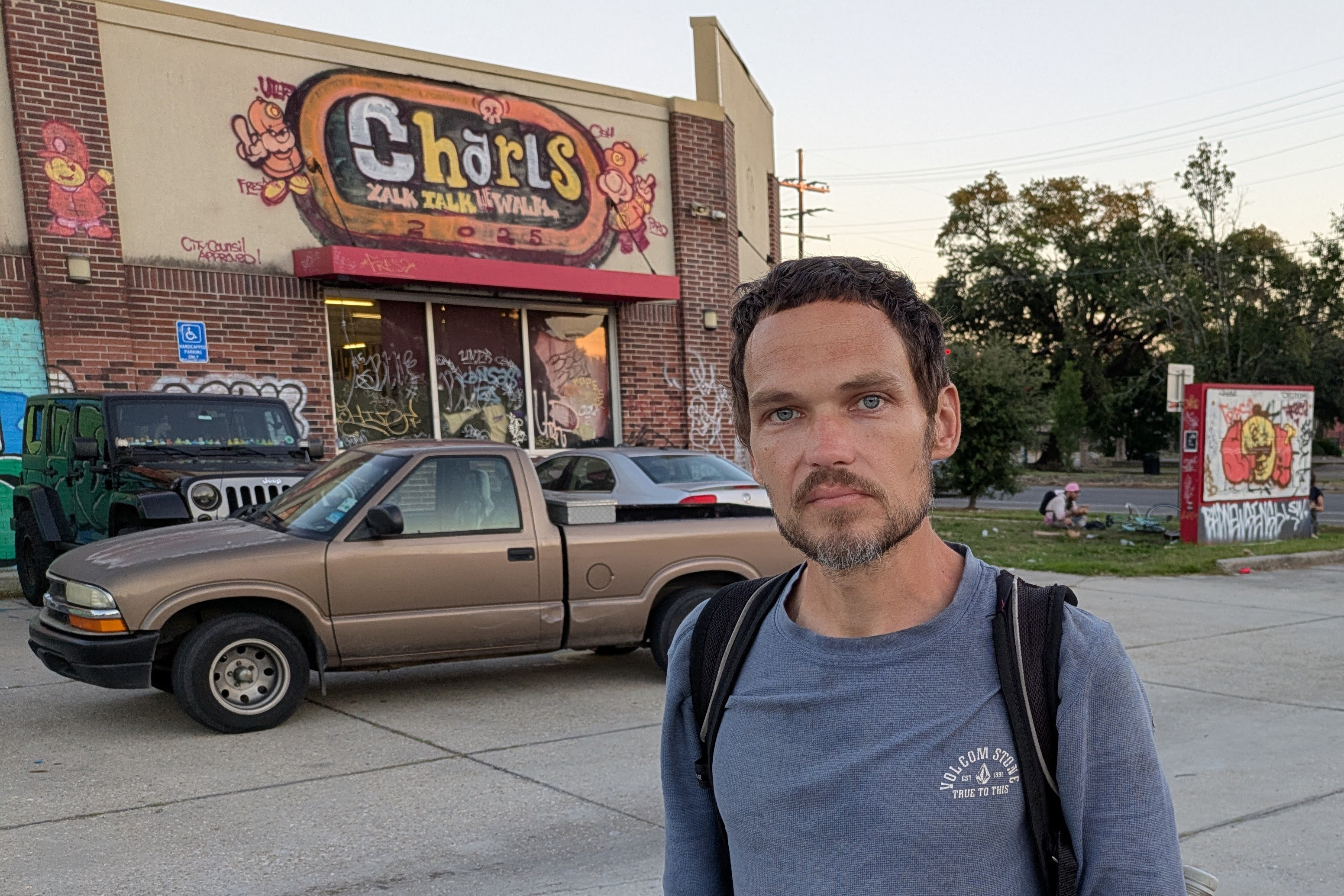
Another man in the parking lot was waiting for the arrival of Aquil Bey, a paramedic and former Green Beret well known for helping people overcome obstacles to getting health care. As soon as the man spotted Bey’s black Jeep, he ran up.
“I’ve got stage 4 kidney disease,” the man said, adding that he was scheduled for treatments at a hospital but was struggling to get there.
“Do me a favor,” Bey said as he unloaded folding tables and medical equipment from his car. “When our team gets here, come and see us. Maybe we can get you transportation.”
Bey is the founder of , a volunteer-run organization that provides free basic medical care and referrals for people who are homeless, using drugs, or part of other vulnerable communities. The group has a steady presence at the free store.
That day, Bey and his team connected the man needing kidney disease treatment to reduced-cost transit programs. They also did blood pressure and blood sugar checks for anyone who wanted them, cleaned infected wounds, and called clinics to make appointments for patients without phones.
A man with a leg injury mentioned he was sleeping on the concrete floor of an abandoned naval base. Bey noticed the free store’s furniture section had a mattress. He and another volunteer hauled it out, strapped it to the top of a car, and delivered it to where the man was sleeping.


“We’re just trying to find all these barriers” that people face and “find ways to fix them,” Bey said.
The clinic at the free store helped Stephen Wiltz connect with addiction care. He grew up in the Lower 9th Ward and had been using drugs since he was 10.
Fed up with discrimination from doctors who blamed him for his addiction, Wiltz said, he was reluctant to go to any treatment facility. But after years of knowing the volunteers at the free store, he trusted them to point him in the right direction.
At 56, Wiltz was in sustained recovery for the first time in his life, he said during a phone interview in the fall.
Those volunteers “cared for people who didn’t have nobody to care for them,” he said.
As the sun went down that fall evening at the store, a punk band started setting up for a show across the room from the medical clinic. Lights dimmed and music blared — a reminder that this was not your everyday clinic or community center.
Bey continued consulting with a patient who had gout.
“I get used to the sound,” Bey said of the rapid drums and loud power chords. “I like it sometimes.”

This <a target="_blank" href="/mental-health/new-orleans-radical-community-center-clinic-thrift-store-lifeline/">article</a> first appeared on <a target="_blank" href="">KFF Health News</a> and is republished here under a <a target="_blank" href=" Commons Attribution-NonCommercial-NoDerivatives 4.0 International License</a>.<img src="/wp-content/uploads/sites/8/2023/04/kffhealthnews-icon.png?w=150" style="width:1em;height:1em;margin-left:10px;">
<img id="republication-tracker-tool-source" src="/?republication-pixel=true&post=2137219&ga4=G-J74WWTKFM0" style="width:1px;height:1px;">]]>NEW ORLEANS — Elyse Stevens had a reputation for taking on complex medical cases. People who’d been battling addiction for decades. Chronic-pain patients on high doses of opioids. Sex workers and people living on the street.
“Many of my patients are messy, the ones that don’t know if they want to stop using drugs or not,” said Stevens, a primary care and addiction medicine doctor.
While other doctors avoided these patients, Stevens — who was familiar with the city from her time in medical school at Tulane University — sought them out. She regularly attended 6 a.m. breakfasts for homeless people, volunteered at a homeless shelter clinic on Saturdays, and, on Monday evenings, visited an abandoned Family Dollar store where advocates distributed supplies to people who use drugs.
One such evening about four years ago, Charmyra Harrell arrived there limping, her right leg swollen and covered in sores. Emergency room doctors had repeatedly dismissed her, so she eased the pain with street drugs, Harrell said.
Stevens cleaned her sores on Mondays for months until finally persuading Harrell to visit the clinic at University Medical Center New Orleans. There, Stevens discovered Harrell had diabetes and cancer.
She agreed to prescribe Harrell pain medication — an option many doctors would automatically dismiss for fear that a patient with a history of addiction would misuse it.
But Stevens was confident Harrell could hold up her end of the deal.
“She told me, ‘You cannot do drugs and do your pain meds,’” Harrell recounted on a Monday evening in October. So, “I’m no longer on cocaine.”


Stevens’ approach to patient care has won her awards and nominations in , , and . Instead of seeing patients in binaries — addicted or sober, with a positive or negative drug test — she measures progress on a spectrum. Are they showering daily, cooking with their families, using less fentanyl than the day before?
But not everyone agrees with this flexible approach that prioritizes working with patients on their goals, even if abstinence isn’t one of them. And it came to a head in the summer of 2024.
“The same things I was high-fived for thousands of times — suddenly that was bad,” Stevens said.
Flexible Care or Slippery Slope?
More than who need substance use treatment don’t receive it, national data shows. Barriers abound: high costs, lack of transportation, clinic hours that are incompatible with jobs, fear of being mistreated.
Some doctors had been trying to ease the process for years. Covid-19 accelerated that trend. Telehealth appointments, fewer urine drug tests, and medication refills that last longer became the norm.
The result?
“Patients did OK and we actually reached more people,” said , immediate past president of the American Society of Addiction Medicine. The organization supports continuing flexible practices, such as helping patients avoid withdrawal symptoms by of addiction medication and focusing on recovery goals .


But some doctors prefer traditional approaches that range from zero tolerance for patients using illegal drugs to setting stiff consequences for those who don’t meet their doctors’ expectations. For example, a patient who tests positive for street drugs while getting outpatient care would be discharged and told to go to residential rehab. Proponents of this method fear loosening restrictions could be a slippery slope that ultimately harms patients. They say continuing to prescribe painkillers, for example, to people using illicit substances long-term could normalize drug use and hamper the goal of getting people off illegal drugs.
Progress should be more than keeping patients in care, said , a Stanford psychologist, who has treated and researched addiction for decades and .
“If you give addicted people lots of drugs, they like it, and they may come back,” he said. “But that doesn’t mean that that is promoting their health over time.”
Flexible practices also tend to align with harm reduction, a divisive approach that proponents say keeps people who use drugs safe and that critics — — say enables illegal drug use.
The debate is not just philosophical. For Stevens and her patients, it came to bear on the streets of New Orleans.
‘Unconventional’ Prescribing
In the summer of 2024, supervisors started questioning Stevens’ approach.
In emails reviewed by ºÚÁϳԹÏÍø News, they expressed concerns about her prescribing too many pain pills, a mix of opioids and other controlled substances to the same patients, and high doses of buprenorphine, a medication considered to treat opioid addiction.
Supervisors worried Stevens wasn’t doing enough urine drug tests and kept treating patients who used illicit drugs instead of referring them to higher levels of care.
“Her prescribing pattern appears unconventional compared to the local standard of care,” the hospital’s chief medical officer at the time wrote to Stevens’ supervisor, . “Note that this is the only standard of care which would likely be considered should a legal concern arise.”
Springgate forwarded that email to Stevens and encouraged her to refer more patients to methadone clinics, intensive outpatient care, and inpatient rehab.
Stevens understood the general practice but couldn’t reconcile it with the reality her patients faced. How would someone living in a tent, fearful of losing their possessions, trek to a methadone clinic daily?
Stevens sent her supervisors of and backing her flexible approach. She explained that if she stopped prescribing the medications of concern, patients might leave the health system, but they wouldn’t disappear.
“They just wouldn’t be getting care and perhaps they’d be dead,” she said in an interview with ºÚÁϳԹÏÍø News.

Both University Medical Center and LSU Health New Orleans, which employs physicians at the hospital, declined repeated requests for interviews. They did not respond to detailed questions about addiction treatment or Stevens’ practices.
Instead, they provided a joint statement from Richard DiCarlo, dean of the LSU Health New Orleans School of Medicine, and Jeffrey Elder, chief medical officer of University Medical Center New Orleans.
“We are not at liberty to comment publicly on internal personnel issues,” they wrote.
“We recognize that addiction is a serious public health problem, and that addiction treatment is a challenge for the healthcare industry,” they said. “We remain dedicated to expanding access to treatment, while upholding the highest standard of care and safety for all patients.”
Not Black-and-White
ºÚÁϳԹÏÍø News shared the complaints against Stevens and the responses she’d written for supervisors with two addiction medicine doctors outside of Louisiana, who had no affiliation with Stevens. Both found her practices to be within the bounds of normal addiction care, especially for complex patients.
, an addiction medicine doctor and the , said doctors running pill mills typically have sparse patient notes that list a chief complaint of pain. But Stevens’ notes detailed patients’ life circumstances and the intricate decisions she was making with them.
“To me, that’s the big difference,” Loyd said.
Some people think the “only good answer is no opioids,” such as oxycodone or hydrocodone, for any patients, said , an addiction medicine doctor and associate professor at Michigan State University. But patients may need them — sometimes for things like cancer pain — or require months to lower their doses safely, she said. “It’s not as black-and-white as people outside our field want it to be.”
Humphreys, the Stanford psychologist, had a different take. He did not review Stevens’ case but said, as a general practice, there are risks to prescribing painkillers long-term, especially for patients using today’s lethal street drugs too.
Overprescribing fueled the opioid crisis, he said. “It’s not going to go away if we do that again.”
‘The Thing That Kills People’
After months of tension, Stevens’ supervisors told her on March 10 to stop coming to work. The hospital was conducting a review of her practices, they said in an email viewed by ºÚÁϳԹÏÍø News.
Overnight, hundreds of her patients were moved to other providers.
Luka Bair had been seeing Stevens for three years and was stable on daily buprenorphine.
After Stevens’ departure, Bair was left without medication for three days. The withdrawal symptoms were severe — headache, nausea, muscle cramps.
“I was just in physical hell,” said Bair, who works for the National Harm Reduction Coalition and uses they/them pronouns.


Although Bair eventually got a refill, Springgate, Stevens’ supervisor, didn’t want to continue the regimen long-term. Instead, Springgate referred Bair to more intensive and residential programs, citing Bair’s intermittent use of other drugs, including benzodiazepines and cocaine, as markers of high risk. Bair “requires a higher level of care than our clinic reasonably can offer,” Springgate wrote in patient portal notes reviewed by ºÚÁϳԹÏÍø News.
But Bair said daily attendance at those programs was incompatible with their full-time job. They left the clinic, with 30 days to find a new doctor or run out of medication again.
“This is the thing that kills people,” said Bair, who eventually found another doctor willing to prescribe.
Springgate did not respond to repeated calls and emails requesting comment.
University Medical Center and LSU Health New Orleans did not answer questions about discharging Stevens’ patients.
‘Reckless Behavior’
About a month after Stevens was told to stay home, Haley Beavers Khoury, a medical student who worked with her, had collected nearly 100 letters from other students, doctors, patients, and homelessness service providers calling for Stevens’ return.
One student wrote, “Make no mistake — some of her patients will die without her.” A nun from the Daughters of Charity, which ran , called Stevens a “lifeline” for vulnerable patients.
Beavers Khoury said she sent the letters to about 10 people in hospital and medical school leadership. Most did not respond.
In May, the hospital’s review committee determined Stevens’ practices fell “outside of the acceptable community standards” and constituted “reckless behavior,” according to a letter sent to Stevens.
The hospital did not answer ºÚÁϳԹÏÍø News’ questions about how it reached this conclusion or if it identified any patient harm.

Meanwhile, Stevens had secured a job at another New Orleans hospital. But because her resignation came amid the ongoing investigation, University Medical Center said it was required to inform the state’s medical licensing board.
The medical board began its own investigation — a development that eventually cost Stevens the other job offer.
In presenting her side to the medical board, Stevens repeated many arguments she’d made before. Yes, she was prescribing powerful medications. No, she wasn’t making clinical decisions based on urine drug tests. But national addiction organizations supported such practices and promoted tailoring care to patients’ circumstances, she said. Her response included a 10-page bibliography with 98 citations.
Liability
The board’s investigation into Stevens is ongoing. shows no action taken against her license as of late December.
The board declined to comment on both Stevens’ case and its definition of appropriate addiction treatment.
In October, Stevens moved to the Virgin Islands to work in internal medicine at a local hospital. She said she’s grateful for the welcoming locals and the financial stability to support herself and her parents.
But it hurts to think of her former patients in New Orleans.
Before leaving, Stevens packed away handwritten letters from several of them — one was 15 pages long, written in alternating green and purple marker — in which they shared childhood traumas and small successes they had while in treatment with her.
Stevens doesn’t know what happened to those patients after she left.
She believes the scrutiny of her practices centers on liability more than patient safety.
But, she said, “liability is in abandoning people too.”


This <a target="_blank" href="/mental-health/addiction-medicine-harm-reduction-opioids-louisiana-doctor-battle/">article</a> first appeared on <a target="_blank" href="">KFF Health News</a> and is republished here under a <a target="_blank" href=" Commons Attribution-NonCommercial-NoDerivatives 4.0 International License</a>.<img src="/wp-content/uploads/sites/8/2023/04/kffhealthnews-icon.png?w=150" style="width:1em;height:1em;margin-left:10px;">
<img id="republication-tracker-tool-source" src="/?republication-pixel=true&post=2131604&ga4=G-J74WWTKFM0" style="width:1px;height:1px;">]]>The purchases varied widely but they all came from the same source: opioid settlement money.
The cash, which comes from companies accused of fueling the overdose crisis, was used in more than 10,500 ways last year, according to an investigation by ºÚÁϳԹÏÍø News and researchers at the and , a national nonprofit focused on addiction.
The money is expected to over nearly two decades, paid by companies that sold prescription painkillers. State and local governments are meant to spend most of it combating addiction. The settlement agreements even and established other guardrails to limit unrelated uses — as the Tobacco Master Settlement Agreement of the 1990s.
But there’s still significant flexibility, and what constitutes a good use to one person can be deemed waste by another.
“People died for this money. Families were torn apart for this money. And to not spend it to try to make our system better, so that people don’t have to experience those losses going forward, to me, is unconscionable,” said , an addiction medicine doctor who was once addicted to opioids and has served as an expert in several opioid lawsuits.
To compile the most comprehensive national database of settlement spending, ºÚÁϳԹÏÍø News and its partners filed public records requests, scoured government websites, and extracted expenditures, which were then sorted into categories, such as treatment or prevention. The findings include:
- States and localities spent or committed nearly $2.7 billion in 2024, according to public records. The bulk went to investments addiction experts consider crucial, including about $615 million to treatment, $279 million to overdose reversal medications, and $227 million to housing-related programs.Ìý
- Smaller, though notable, amounts funded law enforcement gear, such as night vision equipment and Tasers.Ìý
- Many places funded prevention efforts that experts called questionable, such as a and a , at which kids and seniors , posed with inflatable guitars, and pledged to remain drug-free.Ìý
- Some jurisdictions paid for basic government services, such as .Ìý
- The money is controlled by different entities in each state, and about 20% of it is untrackable through public records.Ìý
Explore the database here.Ìý
ºÚÁϳԹÏÍø News is a national newsroom that produces in-depth journalism about health issues and is one of the core operating programs at KFF—an independent source of health policy research, polling, and journalism. Learn more about .This <a target="_blank" href="/health-industry/the-week-in-brief-how-governments-spent-opioid-settlement-money/">article</a> first appeared on <a target="_blank" href="">KFF Health News</a> and is republished here under a <a target="_blank" href=" Commons Attribution-NonCommercial-NoDerivatives 4.0 International License</a>.<img src="/wp-content/uploads/sites/8/2023/04/kffhealthnews-icon.png?w=150" style="width:1em;height:1em;margin-left:10px;">
<img id="republication-tracker-tool-source" src="/?republication-pixel=true&post=2114471&ga4=G-J74WWTKFM0" style="width:1px;height:1px;">]]>In many cases, this type of community event would be unremarkable. But Irvington’s concerts stood out for their funding source: settlement money from companies accused of fueling the opioid overdose crisis.
As part of national settlements, more than a dozen companies that sold prescription painkillers are expected to pay state and local governments over nearly two decades. Governments are supposed to spend most of the windfall combating addiction. Officials who negotiated the settlements even and established other guardrails to avoid a repeat of the Tobacco Master Settlement Agreement of the 1990s, from which went to anti-smoking programs.
But there’s still significant flexibility with these dollars, and what constitutes a good use to one person can be deemed waste by another.
In Irvington, township officials said they used the money appropriately because the concerts reduced stigma around addiction and connected people to treatment. But acting state Comptroller called the concerts a “waste” and “misuse” of the settlements, which resulted from the overdose deaths of hundreds of thousands of Americans.
Similar disputes are intensifying nationwide as officials begin spending settlement money in earnest — all while grappling with slashed federal grants and looming cuts to Medicaid, the state-federal public insurance program that is for addiction treatment.
To shed light on these discussions, ºÚÁϳԹÏÍø News and researchers at the and , a national nonprofit focused on addiction, conducted a yearlong effort to document settlement spending in 2024. The team filed public records requests, scoured government websites, and extracted expenditures, which were then sorted into categories such as treatment or prevention.
The result is a database of more than 10,500 ways settlement cash was used (or not) last year — the most comprehensive national resource of its kind. Some highlights include:
- States and localities spent or committed nearly $2.7 billion in 2024, according to public records. The bulk went to investments addiction experts consider crucial, including about $615 million to treatment, $279 million to overdose reversal medications and related training, and $227 million to housing-related programs for people with substance use disorders.
- Smaller, though notable, amounts funded law enforcement gear, such as night vision equipment, and prevention efforts that experts called questionable, such as hiring a drug awareness magician.
- Some jurisdictions paid for basic government services, such as firefighter salaries.
- The money is controlled by different entities in each state, and about 20% of it is untrackable through public records.
This year’s database, including expenditures and untrackable percentages, should not be compared with the one ºÚÁϳԹÏÍø News and its partners compiled last year, due to methodology changes and state budget quirks. The database cannot present a full picture because some jurisdictions don’t publish reports or delineate spending by year. What’s shown is a snapshot of 2024 and does not account for decisions in 2025.
Still, the database helps counteract a tendency toward in charge of settlement money and confusion among people trying to track it.
More than $237 million — about 9% of all trackable spending in 2024 — went to efforts broadly aimed at preventing addiction, according to public records. These ranged from putting on community awareness events, like the concerts in Irvington, to hiring mental health counselors in schools.
Many of the examples raised red flags for researchers, including:
- Suffield, Connecticut, held a , at which kids and seniors , posed with inflatable guitars, and pledged to remain drug-free.
- Vernon, Connecticut, , at which a fighter spoke about his experience with addiction.
- Hardy County, West Virginia, to repair a school track.
“There is no evidence” to back those efforts, said , who leads prevention-oriented research at the nonprofit Partnership to End Addiction.
Elected officials like the events because “you can announce to the community that you did something,” she said. But unless they’re part of larger initiatives that incorporate other approaches, such as screening students for mental health concerns or supporting parents struggling with addiction, they’re unlikely to have lasting impact.
And when settlement funds pay for those one-offs, there’s less left “that we do know work,” Richter added.
School assembly speakers were also popular, with three Connecticut towns spending more than $30,000 total for former Boston Celtic Chris Herren to with students.
“You get 1,200 kids in the gym and you can hear a pin drop when he talks,” said Joe Kobza, superintendent of schools in Monroe. He described Herren’s talks to students and parents as “pretty impactful.”
But emotional impact isn’t necessarily effective, Richter said. Speakers often talk about drugs messing up their lives even though they’ve become wealthy celebrities. “The messages are so mixed,” she said.
Many local officials admitted their spending decisions weren’t evidence-based. But they meant well, they said. And they received little to no guidance on how to use the money.
Kelly Giannuzzi, Suffield’s former director of youth services, who organized the sock hop, said the goal was to raise awareness and combat loneliness.
Hardy County Commissioner said spending money on track repairs made sense, since he’d seen the positive impact the sport had on his son’s life. He wanted other kids to have the same opportunity.
David Owens, a spokesperson for Vernon, said the town’s mixed martial arts event was to , meant to show people that athletics can help them build connections and avoid drugs. The event brought out young men, who are often difficult to reach, he said.
But the town has no way of knowing if the event had lasting traction.
In New Jersey, acting Comptroller Walsh this summer calling on Irvington township officials to repay the settlement money spent on the concerts.
“If they’re going to hold big parties, that’s up to them and the taxpayers,” Walsh told ºÚÁϳԹÏÍø News. “But they can’t use opioid money for that.”
He also suggested the concerts were political rallies for the mayor, Tony Vauss.
Irvington officials strongly objected to the report and unsuccessfully sued Walsh to try to block its release. Vauss told ºÚÁϳԹÏÍø News it was “misleading and flat-out wrong.”
Vauss said the township distributed overdose reversal medications at the concerts and spread messages about seeking help. At least four people sought treatment on-site, the township said in .
“We felt as though we did everything correctly,” Vauss said.
However, some of the research Irvington cited in the lawsuit to support its case appeared irrelevant, such as a and a graduate thesis.
Irvington officials did not respond to questions about those citations.

As this dispute — and others like it nationwide — continue, people affected by the crisis say it’s crucial to remember the moral weight of these settlements.
It’s “blood money,” said , an addiction medicine doctor who was once addicted to opioids and has served as an expert in several opioid lawsuits.
He’s seen many family members lose parents, children, and siblings.
“I don’t know how I would look a family in the face” if this money isn’t used to prevent more losses, he said.
Read the methodology behind this project.
ºÚÁϳԹÏÍø News’ Henry Larweh; Shatterproof’s Kristen Pendergrass and Lillian Williams; and the Johns Hopkins Bloomberg School of Public Health’s Abigail Winiker, Samantha Harris, Isha Desai, Katibeth Blalock, Erin Wang, Olivia Allran, Connor Gunn, Justin Xu, Ruhao Pang, Jirka Taylor, and Valerie Ganetsky contributed to the database featured in this article.
The has taken a leading role in providing guidance to state and local governments on the use of opioid settlement funds. Faculty from the school collaborated with other experts in the field to create , which have been endorsed by over 60 organizations.
is a national nonprofit that addresses substance use disorder through distinct initiatives, including advocating for state and federal policies, ending addiction stigma, and educating communities about the treatment system.
Shatterproof is partnering with some states on projects funded by opioid settlements. ºÚÁϳԹÏÍø News, the Johns Hopkins Bloomberg School of Public Health, and the Shatterproof team that worked on this report are not involved in those efforts.
This <a target="_blank" href="/public-health/opioid-settlements-addiction-sock-hops-concerts-mma-local-spending/">article</a> first appeared on <a target="_blank" href="">KFF Health News</a> and is republished here under a <a target="_blank" href=" Commons Attribution-NonCommercial-NoDerivatives 4.0 International License</a>.<img src="/wp-content/uploads/sites/8/2023/04/kffhealthnews-icon.png?w=150" style="width:1em;height:1em;margin-left:10px;">
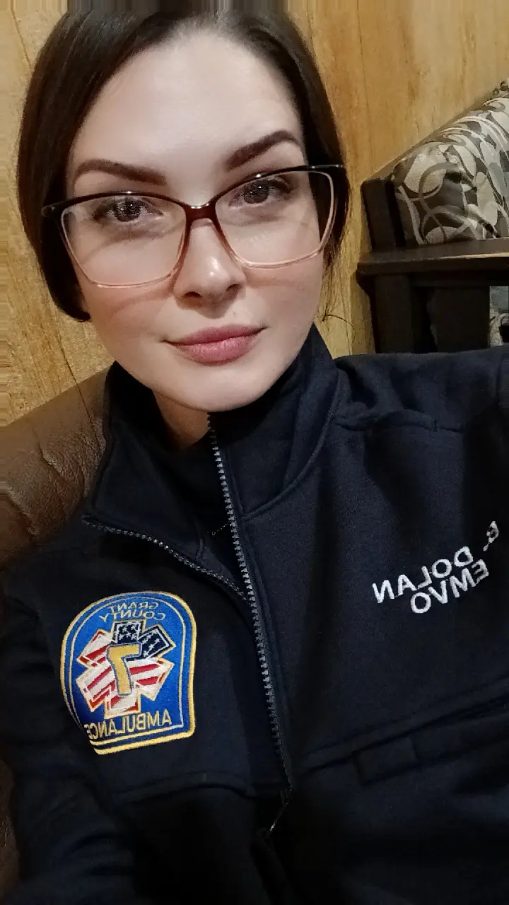
<img id="republication-tracker-tool-source" src="/?republication-pixel=true&post=2102838&ga4=G-J74WWTKFM0" style="width:1px;height:1px;">]]>Bre Dolan, a 35-year-old resident of Hardy County, West Virginia, understands why. Throughout her childhood, when her dad had addiction and mental health crises, police officers were often the first ones to respond. Dolan calls them “good men and women” who “care about seeing their community recover.”
But she’s skeptical that they can mitigate the root causes of an addiction epidemic that has racked her home state for decades.
“Most of the busts that go down are addicts,” she said — people who need treatment, not prison.
Dolan’s father was one of them. And so was she.
Now 14 years into recovery, she’s been surprised to see many local officials spending opioid settlement money — an influx of cash from companies accused of fueling the overdose crisis — on police Tasers, cruisers, night vision gear, and more.
“How is that really tackling an issue?” Dolan said. “How will it help families battling addiction?”
Nationwide, more than $61 million in opioid settlement funds were spent on law enforcement-related efforts in 2024, according to a yearlong investigation by ºÚÁϳԹÏÍø News and researchers at the Johns Hopkins Bloomberg School of Public Health and Shatterproof, a national nonprofit focused on addiction. That included initiatives that public health experts largely support, such as hiring social workers to accompany officers on overdose calls, as well as actions they’re more skeptical of, such as beefing up police arsenals.
Over nearly two decades, state and local governments are set to receive in opioid settlement money, which is intended to be used to fight addiction. The settlement agreements even and established other guardrails to limit unrelated uses of the funds — as the Tobacco Master Settlement Agreement of the 1990s.
But there’s still significant flexibility with these dollars, and what constitutes a good use to one person can be deemed waste by another.
To , an addiction medicine doctor who was once addicted to opioids and has served as an expert in several opioid lawsuits, some law enforcement expenses fall into that second category.
and are not “in the spirit of what we wanted to use the money for when we were fighting for it,” Loyd said.
“People died for this money. Families were torn apart for this money. And to not spend it to try to make our system better, so that people don’t have to experience those losses going forward, to me, is unconscionable,” he said.
As part of this investigation, ºÚÁϳԹÏÍø News and its partners compiled the most comprehensive national database of opioid settlement spending to date, featuring more than 10,500 examples of how the money was used (or not) last year. The team filed public records requests, scoured government websites, and extracted expenditures, which were then , such as treatment or prevention. The findings include:
- Nearly $2.7 billion — that’s the amount states and localities spent or committed in 2024, according to public records. The lion’s share went to investments addiction experts consider crucial, including about $615 million to treatment, $279 million to overdose reversal medications and related training, and $227 million to housing-related programs for people with substance use disorders.
- Smaller, though notable, amounts funded law enforcement initiatives — such as creating a shooting range and tinting patrol car windows — and prevention programs that experts called questionable, such as putting on a fishing tournament.
- Some jurisdictions paid for basic government services, such as firefighter salaries.
- The money is controlled by different entities in each state, and about 20% of it is untrackable through public records.
This year’s database, including the expenditures and untrackable percentages, should not be compared with the one ºÚÁϳԹÏÍø News and its partners , due to and state budget quirks. The database cannot present a full picture because some jurisdictions don’t publish reports or delineate spending by year. What’s shown is a snapshot of 2024 and does not account for decisions in 2025.
Still, the database helps counteract the in charge of settlement money among those .
‘How My Population Would Like Me To Vote’
Dolan has seen intergenerational addiction up close. When her father was high, he sometimes kicked teenage Dolan out of the house with her toddler siblings. She started drinking early and progressed to other drugs, eventually landing in prison.
Although she managed to find recovery on her own, even landing a job as an EMT, she wants to make the path easier for others.
If settlement money were used to hire social workers or build family recovery programs, it could change the course of a kid’s life, she said.
“Maybe people could have helped my dad get into recovery and gave him therapy,” she said. “Anything could have happened.”
But many local officials say law enforcement is one of the few tools they have, especially in rural areas. And their constituents believe it’s effective.
“If the goal was treatment and prevention, it would have been better to throw [the money] into a big grant system and give it to treatment centers,” said , city manager of Oak Hill, West Virginia, which for a drone and surveillance cameras for its police department. “Unfortunately, local governments are really not set up to do that.”
Clarkdale, Arizona, Town Manager said her town bought because they help with enforcement — such as recording crime scenes and conducting search-and-rescue operations — as well as education, when officers interact with kids at community events.
Similar perspectives nationwide have led to spending that includes:
- About (also known as silencers) in Alexandria, Indiana.
- About in Mooresville, Indiana.
- About and Tasers in Hardy County, West Virginia.
- Nearly , to add a police officer to the county’s drug task force, replace that officer locally, buy guns and vehicles, and tint car windows.
Several elected officials said their choices reflect local politics.
That’s “how my population would like me to vote,” Hardy County Commissioner said of his commission’s goal to spend about a quarter of its settlement money on law enforcement.
Mooresville Town Council President told ºÚÁϳԹÏÍø News, “People have petitioned our government for less taxes but have never petitioned for less services” from the local police force. With federal and state budget cuts looming, the town must be resourceful, he said, adding that the Tasers were bought with a portion of settlement funds that have no restrictions.
After these purchases, an Indiana commission of law enforcement equipment that it cautioned against buying with restricted settlement dollars. , , and have released similar lists.
Research backs those restrictions. Studies have shown that drug busts and arrests can . Officers often , making people who use drugs or through police.
In contrast, equipping police officers with overdose reversal medications has been . That’s a key component of in Texas, the state with the highest percentage of reported law enforcement spending.
Police and Firefighter Salaries
Some places used settlement funds to maintain basic first responder services.
For example, Mantua Township, New Jersey, to “offset police salary and wages” and, according to its public spending report, . Township officials did not respond to requests for comment.
Los Angeles County to cover a portion of firefighter salaries and benefits last year and estimates it will use another $1 million this year.
County fire department spokesperson Heidi Oliva said opioid funds were used to fill a budget gap until revenue kicked in from a last November.
The use of funds was “appropriate,” she said in an email, because “the opioid crisis presents a significant burden to EMS response, from dispatch through arrival at hospitals, clinician mental health/burnout, and a variety of other factors.”

Using opioid money to replace other revenue is . But it’s .
“I don’t want to see this money used to make up for stuff that would be paid for anyway,” said , chair of the FED UP! Coalition, a national advocacy organization representing many parents who’ve lost children to addiction.
Settlement dollars are “the only financial representation from the governments and from the drug companies” of families’ losses, Busch said. To see that money used to maintain the status quo is “painful” and “distressing.”
Busch fears this practice will as states grapple with federal budget cuts.
Already in New Jersey, lawmakers in settlement funds to health systems to cushion against anticipated Medicaid losses — a move opposed by the state’s , , and .
However, some states are taking proactive steps.
Colorado this year against such actions.
“These dollars can’t be part of budget games where we simply backfill existing programs,” state Attorney General Phil Weiser told ºÚÁϳԹÏÍø News. “We have to build on whatever we’re doing because it hasn’t been enough.”
Other states, such as , , and , are newly requiring local governments to report how they spend the money, which may make it easier to spot disputed practices. Officials in Delaware, Hawaii, Massachusetts, and Missouri said they expect to revamp their public reporting systems to increase transparency by early 2026.
In Mississippi, which produced no substantive public reports last year, the attorney general’s office has that will host spending information after Dec. 1.
Jennifer Twyman is anxious to see some positive changes.
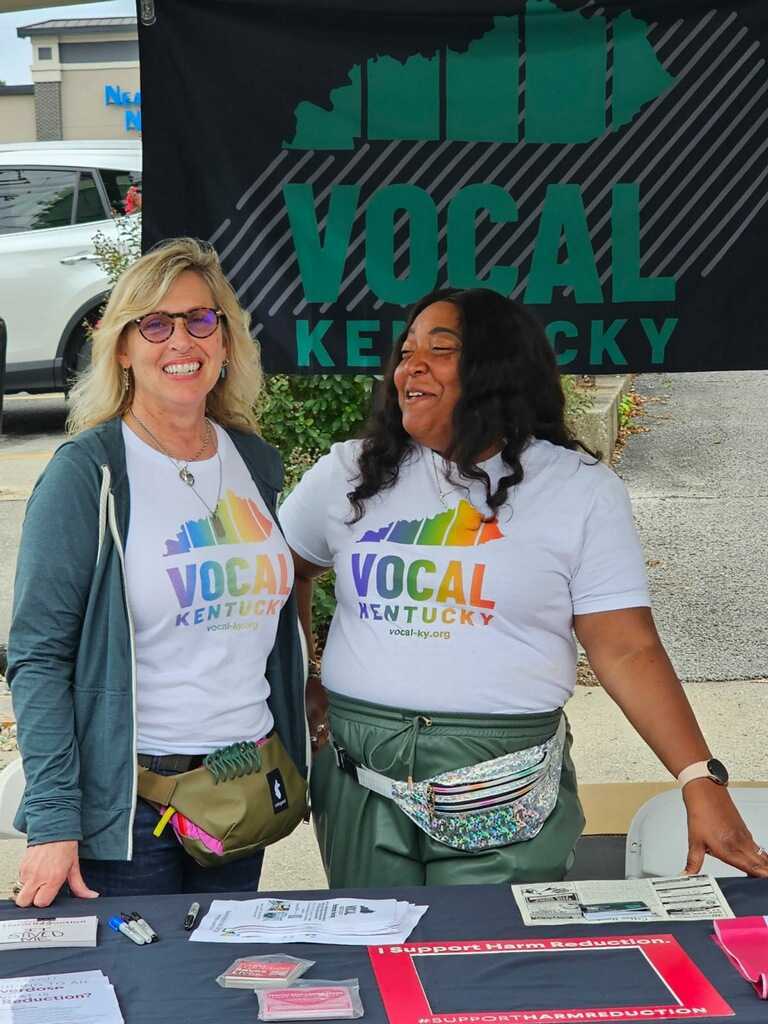
“We have people literally dying on our sidewalks,” said the Louisville, Kentucky, advocate.
Twyman struggled with opioid misuse for 20 years and now works with to end homelessness and the war on drugs. To her, any spending that doesn’t directly help people with addiction betrays the settlement’s purpose.
“It is the blood from many of my friends, people that I care deeply about,” she said. “That money could have been me, could have been my life.”
Read behind this project.
ºÚÁϳԹÏÍø News’ Henry Larweh; Shatterproof’s Kristen Pendergrass and Lillian Williams; and the Johns Hopkins Bloomberg School of Public Health’s Abigail Winiker, Samantha Harris, Isha Desai, Katibeth Blalock, Erin Wang, Olivia Allran, Connor Gunn, Justin Xu, Ruhao Pang, Jirka Taylor, and Valerie Ganetsky contributed to the database featured in this article.
The has taken a leading role in providing guidance to state and local governments on the use of opioid settlement funds. Faculty from the school collaborated with other experts in the field to create , which have been endorsed by over 60 organizations.
is a national nonprofit that addresses substance use disorder through distinct initiatives, including advocating for state and federal policies, ending addiction stigma, and educating communities about the treatment system.
Shatterproof is partnering with some states on projects funded by opioid settlements. ºÚÁϳԹÏÍø News, the Johns Hopkins Bloomberg School of Public Health, and the Shatterproof team that worked on this report are not involved in those efforts.
This <a target="_blank" href="/public-health/opioid-settlements-law-enforcement-spending-states-towns-guns-narcan/">article</a> first appeared on <a target="_blank" href="">KFF Health News</a> and is republished here under a <a target="_blank" href=" Commons Attribution-NonCommercial-NoDerivatives 4.0 International License</a>.<img src="/wp-content/uploads/sites/8/2023/04/kffhealthnews-icon.png?w=150" style="width:1em;height:1em;margin-left:10px;">
<img id="republication-tracker-tool-source" src="/?republication-pixel=true&post=2102815&ga4=G-J74WWTKFM0" style="width:1px;height:1px;">]]>Public health experts and local advocates say the outbreak is fueled by a confluence of on-the-ground factors: the sidelining and closing of programs that distributed sterile syringes to people who use drugs, a shortage of medical providers focused on HIV, and the clearing of the city’s largest homeless encampment, which upended care for newly diagnosed people living there.
But those issues may not remain local for long.
The Trump administration is pushing similar tactics nationwide. In a , Trump called for defunding programs that engage in harm reduction — a broad term that encompasses many public health interventions, including syringe services, aimed at keeping people who use drugs alive. Such efforts are sometimes controversial, with critics saying they enable illegal activity. The executive order also supports forcing homeless people off the street and into treatment. This comes after the administration cut or delayed funding for various addiction and HIV-related programs and federal agencies .

The administration says its approach will increase public safety, but suggest otherwise. Many advocates and researchers warn these efforts could spark more outbreaks like the one in Bangor.
“That feels inevitable,” said Laura Pegram, director of for NASTAD, an association of public health officials who administer HIV and hepatitis programs.
She said people who use drugs face a trifecta of risks: HIV, hepatitis C, and overdose. “Across the country, I think we’ll start to see those three things starting to be on the rise again.”
“That will be incredibly costly,” she added — in dollars and “in a real human way.”
Outbreaks that start among people who use drugs can easily spread to those who don’t.
An HIV Outbreak
The first HIV case in Bangor’s current outbreak , well before Trump’s return to the presidency.
Puthiery Va, director of , attributed the emergence to the opioid epidemic, housing shortages, and the greater Bangor area’s sparse health care services.
Local advocates highlighted an additional, acute factor: supply shortages at the region’s largest syringe services program and its subsequent closure.
A nonprofit that provided health care and social services to people who use drugs, Health Equity Alliance, or HEAL, distributed sterile needles annually.
Like other such programs nationwide, its goal was to prevent the spread of infectious disease that can occur if people share needles to inject drugs.
However, financial struggles and mismanagement led to severe shortages in recent years. Former HEAL executive director Josh D’Alessio acknowledged such issues, telling ºÚÁϳԹÏÍø News, “We did run out of syringes” at times or limit how many participants could take. Several of these shortages struck in the fall of 2023, leading HEAL staffers to suggest a link to the first HIV case.

The Future of Harm Reduction
Research suggests a strong connection between past HIV outbreaks among people who use drugs and lack of access to sterile needles, said , an epidemiologist at Tufts University School of Medicine.
A 2015 outbreak in Scott County, Indiana, and one in the a few years later were curbed only after , he said. If such programs had existed sooner in Scott County, more than a hundred infections could have been prevented, .
Va, who leads the Maine Center for Disease Control and Prevention, said she considers the shortage of syringe services in the Bangor area to be a factor in the outbreak but not the primary cause.
Stopka said the best practice during an outbreak “is to amplify access to sterile syringes.”
But Trump’s recent executive order links harm-reduction programs to crime, saying such efforts “only facilitate illegal drug use and its attendant harm.” The order doesn’t name syringe services programs — which have been supported by both Democrats and Republicans in the past — but it targets “safe consumption” sites, where people can use drugs under supervision. the attacks will be broader.
A letter from the nation’s leading addiction agency expanding on Trump’s executive order said federal funds to buy syringes or drug pipes. However, that has been true for most of the past few decades. The letter did not address supporting general operating costs for syringe services programs.
Department of Health and Human Services spokesperson Andrew Nixon told ºÚÁϳԹÏÍø News that the administration is committed to “addressing the addiction and overdose crisis impacting communities across our nation.” But he and spokespeople for the White House did not respond to specific questions about the administration’s stance toward syringe services.
In Bangor, some locals have raised concerns about harm reduction that echo the president’s. At a — shortly after a syringe services program was newly certified by the state to operate locally — residents and business owners said they felt unsafe with the growing population of people who were homeless and using drugs. They worried syringe programs were fueling the behavior.
But research suggests syringe services programs in the community and . They new HIV and hepatitis C cases, into addiction treatment fivefold, . They are also of overdose reversal medications, the use of which many communities — and the Trump administration — have said they support.
The city ultimately decided the newly certified program, , could not operate in prominent public parks or squares.


In the following months, Needlepoint ran its syringe services only at the city’s largest homeless encampment, where several people had tested positive for HIV, said the group’s executive director, William “Willie” Hurley. That ended in February when the city cleared the encampment.
This summer, Needlepoint secured a private location for its syringe services but shut it down five days later when city officials .
, director of Bangor’s health department, said the city is trying to strike a balance between “making services available and what the community wants.”
“Getting the buy-in of most of the community” is “critical to the future of harm reduction,” she said.
Other cities have seen backlash result in new laws that restrict how syringe services programs operate or shutter them.
Gunderman said she is hoping to avoid that in Bangor.
Clearing Encampments
Trump’s recent executive order also calls for clearing homeless people off the street and involuntarily committing them to treatment facilities.
The administration is enacting this policy in Washington, D.C., where it has and threatened homeless people if they don’t leave the streets.
White House spokesperson Abigail Jackson said people have the option to be taken to a shelter or receive addiction and mental health services.
Similar policies have taken hold nationwide in recent years, even in liberal hubs like and .
Last year in Bangor, as a homeless encampment that grew to nearly 100 residents, business owners and locals called for its clearing.
Some advocates and social service providers warned that doing so could exacerbate the HIV outbreak and overdose crisis. At two City Council meetings in November, that it would be difficult to find people they served after a clearing and that scattering newly diagnosed people HIV clusters elsewhere.
“Plenty of people said you’re going to lose track of these people,” , a board member for the Bangor Area Recovery Network, told ºÚÁϳԹÏÍø News. “They did it anyway.”

‘I’m Still Alive’
Two months after clearing the encampment, not knowing the location of more than a third of the people who had lived there.
Clark said it’s not surprising that the city couldn’t connect everyone to housing or treatment. Many people distrust these services, shelters are frequently full, and treatment services are scarce. “Where exactly are these people supposed to go?” she said.
City officials stressed in Council meetings and reports that they were taking a humane approach. They ramped up social services for months leading up to the clearing, connecting people to everything from housing to storage facilities and laundry.
Gunderman, the city health director, said she knows the sweep wasn’t ideal but that neither was crowding folks in an unsanitary encampment. “It was a situation where there weren’t a lot of great answers,” she said.
To help track folks from the encampment and keep them engaged in HIV treatment, the city is now using about to hire two case managers. (The only other local HIV medical case management program .)
“What we know from outreach we’ve been doing already is that we spend a lot of time looking for people,” Gunderman said.
Jason, who has been homeless for most of the past decade and tested positive for HIV this year, has seen that in action.
Members of what he calls his medical team have scoured the streets for hours to find his tent and remind him to take his HIV treatment shots, he said. Some picked up prescriptions and delivered them to him.
“They’ve made sure I’m taken care of,” Jason said. (ºÚÁϳԹÏÍø News agreed to use only his first name to protect his privacy.)
Jason believes he got the virus last year at the homeless encampment while using drugs that someone else prepared. He had tried to avoid the encampment for months. But whenever he set up his tent elsewhere, he said, police officers told him to move.
When he got the diagnosis, he thought of his uncle, who died of AIDS in the 1980s.
“It hurts to talk about,” Jason said, “but I’m still alive.”
After months of treatment, his viral load is . Over the summer, his team helped him find housing.
But Jason is still struggling to find sterile needles regularly. He worries about others facing a shortage.
“That’s how this outbreak has been spreading more and more,” Jason said. “Every time we turn around there’s another case.”
This <a target="_blank" href="/mental-health/hiv-outbreak-bangor-maine-syringe-services-programs-trump-homelessness/">article</a> first appeared on <a target="_blank" href="">KFF Health News</a> and is republished here under a <a target="_blank" href=" Commons Attribution-NonCommercial-NoDerivatives 4.0 International License</a>.<img src="/wp-content/uploads/sites/8/2023/04/kffhealthnews-icon.png?w=150" style="width:1em;height:1em;margin-left:10px;">
<img id="republication-tracker-tool-source" src="/?republication-pixel=true&post=2086181&ga4=G-J74WWTKFM0" style="width:1px;height:1px;">]]>Pharmacy benefit managers, often called PBMs, that negotiate prescription drug prices between drug companies, insurance plans, and pharmacies. Some lawyers and advocates say PBMs helped fuel the overdose crisis by of opioid prescriptions.
As governments begin exploring potential lawsuits against PBMs — a step that could represent the next wave in opioid-related litigation — Optum Rx is attempting to shut down those efforts, in some cases before they even fully take shape.
In June, Optum Rx sued Anderson, Boyd, Christian, Nicholas, and Oldham counties in Kentucky for allegedly making decisions about participating in the new wave of national opioid lawsuits behind closed doors, violating Kentucky’s open meetings law. Optum Rx is asking courts to effectively force those counties to make their decisions again, this time in open meetings, potentially with the hope that some won’t bother because of the administrative burden. The result could be fewer claims against the company and possibly less money for it to pay in a future settlement.
But legal experts call Optum’s case “hypertechnical” and “frivolous,” and addiction recovery advocates say it could set a dangerous precedent for companies to evade accountability for their role in fueling the overdose crisis.
, an attorney, a national expert on opioid litigation, and founder of , said Optum’s suit reminded her of an adage among lawyers: “If the facts are on your side, pound the facts. If the law is on your side, pound the law. If neither is on your side, pound the table.”
“Right now, what we’re seeing is it pounding the table,” Minhee said of Optum Rx. The company is “desperately” trying “to find some kind of foothold” to get cases against it thrown out.
Minhee said these suits fit a pattern of Optum Rx using thin arguments to try to delay or evade opioid litigation nationwide.

Last year, Optum Rx, along with another PBM, to throw out an opioid lawsuit filed by Los Angeles County, claiming during a December hearing that the county hadn’t shown harm. The judge and ultimately rejected the companies’ request.
In April, the same companies a federal judge overseeing national opioid litigation, claiming he was biased. was based partly on a Florida lawyer’s having said the judge was “plaintiff-oriented.” Their attempt failed.
Now, Optum Rx is working to keep five Kentucky counties out of that same sweeping opioid litigation.
That national legal undertaking began more than seven years ago, as jurisdictions saw overdose deaths climb. Many people who had become addicted to prescription painkillers were cut off by their doctors, and some transitioned to using deadlier heroin or fentanyl. Health care and public safety costs skyrocketed. Thousands of cities, counties, and states began suing health care companies for allegedly creating a public nuisance by aggressively marketing prescription painkillers and negligently distributing them.
Those cases were lassoed together , which has resulted in . The first few waves of settlements involved opioid manufacturers, distributors, and retail pharmacies, with companies such as Johnson & Johnson, CVS, and Walgreens agreeing to pay state and local governments billions of dollars. The money is meant to be used for addiction treatment and prevention services — though its rollout has been controversial.
To add a new round of companies as defendants, jurisdictions must undertake a multistep process, said , a Florida-based attorney who represents many local governments in the massive national litigation. The five Kentucky counties in question were in the early stages of that process, only having asked the judge to amend their complaint, he said. They hadn’t added Optum Rx yet.
If Optum Rx’s suits are successful, those counties would have the option of redoing the initial steps of the process in a public meeting, then continuing to add Optum Rx as a defendant, Mougey explained. The company may hope that some counties won’t undertake the extra administrative effort.
Optum Rx’s “goal is clearly just to wear down and tire out these small counties,” Mougey said. “They’re trying to have a chilling effect on the litigation.”
It’s not clear why Optum Rx targeted those five counties out of the many localities undertaking the process to add the company as a defendant. The Kentucky counties range from having (Nicholas) to (Christian). One is among (Oldham), while others are poorer. Boyd County, , is one of the hardest hit, with a recent overdose rate .
Optum Rx, in its , which was similar to claims against the other counties, said local authorities had taken official legal action by asking the judge to make a change in its case. The suit said such action must be done in a public meeting and that the county did not hold one.
Optum spokesperson Isaac Sorensen told ºÚÁϳԹÏÍø News that the company’s argument is not about “a technicality.”
It is “an important legal requirement designed to ensure accountability and transparency before a county takes legal action,” said the statement Sorensen provided. “We have found many counties ignored this requirement, alongside their duty to preserve relevant evidence, and Optum Rx will defend against these improper legal actions.”
The five Kentucky counties disagree with these assertions, according to court records. As of late July, all five had filed motions to dismiss Optum Rx’s claim.
Boyd County, like the others, argued in that asking a judge to amend its complaint was a routine, procedural step that did not require a public meeting. Optum Rx jumped the gun, the county argued, filing a case before any final action had been taken.
“No amended complaint has been filed. No new defendant, OptumRx included, has been added. No new lawsuit has been initiated,” Boyd County’s response said.
The county also pointed out that it held an open meeting in 2017 that kicked off its involvement in the national litigation and authorized future amendments to that litigation.
Hearings on the counties’ motions to dismiss Optum Rx’s suits are set for late August and early September, according to court records.
These cases are shaping up to be a Goliath-versus-David legal action. Although Oldham County is the wealthiest of the Kentucky counties that Optum Rx sued, is less than 0.1% of Optum Rx’s annual revenue, which the company reported as in 2024.
Oldham County Attorney told ºÚÁϳԹÏÍø News he’d seen the impact of the opioid epidemic as a prosecutor working on a growing number of drug-related cases over the years. Now, as settlement money is arriving from other companies, it has funded increased addiction treatment in local jails. More settlement money from additional companies could expand such services, Baxter said.
If Optum Rx succeeds in kicking Kentucky counties out of the national litigation, it would set “a really horrific precedent” for other PBMs and health care companies to do something similar, said , CEO of the statewide nonprofit People Advocating Recovery.
Hyde said she’s been in recovery for more than a decade from an addiction that began with prescription painkillers for a broken leg. She wants to see PBMs and other companies held accountable and made to change their processes to prevent future crises.

Despite a recent , Hyde said people in her state, their families, and the economy are still hurting.
“Recovery doesn’t just happen overnight,” she said. “Without these dollars that have been a direct result of people being misled, mistreated, and taken advantage of, we will still be detrimentally impacted.”
ºÚÁϳԹÏÍø News is a national newsroom that produces in-depth journalism about health issues and is one of the core operating programs at KFF—an independent source of health policy research, polling, and journalism. Learn more about .This <a target="_blank" href="/courts/optum-rx-unitedhealth-group-kentucky-counties-lawsuits-opioids-open-meetings-law/">article</a> first appeared on <a target="_blank" href="">KFF Health News</a> and is republished here under a <a target="_blank" href=" Commons Attribution-NonCommercial-NoDerivatives 4.0 International License</a>.<img src="/wp-content/uploads/sites/8/2023/04/kffhealthnews-icon.png?w=150" style="width:1em;height:1em;margin-left:10px;">
<img id="republication-tracker-tool-source" src="/?republication-pixel=true&post=2075752&ga4=G-J74WWTKFM0" style="width:1px;height:1px;">]]>But now that the windfall is being spent, are attorneys general doing enough to ensure it’s used for the intended purposes?
No, say many families affected by the overdose crisis, recovery and harm reduction advocates, policy experts, and researchers following the cash.
“This is blood money,” said Toni Torsch, a Maryland resident whose son Dan at age 24. It can’t make up for the lives lost, but “we do want to make sure that it’s going to count.”
Torsch and others affected by the crisis are increasingly worried that no one seems to be guarding the opioid settlement cash while elected officials eye it hungrily. With the Trump administration slashing federal funding for addiction and Congress approving massive reductions to Medicaid — the nationwide — people fear state legislators will use the settlements as a grab bag to fill budget shortfalls.
In the face of these concerns, two research and advocacy organizations are proposing a solution: a crowdsourced database to identify potential examples of misuse and prompt attorneys general to investigate.
The and launched that allows members of the public to submit alleged cases of waste, fraud, abuse, and mismanagement of opioid settlement funds. Submissions are reviewed by , director of the Opioid Policy Institute, and then posted with details such as how much money was spent, what was purchased, who made the decision, and links to relevant news articles or budget documents.

, shared first with ºÚÁϳԹÏÍø News, includes about 150 examples to start, including $2,362 awarded by a Missouri county to its roads and bridge department and $375,600 spent on a body scanner for a Michigan county jail. The initial examples were sourced from people in recovery, advocates, and others Stoltman and his team asked to test the project. Stoltman acknowledged he’ll face criticism as the primary arbiter of what qualifies as misuse for the database, but said he’ll use research studies to defend his decisions.
The website also shows people how to file complaints with their state attorney general and ask the office to develop a formal process for receiving and investigating such complaints.
“I hope this is a wake-up call for state AGs that their work on this project is not done,” said Frank Kearl, who co-led the effort with Stoltman and is working as an attorney at Popular Democracy until July 14. “We still have time” to make changes to ensure we “spend this money in a way that actually responds to the harm that was caused.”
The website’s launch comes just over a week after New Jersey lawmakers passed a budget that in settlement funds despite the state . Legislators said it would shield hospitals from the blow of federal Medicaid cuts, but it gives short shrift to people with substance use disorders, whom the money was meant to serve.
Lawmakers in and are also considering using settlement funds to plug gaps, and and Nevada have discussed it too.
“That’s not what it’s there for,” said Torsch, who runs a nonprofit dedicated to addiction recovery in her son’s honor. “We want to make sure that money is being spent in the most responsible and effective way to help people that are still struggling.”

Last year, when Torsch heard that a western Maryland county spent some of its settlement money on guns, she reached out to her state attorney general to complain. The office said it wasn’t its responsibility, Torsch said, and told her to contact the health department.
She was confused.
The attorney general’s office is supposed to represent “the top cops,” Torsch told ºÚÁϳԹÏÍø News.
The Maryland attorney general’s office declined to answer ºÚÁϳԹÏÍø News’ questions about how it handles opioid settlement complaints.
are expected to pay state and local governments more than $50 billion in opioid settlements over nearly two decades. Purdue Pharma’s case, the most well known, is still . But other companies, including Johnson & Johnson, CVS Health, and Walgreens, have begun paying.
Although the specifics of each settlement deal vary, most require states to use at least 85% of the money on efforts related to the opioid crisis. But enforcement is that paid out the money. And legal experts are skeptical that the companies are monitoring state spending.
Attorneys general should be enforcing that standard too, said Stoltman, of the Opioid Policy Institute. “If you’re going to bang your chest about how much money you got for your state for opioids,” he said, “what are you doing to make sure that it’s actually being spent well?”
Stoltman’s and Kearl’s teams in 56 states and territories to see if each office had a complaint form specific to this pot of money, explained the details needed to report misuse, and allowed submitters to track their complaints. They also searched websites of state auditors, comptrollers, and similar entities for complaint forms or procedures.

Their findings? Only three states mentioned specific processes for reporting misuse of opioid settlement money.
and had links on settlement-related websites that directed people to general complaint forms. Oklahoma was the only state to have .
Jill Nichols, opioid response and grant coordinator in the Oklahoma Office of Attorney General, said it was created in April in response to the researchers’ inquiry. As of late June, she’d received one complaint, which was found to be without merit.
Stoltman and Kearl said they hope the crowdsourced database will encourage more attorneys general to take an active oversight role by illustrating how much potential misuse is occurring.
The Michigan attorney general’s office said it plans to publish a settlement-specific complaint form this year.
But some attorneys general told ºÚÁϳԹÏÍø News it wasn’t their job to track how the money is spent.
Brett Hambright, a spokesperson for Pennsylvania Attorney General David Sunday, said the state created an to take on that responsibility.
In North Carolina, Attorney General Jeff Jackson’s office said, settlement funds are controlled by the state legislature and local governments. “Our office does not administer the funds nor do we have the power to withhold them,” spokesperson Ben Conroy said.
Even when attorneys general watch the money closely, their power may be limited. For example, Arizona Attorney General Kris Mayes went to court last year to stop the state legislature from giving $115 million in settlement funds to the Department of Corrections. But a .
Maryland Attorney General Anthony Brown’s office directed ºÚÁϳԹÏÍø News’ questions to other state agencies.
Michael Coury, a spokesperson for Maryland’s Office of Overdose Response, said members of the public can email the office with complaints. If the office agrees misuse has occurred, it will bring the complaint to the attorney general, who — per — “may” take action.
As of this year, the attorney general’s office of Maryland’s opioid settlement funds annually to cover personnel and administration costs related to opioid-related lawsuits. This may involve suing more companies for future settlement deals.
Torsch, the Maryland mom, said she wishes the focus wasn’t just on winning more money but also ensuring that existing settlement dollars are spent well.
“We owe it to all the families that have been destroyed and suffered great losses,” she said.
ºÚÁϳԹÏÍø News is a national newsroom that produces in-depth journalism about health issues and is one of the core operating programs at KFF—an independent source of health policy research, polling, and journalism. Learn more about .This <a target="_blank" href="/public-health/opioid-settlements-crowdsourced-database-monitor-spending-state-attorneys-general-oversight/">article</a> first appeared on <a target="_blank" href="">KFF Health News</a> and is republished here under a <a target="_blank" href=" Commons Attribution-NonCommercial-NoDerivatives 4.0 International License</a>.<img src="/wp-content/uploads/sites/8/2023/04/kffhealthnews-icon.png?w=150" style="width:1em;height:1em;margin-left:10px;">
<img id="republication-tracker-tool-source" src="/?republication-pixel=true&post=2058260&ga4=G-J74WWTKFM0" style="width:1px;height:1px;">]]>