

Rebecca Norton warned officials at her mother���s Minnesota memory care facility that another resident was coming into her mother���s room and harassing her, a state report said. Her mother, Gladys Lynch, was later shoved down by the resident and died five days later, the report said. Her death was ruled a homicide. (Liam James Doyle for 窪蹋勛圖厙 News)
Violence Repeatedly Erupts at Dementia Care Facilities Despite Warnings, Inspections Show
Sam Ato Timaloa, a paroled sex offender who also served time for attempted murder, had dementia and an acute intolerance of noise ��� especially from roommates at Sunrise Post Acute, a nursing home in Banning, California. Over four months in 2025, a state investigative report found, Sunrise switched Timaloa���s room eight times, the last into one occupied by Attilio Cecchetto, 92, a retired tile installer whose dementia led him to frequently moan, mumble, and yell.
Overnight, a nurse aide walked into their room and saw blood splattered on the floor, walls, and ceiling, according to a grand jury transcript. Cecchetto���s face ���looked twisted and smashed,��� the aide testified. A Banning city police officer testified that Timaloa, 77, told him that he had punched Cecchetto twice.
���He just kept saying that Attilio was being too loud: ���He talks too much,������ the officer said.

Cecchetto died two days later from blunt force facial trauma.
���You get placed in a facility like this to be taken care of, not to be murdered,��� one of his sons, Gino Cecchetto, said in an interview. ���This was completely preventable at many different points.���
Timaloa pleaded not guilty to assault. The charges were later upgraded to murder, and a judge ordered a mental health evaluation. The judge will rule as early as August on whether Timaloa is competent to stand trial.
PACS Group, the nursing home chain that owns Sunrise, denied negligence. ���We strive to provide quality care to everyone we serve, and our hearts continue to go out to the Cecchetto family for their loss,��� PACS spokesman Brooks Stevenson said in an email.
In nursing homes primarily occupied by impoverished people as well as posh assisted living facilities that cost upward of $10,000 a month, agitated residents have shoved, punched, bit, and kicked others. They have wielded canes, walkers, pens, a plate, a mop stick, a shoe, a belt buckle, and even the footrests of wheelchairs as weapons, federal inspection reports show.
How often these altercations take place nationwide is unknown, but an of 14 assisted living facilities in New York state led by Cornell University researchers estimated 1 in 7 residents experienced aggression within a month, including verbal, physical, or sexual acts. Their of 10 New York state nursing homes estimated 1 in 5 residents experienced an altercation in a month. Researchers have found that these assailants are to have dementia.
The diseases that cause dementia can impair brain circuits involved in impulse control and threat perception, raising the risk of aggressive behavior. Residents with Alzheimer���s disease and other dementias constitute more than living in these settings, many of which include specialized units.
Often, altercations involving a resident with dementia erupt after danger signals are missed or ineffectively addressed, according to a 窪蹋勛圖厙 News examination of court records, police reports, and state and federal inspection reports.
Since the start of 2024, the federal Centers for Medicare & Medicaid Services has faulted nursing homes at least 700 times for failing to protect residents from physical, sexual, or verbal abuse by other residents, CMS inspection reports show. The federal records do not include assisted living facilities, which are regulated by states.
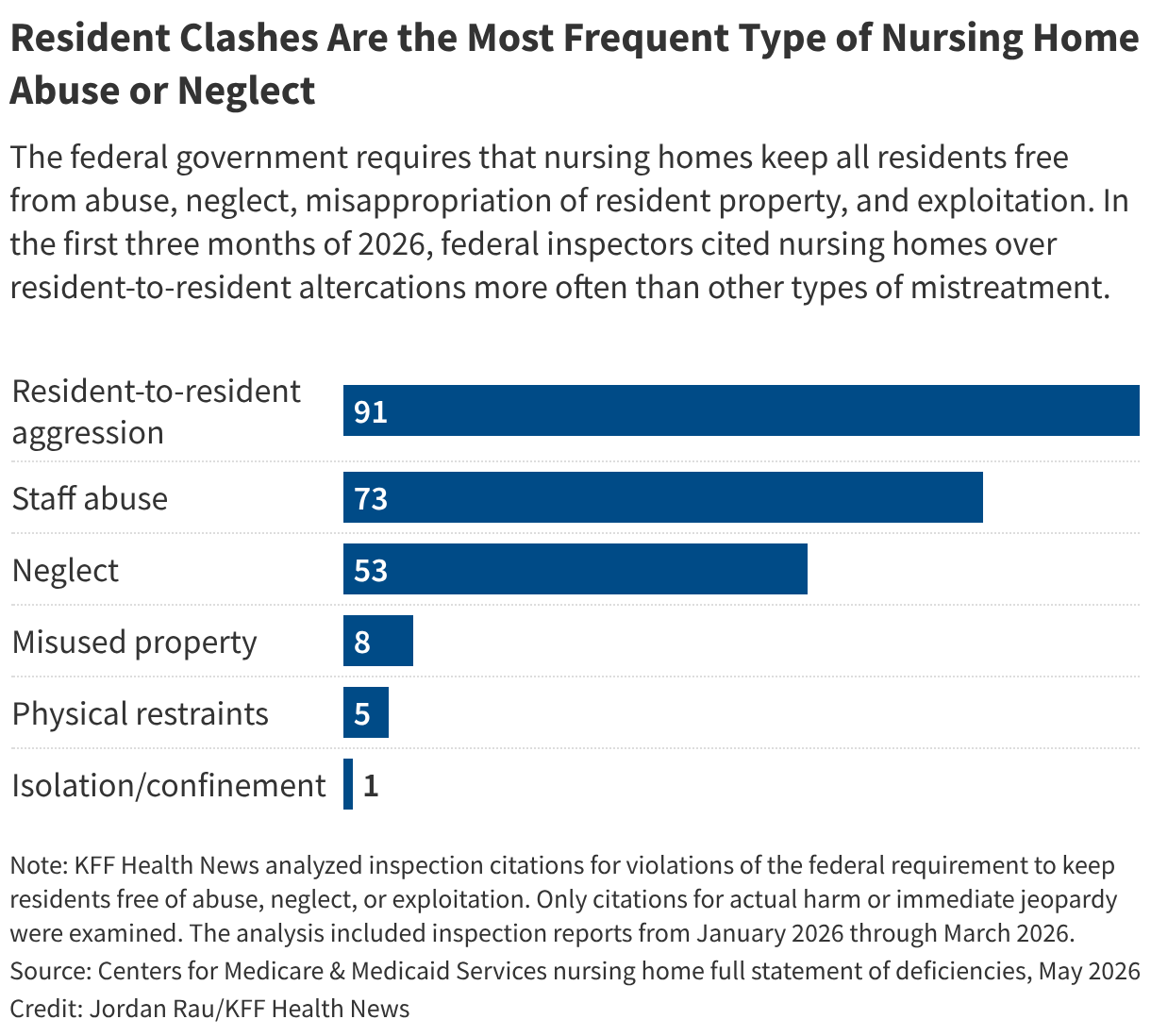
In the first three months of this year, CMS cited nursing homes more often for resident-to-resident abuse than for any other type of abuse, neglect, or exploitation, including abuse by employees, the reports show.
The long-term care industry says not every clash can be averted. Presbyterian Homes & Services, a nonprofit Christian chain of senior living facilities, said in a statement: ���Caring for individuals living with advanced dementia is complex, and behaviors can change in ways that are difficult to fully predict or prevent, even with clinical interventions in place.���
Eilon Caspi, a and researcher who studies resident-on-resident altercations, said that usually there is a specific unmet need that precedes an altercation. ���In the vast majority of incidents,��� he said, ���there are warning signs in the months, weeks, days, hours, and sometimes minutes and seconds prior.���
Fertile Battlegrounds
One about Alzheimer���s, the most common dementia disease, holds that as the brain���s networks deteriorate, the balance shifts between the prefrontal cortex, which helps govern judgment and self-control, and limbic regions including the amygdala, which helps process fear and threat responses.
As cognition clouds, people lose the ability to understand what is happening around them and to put distress into words, researchers say. Pain, infection, medication side effects, and other physical and emotional distresses through shouting, intimidating gestures, kicking, pushing, or punching. Long-term care facilities can be triggering environments, with intimate care often delivered by a changing stream of aides whom residents can���t recognize. Amid noise, close quarters, and rigid routines, interactions become flash points.
���You don’t feel safe, because you don’t know these strangers who are coming in and taking off your clothes,��� said Al Power, a geriatrician and an advocate for alternative models of care for people with cognitive issues. ���These things will be distressing to anybody.���

The Cornell researchers found verbal altercations were the most common type of aggressive interaction but estimated 4% of assisted living residents and 5% of nursing home residents in their studies experienced physical assaults in a month.
Another Cornell study found that Connecticut police were called to nursing homes for more often than allegations of staff abuse, theft, and residents wandering away without supervision combined. A national analysis of survey data from the Centers for Disease Control and Prevention calculated in assisted living facilities engaged in physical aggression or abuse toward other residents or staff members.
Many of the physical aggressions 窪蹋勛圖厙 News identified in CMS inspection reports were perpetrated by residents with diagnoses of dementia, schizophrenia, or other cognitive disorders. In some physical altercations, both residents were aggressors, while other fights were one-sided. Sometimes the residents were roommates.
Laura Mosqueda, a geriatrician at the University of Southern California���s Keck Medicine in Los Angeles and a senior adviser to the National Center on Elder Abuse, said: ���What worries me is that we just end up blaming two people who have either cognitive impairment or severe, uncontrolled mental health issues, when they���re supposed to be in an environment where people are safe.���
���Only a Matter of Time���
Gladys Lynch, a retired department store accountant, transferred into the memory care unit at Harbor Crossing in White Bear Lake, Minnesota, in September 2025. Her monthly cost was more than $10,000, according to an invoice provided by the family.
One of Lynch���s daughters, Rebecca Norton, installed web cameras in her room and often saw another resident inside. ���Every day I looked at it, this woman would be walking into my mom���s room, harassing her, digging through her things, using her bathroom, yelling at her,��� Norton said in an interview. She informed Harbor Crossing���s administration, and the facility said it would start locking her mother���s door.
Norton emailed a Harbor Crossing administrator a list of issues with her mother���s care. ���My biggest concern,��� she wrote, was that her mother���s door was not consistently locked and the webcam showed the woman had again entered, rummaged through the bathroom, and taken a couple of adult diapers.

Unknown to Norton, Harbor aides had raised concerns about the other resident, who like Lynch was new to Harbor Crossing���s memory unit, according to a . Diagnosed with Alzheimer���s, severe dementia with agitation, depression, and anxiety, the woman was confused, had difficulty communicating her needs, and hit aides.
Aides repeatedly reported that the woman had ���ongoing aggression, entered other residents��� apartments, invaded others��� personal space, and was difficult to redirect,��� the health report said. They said medications had been ineffective and pressed for new ones. The report said one nurse told the woman���s doctor it was ���only a matter of time before��� she ���hurts another resident.���
Captured on Camera
On the last day of September, she entered Lynch���s room and resisted leaving, the state report said. The next morning, she reappeared. Video of the incident was described in the police and state reports and reviewed by 窪蹋勛圖厙 News. It shows Lynch guided the woman out and appeared to attempt to lock the door, but the woman opened it and returned once more.
The woman declared it was her house, went into Lynch���s bathroom, used the toilet, and then returned to the room Lynch was in. Lynch can be seen repeatedly pressing the alert pendant around her neck to signal nurses for help.
The video shows the woman was almost out of her apartment door when she attempted to touch an object near the door. Lynch put her hands up to block her. The woman slapped at her hands and said, ���I���m going to kill you if you don���t quit it.��� She pushed Lynch, who fell, her head hitting the floor and blood seeping out.
Aides arrived 13 minutes after she had initially pressed her pendant, the state report said. Lynch suffered a brain hemorrhage and fractures to her eye socket and ribs, according to the state report. She died in the hospital five days later at age 96; the medical examiner���s office declared it a homicide.
Norton said her mother was kind and pleasant and never combative. ���My mom deserved better than what they gave her,��� she said.

Prosecutors declined to bring charges, according to the police report. The Harbor Crossing was responsible for neglect because it was aware the woman ���exhibited violent and aggressive behaviors��� and yet had failed to put in place effective interventions. Harbor Crossing has requested the state reconsider its findings.
In June, Suzanne Scheller, the attorney for Lynch���s family, filed a wrongful death lawsuit against Presbyterian Homes, which owns Harbor Crossing.
Presbyterian said in a statement: ���We are deeply saddened by the loss of Ms. Lynch, and our thoughts remain with her family and all those impacted.��� It declined to comment further on the incident or the lawsuit.

Preventive Tactics
Geriatricians, researchers, and resident advocates say long-term care homes should to reduce the risk of altercations, including closer supervision of residents at high risk, relocating them closer to nursing stations, separating residents with repeated conflicts, and adjusting roommate assignments or seating in shared spaces.
Each resident should have a care plan, and homes should train staff to be alert to a resident���s triggers and intervene quickly, dementia specialists say. Organized activities are essential to keep residents occupied and engaged. Antipsychotics and other psychotropic medications are often prescribed, but they can increase the risk of falls, strokes, and .
An aide can be assigned to watch a particularly challenging resident one-on-one, but many places lack enough staff for protracted, dedicated supervision. Some assisted living facilities will tell a resident���s family they must hire a personal aide, who can cost thousands of dollars extra each month. In extreme situations, facilities might send a resident to an emergency room for evaluation or to a psychiatric hospital, or .
Camille Russell, who served as Kansas��� long-term care ombudsman until 2024, said she observed nurses and aides were often ���woefully undertrained��� in basic elements of dementia care.
���We���ve gotten too far away from making decisions that are caring decisions,��� Russell said. ���There has to be a balance, and the balance has gotten too far to the profit side.���
A Debilitating Kick
Many physical altercations between residents result in a scratch or a bruise, but nonfatal scraps can leave permanent damage on deeply frail residents.
Linda Twiddy���s first weeks in a Chesapeake, Virginia, memory care unit in August 2024 were happy, her daughter, Barbara Howerin, said in a May interview. Twiddy, a former church secretary with vascular dementia, sang along with a visiting church choir, decorated pumpkins, and visited a cat cafe. The facility, The Vero at Chesapeake, charged Twiddy a one-time $6,825 move-in fee and monthly charges of $7,475, according to the lease.
Seven weeks after Twiddy started living there, a nurse called Howerin. She told her that her mother had been kicked in an altercation with another resident and was being sent to the hospital.
When Howerin arrived at the hospital, she was shocked by the extent of the injury. ���It was like 10 inches long by 6 inches wide, the whole front of her shin,��� she said. ���The calf was just like dangling down.���
According to an internal facility incident report the family obtained, an aide heard Twiddy scream for help and raced over to see a male resident with dementia trying to hit Twiddy as she sat on the floor in ���a pool of blood.��� The report said, ���Linda was screaming get him away from me, he pushed and kicked me.���
The man had prior episodes of aggression, according to documents Twiddy���s family obtained in a lawsuit they brought against The Vero in Chesapeake Circuit Court. At his previous facility, a progress note from 2023 stated, he was ���becoming very aggressive in tone and actions to residents and staff.��� He ���grabbed another resident by the wrists and pushed her,��� according to the note. He was sent to an emergency room for evaluation of agitation, according to a hospital report. It did not make clear whether he was discharged back to the facility or elsewhere.
Agitation Tied to Pain
The male resident���s medical records at The Vero said he was diagnosed with late-onset Alzheimer���s disease, agitation, and anxiety, according to his doctor���s deposition. He had chronic pain in his back and trouble sleeping. He could answer simple yes-or-no questions but had trouble providing more extensive answers and couldn���t communicate that he was in pain, she testified. His behavioral changes usually occurred when he had a urinary tract infection, the doctor said.
When he was agitated, aides could sometimes calm him by turning on the television so he could watch his beloved New England Patriots, one aide testified in a deposition. A former aide said she tried to avoid dealing with him altogether. ���If you go up to him and he was agitated, he���d reach out to try to grab you,��� she testified. ���If he had that cane, he would swing that cane or he would punch at you.���
In a court filing, The Vero denied allegations by Twiddy���s family that it should have protected residents from him. The filing said The Vero complied with all standards of care and that any injuries Twiddy sustained ���were caused by her own negligence��� or acts of others.
In their investigation of the incident, Virginia regulators alleged The Vero had for the health, safety, and well-being of its residents. The inspection report said The Vero pledged to appropriately staff the memory care unit based on the number of residents and to ensure someone completed rounds at least every two hours during sleeping hours.
Twiddy underwent three surgeries at the hospital for her leg, including a skin graft, then spent a month in rehabilitation. ���She was never able to walk again,��� her son, Doug Twiddy, said in a May interview.
The family moved Linda Twiddy to a different memory care facility where the nursing station had a clear view of all the rooms. She lived there until her death earlier this year.
The lawsuit was settled on confidential terms in early June. Carlton Bennett, the family���s attorney, declined to comment. In an email, Lauren Rogers, a spokesperson for Sinceri Senior Living, which operates The Vero, said the company was pleased the legal case had been resolved but could not comment further, citing confidentiality and patient privacy.
���The Vero at Chesapeake is committed to providing a caring, supportive environment where resident health, safety, and well-being remain our highest priorities,��� she said.
A History of Violence
After Attilio Cecchetto was fatally bludgeoned at Sunrise Post Acute, his adult children and their attorney, Jody Moore, discovered disturbing details about Sam Ato Timaloa. He had been imprisoned in 1999 after being convicted of raping an underage girl and sentenced in 2008 to 24 years in prison for attempted murder involving domestic violence, according to Riverside County court records. His public defender declined to comment.
Cecchetto���s sons, Moore, and her colleagues at Moore Hutchins Moore also learned more about the home���s owner, PACS Group, a publicly traded company with more than 300 long-term care facilities. Last year, PACS earned $191 million on revenue of $5.3 billion, according to its .
In the Cecchettos and their father���s widow filed against PACS, they accused the company���s founders, Jason Murray and Mark Hancock, of draining resources from their nursing homes to pay for the chain���s expansion and swell their personal wealth.
The two had earned more than $650 million through stock sales since taking the company public and bought two private luxury jets, according to the lawsuit and securities filings. PACS has also purchased corporate sponsorships for Utah sports teams even though it owns no nursing homes in the state, the lawsuit said.

California regulators fined Sunrise $120,000 for Cecchetto and for not taking Timaloa���s articulated dislike of noise into account when assigning rooms. Medicare issued its own $62,810 fine.
In responding to the Cecchettos��� lawsuit, PACS denied negligence for his death and alleged he ���failed to exercise ordinary care on his own behalf for his own safety.��� It has sued to overturn the $120,000 state fine, saying it was issued too late and that Sunrise ���did what might reasonably be expected of a long-term health care facility licensee acting under similar circumstances��� to comply with state rules.
The Cecchettos��� lawsuit asks for a judge to impose robust procedures PACS homes must follow for admissions, staff training, room changes, and the reporting of altercations between residents. The suit asks for a court-appointed monitor to oversee compliance. In its written statement to 窪蹋勛圖厙 News, PACS said ���important context��� would come out during the process and declined further comment.
In an interview, Cecchetto���s three sons, Dino, Gino, and Marco Cecchetto, described their father���s life. He spent his childhood on a farm in Italy, growing up under Benito Mussolini. After World War II he moved to Canada, where he learned to tile and lay marble and terrazzo, a decorative flooring material made of chips of stone, glass, or other materials embedded in cement or resin. He relocated to California in the early 1960s, became naturalized, and worked as a tile journeyman and a contractor for decades.
���We don���t want this to happen to somebody again,��� Gino Cecchetto said. ���With the life he led, he deserved a quiet, dignified death. Instead, he ended his life in pain and fear.���
Data Methodology
窪蹋勛圖厙 News��� analysis of federal nursing home inspection reports focused on citations for violations of stating that each resident has the right to be free of abuse, neglect, and exploitation.
The analysis looked at the most serious levels of citations, those in which inspectors determined that one or more residents had been harmed, or that the facility���s actions caused ��� or were likely to place residents in immediate jeopardy of ��� serious injury, harm, impairment, or death. We reviewed the reports since January 2024 and tallied those that explicitly described resident-to-resident altercations.
We conducted a more granular analysis of a subset of the inspection reports from January through March 2026 involving harm or immediate jeopardy. Each report was reviewed and categorized by the type of abuse, neglect, or exploitation.


