
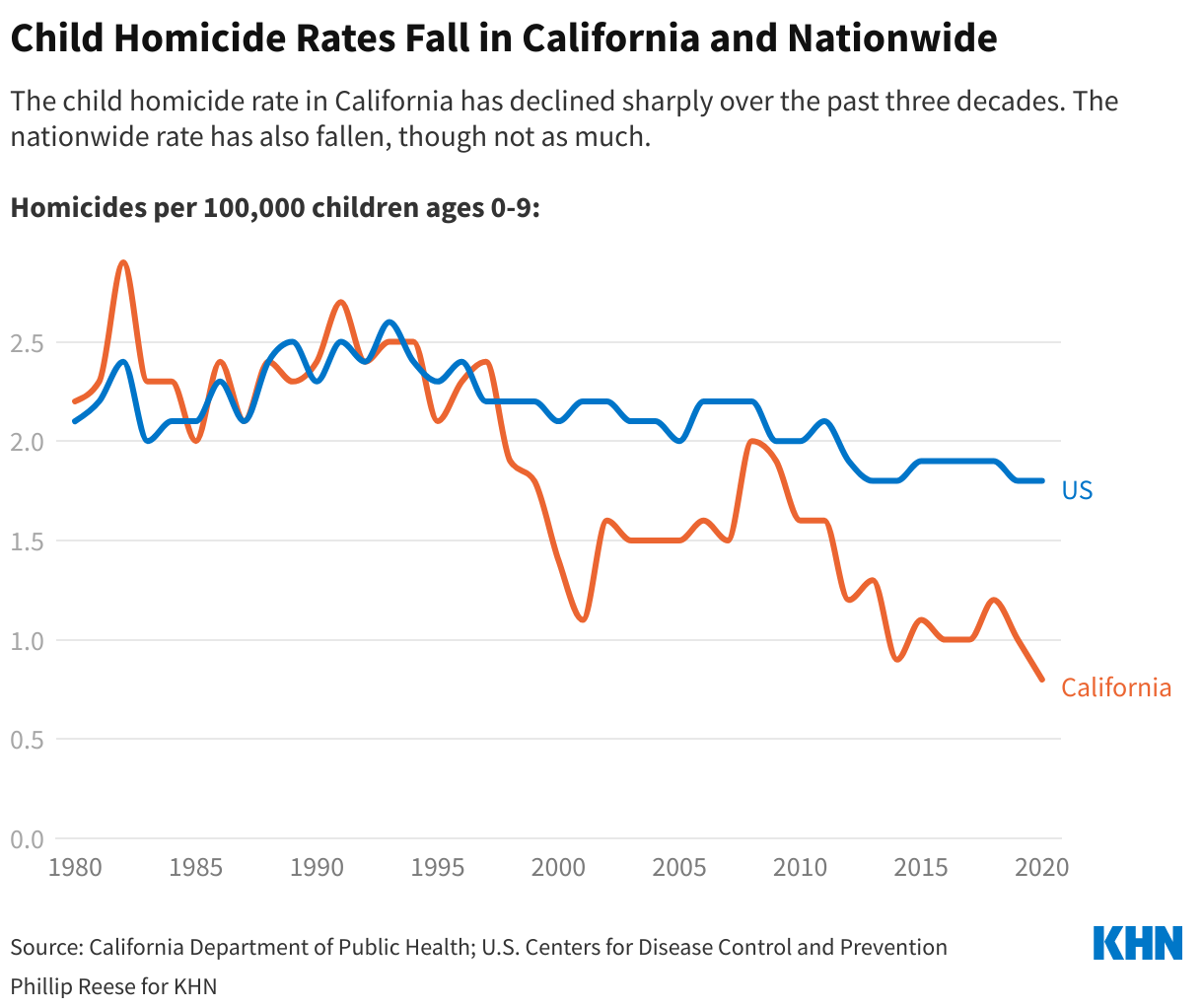
The stunning climb in homicide rates in recent years in California and big cities across the nation obscures a remarkably good-news trend involving young children: The number of child homicide victims fell dramatically in California over the past decade, the latest death certificate data shows, a pattern mirrored to a lesser extent nationwide.
In 1991, California鈥檚 coroners officially classified 133 deaths of children ages 9 and younger as homicides. By 2011, that figure had fallen to 81.
In 2020, it stood at 40.
Adjusted for population changes, the state鈥檚 child homicide rate 鈥� the number of homicides per 100,000 children ages 0 to 9 鈥� dropped about 50% from 2011 to 2020 and is down about 70% from three decades earlier, according to data from the U.S. Centers for Disease Control and Prevention and the California Department of Public Health.
Nationwide, the child homicide rate fell 14% over the past decade and 28% from three decades earlier.
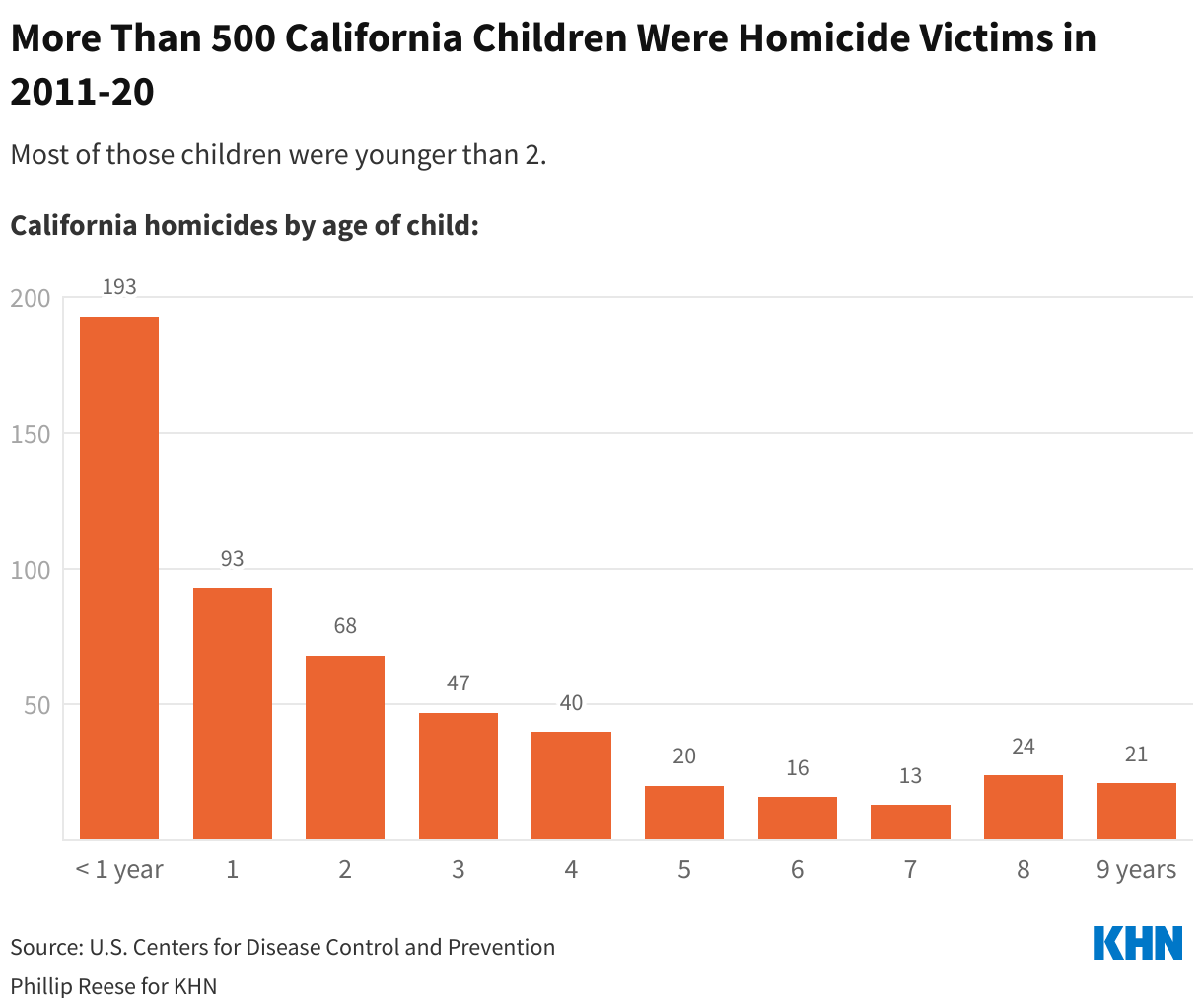
Most child homicides involve newborns, infants, and young toddlers. , executive director of the Los Angeles County Inter-Agency Council on Child Abuse and Neglect, noted that laws came online in California and many other states around 2001. Enacted in response to a spate of infant abandonments, these laws allow parents to confidentially surrender an infant 3 days old or younger without fear of prosecution.
More than 1,000 California infants have been safely surrendered since the law went into effect, according to the California Department of Social Services. The number of infants found recklessly abandoned statewide fell from an average of 18 a year from 2001 through 2005 to an average of two a year from 2015 through 2019. And the number of abandoned babies who died went from 52 in 2001-05 to zero in 2015-19.
鈥淪afe surrender has clearly made a difference,鈥� Tilton Durfee said. 鈥淲e show an absolute correlation between the declining number of child homicides and the rising number of safe surrenders. I mean, it鈥檚 not equal, it鈥檚 not exact, but clearly since we started, we saw the number of child homicides by abandonment decline.鈥�
Better access to family planning services may also play a role in the decline of child homicides as people give birth to fewer unwanted babies. The birth rate 鈥� births per 1,000 women 鈥� in California and nationwide has plummeted over the past three decades, and women are, on average, waiting until they are older and more mature to give birth. Although fathers or boyfriends kill children significantly more often than mothers, Tilton Durfee said data collected in Los Angeles County shows a correlation between the age of the mother and child homicides: Older mothers kill children less often.
Some child welfare experts pointed to an association between declining child homicide rates and increased access to abortion.
Although news coverage is painfully rife with stories of child victims who fell through the cracks of overwhelmed social service agencies, experts interviewed by KHN said that the social safety net is stronger overall in California now than it was in earlier decades and that early intervention with at-risk families has made a difference.
Various agencies 鈥� law enforcement, social services, hospitals, nonprofit community groups 鈥� seek to prevent child homicides. Child safety advocates said many California counties have worked in recent years to improve communication among those groups so they know when a child may be at risk for homicide.
鈥淭hey are more apt to do something with what they know and involve each other,鈥� said Dr. Michael Durfee, who helped start the nation鈥檚 first multiagency 鈥渃hild death review team鈥� in Los Angeles County in 1978.
Organizations like and state agencies like the Department of Social Services have also started several home-visitation programs for parents of newborns. 鈥淚 think home visitation has made a big difference,鈥� said Tilton Durfee. She said the programs provide 鈥渟ome eyes and ears and support inside the home to see how safe the child is or to help the stressed parent.鈥�
Other advocates credited advances in early diagnoses and support services for children with disabilities, who historically have been than other children to be victimized.
鈥淲e鈥檙e screening, and so now we鈥檙e starting to identify those things and make changes early on,鈥� said Sheila Boxley, president and CEO of the statewide Child Abuse Prevention Center.

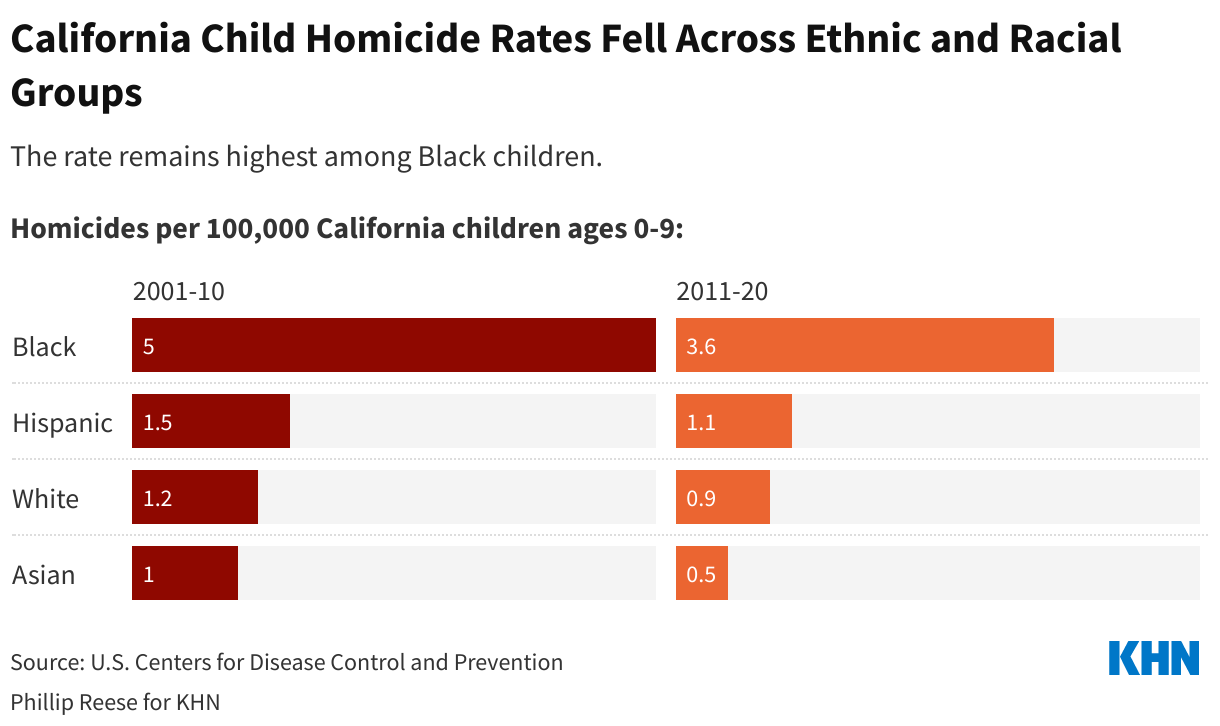
The decline in California鈥檚 child homicide rates held true across race and ethnicity 鈥� but didn鈥檛 erase disturbing disparities. The rate of homicides involving young Black children from 2011 through 2020 was more than three times as high as the rate for white and Hispanic children and about seven times as high as the rate for Asian children.
Tilton Durfee blamed long-standing systemic racism. She said the factors often at play in families in which a young child is killed 鈥� unemployment, substance misuse, mental illness, domestic violence 鈥� are statistically more likely in the African American community.
Determining when a child鈥檚 death is a homicide is often difficult. Several datasets try to capture the extent of the problem. The death certificate data used for this story is based on coroners鈥� cause-of-death determinations.
Kimberly Gin, the Sacramento County coroner and president of the California State Coroners Association, said coroners have used the same standard for decades when determining whether a death is the result of homicide. A homicide occurs as a result of a willful act 鈥渃ommitted by another person to cause fear, harm, or death,鈥� according to the National Association of Medical Examiners.
鈥淪ome are easy: If a child is shot, it鈥檚 a homicide,鈥� Gin said. 鈥淭he drug overdoses or if it looks like it may be an accident 鈥� sometimes it isn鈥檛 as clear.鈥�
A from the California Department of Justice collects information directly from law enforcement agencies about deaths designated by those agencies as homicides, including the age of victims. For most age groups, the information reported by law enforcement investigators matches a coroner鈥檚 final cause-of-death determination. But when the victims are very young, records show broader discrepancies between the initial assessment by law enforcement agencies and the coroner鈥檚 final determination.
The state DOJ dataset consistently shows more California homicides for children ages 0 to 9 than the death certificate data does: 13 more homicides in 2020, for instance. However, like the death certificate data, it shows a significant decline in the child homicide rate: a 70% decline since 1991 and a 28% decline since 2011.

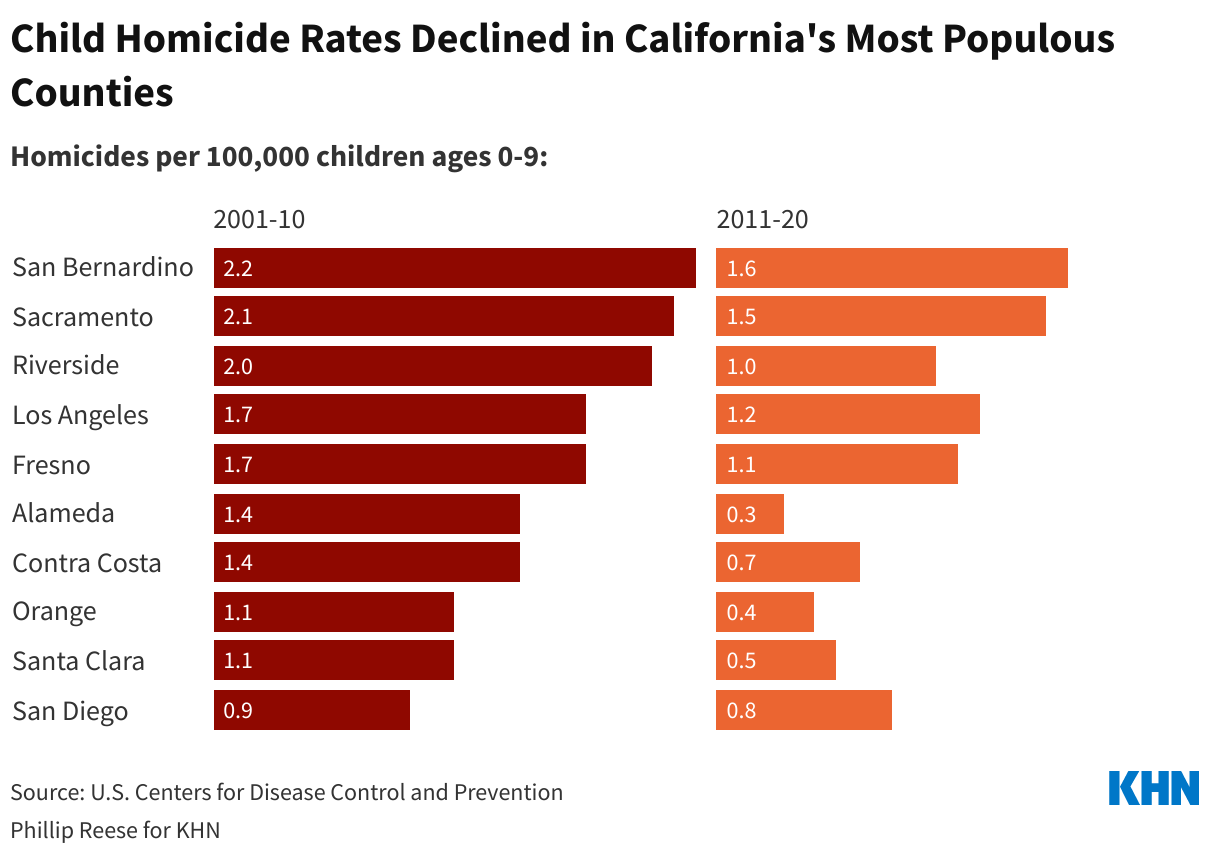
The decline in child homicides continued during the first year of the pandemic, even as homicides surged for many other age groups, according to both death certificate and state DOJ figures. Preliminary figures show further declines in 2021, but Gin, the Sacramento County coroner, called those numbers 鈥渋ffy鈥� because investigations into child deaths from last year may be ongoing.
Tilton Durfee supports several measures that she says would keep the child homicide rate falling. She called for improvements to mental health care for parents of newborns. She said more programs are needed to prepare pregnant parents for the challenges they will face. She expressed support for pending legislation that would reestablish a state child death review council to identify trends and disparities in child deaths. And she said insurance companies and public agencies should start covering the costs of home visits to support new parents.
鈥淲e are very shy of having the level of home visitation that could make the dent that is possible,鈥� she said, 鈥減articularly with these young children.鈥�
Phillip Reese is a data reporting specialist and an assistant professor of journalism at California State University-Sacramento.
This story was produced by , which publishes , an editorially independent service of the .