California To Drug Users: We鈥檒l Pay For You To Test Your Dope


Michael Marquesen, executive director of the Los Angeles Community Health Project, helps run a needle exchange program out of a white van in the Skid Row neighborhood every Monday morning. (Pauline Bartolone/KHN)
Listen here to Pauline Bartolone鈥檚 radio version of this story, which first ran on .
Can鈥檛 see the audio player?
Michael Marquesen first noticed about a year ago that fentanyl, a dangerous synthetic opioid, had hit the streets of Los Angeles. People suddenly started overdosing after they shot up a new white powder that dealers promised would give them a powerful high.
鈥淚n Hollywood, they鈥檙e like 鈥楨verybody鈥檚 dropping 鈥� everybody鈥檚 overdosing!鈥欌�� said Marquesen, director of the Los Angeles Community Health Project, which provides support services for people dealing with drug addiction.
The white powder was easily distinguishable from the black, tar-like heroin that is common in California, and users initially believed it was high-end heroin. But it was fentanyl 鈥� than heroin 鈥� said Marquesen, whose group runs a mobile needle exchange out of a white van, serving drug users all over the city.

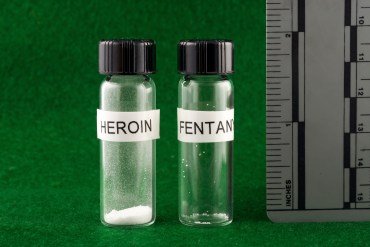
A lethal dose of heroin compared to a lethal dose of fentanyl (Bruce A. Taylor-Criminalist II/NH State Police Forensic Lab)
The deadly fentanyl wave sweeping the East Coast and the Midwest has arrived in California. The number of deaths from fentanyl in the state, though still a fraction of those seen in some other states, has spiked in recent years. And state health officials have responded with a proactive but experimental policy: Since last May, they have supplied needle exchanges with rapid-response test strips that allow drug users to determine if their next high is contaminated with the potentially fatal opioid.
It鈥檚 hard for drug users to know exactly what is mixed into their supply, because dealers don鈥檛 tell them 鈥� and often don鈥檛 know themselves. Needle exchange workers say the strips have revealed the presence of fentanyl not only in white powder form but also as an additive to black-tar heroin and even in such non-opioids as methamphetamine and crack/cocaine.
Officials hope that if people know the dangers lurking in their stash, they鈥檒l be more careful to protect themselves from accidental overdoses.
The idea of to test for fentanyl started at a publicly funded needle exchange in Vancouver, British Columbia. The state of New York also makes public money available for needle exchanges to buy the test strips. Eight New York exchanges, a third of the total, supply them to drug users, according to the state鈥檚 public health agency.
Last fall, Marquesen鈥檚 needle exchange started handing them out from the white van, along with a brief lesson on how to use them. Eleven California needle exchanges, from Eureka to Santa Barbara, have ordered the strips so far, state officials said.
Kelly, a 44-year-old heroin user in Los Angeles who withheld her last name because her family doesn鈥檛 know about her addiction, supports the use of test strips. She nearly died from an overdose of heroin, which she later learned had been spiked with fentanyl.
鈥淭here鈥檚 dealers who are trying to make their stuff better because it鈥檚 garbage,鈥� said Kelly. Those dealers don鈥檛 tell their customers about the fentanyl in their drugs, she said, and that puts them at grave risk.
Fentanyl and other synthetic opioids killed 324 people in California in 2016, a jump of nearly 50 percent from 2015 and more than double the toll of five years earlier, according to preliminary data from the California Department of Public Health. The most recent spike is attributable to fentanyl, which accounted for almost three-quarters of those 2016 deaths, the department said.
The California figures still pale in comparison with other states. In New York, almost 1,100 people lost their lives to fentanyl and other synthetic opioids in 2016, twice as many as a year earlier, according to the U.S. Centers for Disease Control and Prevention. In the much smaller state of Maryland, were fentanyl-related in 2016, more than triple the number of the previous year, according to that state鈥檚 health department.
In Ohio, nearly 2,500 died from fentanyl and related opioids in 2016, double the number of the year before.
Accidental overdoses involving fentanyl were blamed in the deaths of both Prince in 2016 and Tom Petty in October.


Eliza Wheeler (left), an overdose response strategist with the Harm Reduction Coalition, helps run a syringe exchange for intravenous drug users on a Thursday night in San Francisco鈥檚 Mission District. (Pauline Bartolone/KHN)

Wheeler says drug users are more likely to take precautions because of the test strips. Needle exchange participants report using less of the drug or getting high with others, she says. (Pauline Bartolone/KHN)
In San Francisco, needle exchange workers and users say the ability to test drugs has changed behavior.
鈥淧eople are much more cautious if they know there鈥檚 fentanyl in it,鈥� said Patty, who didn鈥檛 want to give her last name because of her heroin and crack use. 鈥淗onestly, nobody wants to die.鈥�
But some experts urge caution in using test strips, noting the strategy is still experimental.
Sold for a dollar apiece by BTNX Inc., a Canadian company, .they are designed to test urine and have not been approved by the U.S. Food and Drug Administration for use on drug samples, a BTNX spokesman said.
Dr. Karen Mark, chief of the California public health department鈥檚 Office of AIDS, said all the evidence suggests that the strips effectively detect fentanyl.
But Dr. Dan Ciccarone, a professor at the University of California-San Francisco who researches drug abuse, noted that the strips show only whether a sample contains fentanyl, not how much 鈥� so there鈥檚 no way to know if it鈥檚 a deadly dose. The strips are also too sensitive and could be yielding false positives, he said. That may not be such a bad thing per se, he said, but drug users might stop using them after a series of positives.
Despite reservations, many experts say the severity of the opioid epidemic justifies California鈥檚 unproven approach.
鈥淭he crisis situation that we find ourselves in 鈥� definitely calls for a lot of nimble and innovative responses,鈥� said Leo Beletsky, associate professor of law and health sciences at Northeastern University in Boston. 鈥淲e鈥檙e going to see more fentanyl in our drug supply in coming years.鈥�
This story was produced by聽, which publishes聽, an editorially independent service of the聽.