Carmen Smith remembers the day about a year ago she gained Medicaid coverage.
鈥淚t was like Christmas Day, it was like getting a gift from Santa Claus!鈥� she says. 鈥淧eople don鈥檛 realize how important and how special it is to have insurance to be able to go see a doctor on a regular basis when you have an illness like mine.鈥�
Smith has Type 2 diabetes. Before qualifying for Medicaid coverage, she was what policy experts call a 鈥渇requent flier.鈥� She had used the emergency room five times in one year.
She bought insulin over the counter, guessed at her dosage and frequently got sick.

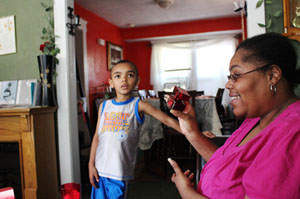
Carmen Smith is controlling her diabetes 鈥� and steering clear of the emergency room 鈥� since she got Medicaid through a Cleveland health initiative (Sarah Jane Tribble/WCPN).
鈥淚 remember one instance when my sugars were up and I felt like I was having a heart attack. So it was like heart palpitations. And I ended up staying in the emergency room鈥檚 24-hour observation department,鈥� Smith says.
That kind of triage care is expensive. Smith couldn鈥檛 pay the bills but she made too much to qualify for Medicaid.
Enter MetroHealth 鈥� a public hospital based in Cleveland. For years, the facility struggled to cover the costs of patients like Smith.
So long before Ohio expanded Medicaid, the hospital redirected more than $30 million from Cuyahoga County taxpayers to create its very own Medicaid program for residents.
Here鈥檚 how it worked: MetroHealth used extensive electronic medical records to carefully select uninsured patients and sent 28,000 of them Medicaid cards before they even applied. Then, the hospital gave highly personalized attention to some patients and kept track of them.
The results from the first nine months are in, said , a researcher at MetroHealth.
鈥淎ll of the clinical outcomes are really amazing,鈥� he says.
Cebul says they focused on a subset of 18,000 patients like Smith who came to the hospital a lot.
鈥淭he diabetes outcomes were probably the most impressive,鈥� Cebul says. 鈥淭he sugar control, the blood pressure control, the lipid control, virtually everything was much better and dramatically so.鈥�
The hospital also assigns each patient a nurse. That nurse books their appointments, calls them if they miss one and checks to make sure they took their medications.
In nine months, emergency department visits dropped 60 percent and primary care visits went up 50 percent.
The hospital also ended up spending less than it budgeted, saving an average of $150 on each patient every month.
鈥淏etter care, better outcomes, better costs,鈥� Cebul says.
Outside of Cleveland, a handful of cities and states expanded Medicaid earlier than the rest of the nation. But results haven鈥檛 always been so promising.
In Oregon, for example, emergency department use when patients got Medicaid, not down.
They ran their experiment differently, essentially giving Medicaid coverage on a random basis while leaving others uninsured. And they didn鈥檛 do any of the oversight that Cleveland did. (A subsequent to coordinate care in Oregon has achieved promising early results.)
Matt Salo leads the National Association of Medicaid Directors. He says no one program will have all the answers. Instead, at a time when health reform is changing the way patients everywhere are treated, Salo says, there鈥檚 a lot at stake in trying to figure out what works.
鈥淵ou know we鈥檝e got 50-plus states who are out there actively trying to steal best practices and good ideas and reform principals from other states,鈥� he says.
But Carmen Smith knows this is working for her. She recalls how before getting Medicaid she was using a scooter to shop at Wal-Mart. Now, she鈥檚 rides her bike to get around town.
鈥淚鈥檓 really excited 鈥檆ause I鈥檓 doing a good job. I feel so good about myself. I get off my bike and I鈥檓 like out of breath. I鈥檓 not tired.鈥� Smith says.
She says she can鈥檛 wait to call her nurse and talk about blood sugar levels.