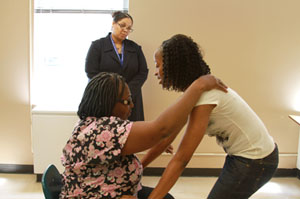
Francess Sillah helps to transfer Tanya Pittman out of an imaginary wheel chair while role playing during a group interview at Health Management Inc. Venus Ray, the agency’s executive director, looks on and assesses their skills to be a home health aide. (Photo by Jessica Marcy)
By the end of the session, Ray has dismissed 42 of the applicants, almost two-thirds, even though she’s in dire need of employees.
Ray is executive director of Health Management Inc., which employs about 410 people, including 395 home health aides. With business booming, she is constantly looking to hire more, and she holds group interviews once or twice a month.
“There’s a huge demand, and it’s only going to get larger as the years go by,” Ray said. With the nation’s aging population, she added, many people “will tell you that they are more comfortable in their home.”
The demand for workers by Ray’s company mirrors national trends and is fueled in part by stepped-up efforts to keep seniors and the disabled out of nursing homes. The growth is likely to pick up in coming years as the 2010 federal health law tries to reduce hospital readmissions and expands programs such as Money Follows the Person, which encourages Medicaid recipients to receive care at home.
Washington D.C. Area Requirements Vary
The area is a good example of how regulation of direct-care workers can really depend on geography.
- In Maryland, the Board of Nursing licenses all certified nursing assistants and home health aides. The state requires them to complete 100 hours of training. Those working in homes must also undergo an additional 12 hours of training annually, and pass a competency evaluation. They must also undergo a criminal background check. Although Maryland does not standards for personal care aires, some people hire companions to help with household chores, but they are not supposed to provide any care.
- Virginia requires that certified nurse assistants have 120 hours of training and that home health aides have the 75 hours specified by federal law. Personal care aides must have 40 hours of training if they work for a Medicaid agency. The state requires all employees of home health agencies to have a Virginia State Police check, which does not include fingerprinting.
- The District mandates that certified nursing assistants have 120 hours of training and that home health aides and personal care aides have 75 hours. People in all three professions also must receive 12 hours of annual training.
-Jessica Marcy
But experts warn that a shortage of qualified labor is looming. Workers often lack the training and support needed to properly care for patients, and poor working conditions lead to high turnover, experts say. In addition, : In 2009, the median national hourly wage for direct-care workersÌý– a term that includes home health aidesÌý– was $10.58, substantially below the $15.95 median for all U.S. workers. Nearly half lived in households that received food stamps, Medicaid or other government aid, according to , an advocacy group for direct-care workers.
In addition, experts say, regulations about training and background checks for direct-care workers vary across states, and often leave consumers without adequate protection.
“I see tremendous challenges on the care side and the consumer side,” said Peggy Powell, national director of curriculum and workforce development at PHI, which is based in New York. “My fear, my deep concern, is that in this quick switch [to provide care at home], there is the potential for care to get worse and for the direct-care workers’ job to get harder, with less support and training.”
A Growing Force
There are several types of direct-care workers, and their titles often vary:
- Certified nursing assistants provide basic clinical care such as taking blood pressure and caring for wounds. They also help with the activities of daily living such as eating, dressing and bathing. They usually work in nursing homes or assisted living facilities and have at least the 75 hours of training required by the federal government for positions at a Medicare- or Medicaid-certified facility.
- Home health aides provide similar care but in private homes and under the supervision of a nurse or therapist. If they’re employees of a home care agency, these aides also may need at least 75 hours of training because the federal requirement extends to agencies that serve Medicare and Medicaid patients.
- Personal care aides work in the home and help with everyday activities such as bathing and also perform light housekeeping and cooking chores. There are no federal requirements for their training, which is generally minimal. About a quarter of these workers are not employed by agencies, according to PHI.
In some states, certified nursing assistants and home health aides can administer medication, although some states require that they get extra training to do that. Personal care aides cannot.
 Ìý
Ìý
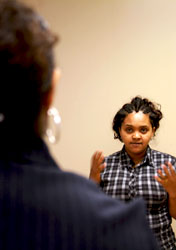
Hannah Asmare struggles to explain in English why she wants to be a home health aide to Venus Ray, executive director of Health Management Inc. Asmare was one of 65 applicants at the home health agency’s group interview process (Photo by Jessica Marcy).
More than 3.2 million people work in direct care, according to 2008 data from theÌýBureau of Labor Statistics. That is 52 percent more than in 1998. Jobs in direct care are to account for four of every 10 new health-care jobs between 2008 and 2018, according to PHI.
‘What’s Your Passion?’
Venus Ray begins her group interview by asking: “Why do you want to be a home health care worker? What’s your passion?”
Many describe caring for a loved one, while others say they have been drawn to the field by their deep religious faith. Latreaviette Stewart, 21, says she decided to become an aide after caring for her grandmother, great-aunts and her mother’s best friend, who recently died of breast cancer. She just completed a home health aide program at the Community College of the District of Columbia.
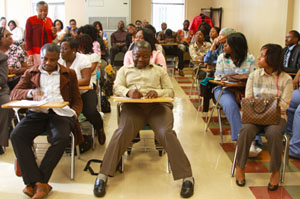
Pamela Nfor, a 34-year old aide from Cameroon who has a child with disabilities, describes why she wants to be a home health aides with Health Management Inc. during a group interview process (Photo by Jessica Marcy).
? Pamela Nfor, a 34-year-old aide from Cameroon who has a child with disabilities, says she enjoys seeing how clients, even those who are depressed and can’t go out, improve under her care. “I love the job and I hate the money,” she tells other applicants, who erupt in laughter.
Emotions run deep during the morning’s activities. One West African woman passionately describes how God revealed her vocation to be in home health care after she prayed intensely, while another woman nearly breaks into tears when she’s asked to leave after her cell phone goes off. Both women fail to pass the interview process.
Later, Ray said that she once had to dismiss an entire group of 12 applicants after all of their cell phones rang.
The applicants provide a visual snapshot of national trends. Direct-care workers are disproportionately minorities, and 23 percent are foreign-born. Almost 90 percent are female. The average age is 42, but the number of workers older than 55 is increasing rapidly, according to PHI.
To ensure a qualified workforce, experts say, it’s important to increase wages, improve training and beef up licensing requirements.
“It’s really important to figure out how to build career ladders for these workers so that they can advance and see this as a real career,” said Bob Konrad, a researcher at the University of North Carolina at Chapel Hill. “We have to turn these folks into really active and engaged people in the health policy world.”
ºÚÁϳԹÏÍø News is a national newsroom that produces in-depth journalism about health issues and is one of the core operating programs at KFF—an independent source of health policy research, polling, and journalism. Learn more about .
USE OUR CONTENT
This story can be republished for free (details).
]]>