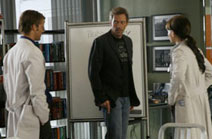

Pushing medical practice to the extreme may be the cost of keeping viewers hooked on Fox’s hit show, which dramatizes the diagnosis of rare maladies. But for patients treated in Mercer County, N.J., where House’s mythical hospital is located, that sequence of tests would likely tally charges of more than $9,200, according to NewChoiceHealth.com, a Web site that compares hospital charges, and MTBC, a physician billing company.
For most cases, doctors say, that style of “shotgun testing” — a barrage of seemingly random tests — would do little to help patients or lead to a diagnosis. And policymakers, as part of the health care debate, are talking up the importance of using medical know-how more judiciously and effectively to rein in costs.
Excerpt From The Episode
Dr. House: “Do an amylase, d-dimer, c-reactive protein, get a urine, and do a bronchial sputum while you’re at it. You, check his lab for radiation and toxins. And do a bone-marrow biopsy.”
Younger doctor: “All of that in twenty-four hours?”
House: “Nah, whatever you don’t get done, you can finish at the autopsy.”
But media analysts say medical dramas like “House,” as well as glowing news accounts of high-tech medicine, encourage patients to expect that the latest devices, drugs and other treatments will yield miraculous results. The downside of tests and treatments, such as their high costs and possible side effects, get less air time.
“There’s a real disjuncture between the model [for health care that] policymakers are trying to push compared to T.V.,” says Joe Turow, a professor at the University of Pennsylvania. Turow’s forthcoming book, an update to his 1989 volume “Playing Doctor,” will examine medical dramas from “Marcus Welby, M.D.,” which debuted in 1969, to “House” and “Grey’s Anatomy.” Television has consistently portrayed medicine as an unlimited resource, he says.
That message cuts against the one that President Barack Obama is trying to deliver: That the U.S. needs to save money by cutting unnecessary tests. Patients are “going to have to give up paying for things that don’t make them healthier,” he said during a July press conference. “I think that’s the kind of change you want.”
Yet some analysts suggest that what patients really want is medicine as practiced on TV. Advice such as “watchful waiting” does not make for good storylines, so some patients might resist a suggestion from a doctor to forego intensive tests and treatment for their illnesses.
David Foster, a Harvard-trained physician who is a “House” writer, points out that House’s patients, along with those in most other television shows, are frequently near death by the time they come under the care of their fictional doctors. “The conceit of our show is patients are dying,” he says. “That is an area where everybody agrees money should be spent.”
Researchers haven’t examined the influence of medical dramas on the use of health services, but studies indicate that television shows can affect viewers’ understanding and perceptions of situations. Vicky Rideout, a Kaiser Family Foundation researcher, found that an episode of “Grey’s Anatomy” quadrupled the percentage of regular viewers with accurate knowledge about HIV transmission during childbirth. The foundation provided the show’s writers with medical information about HIV transmission.
“It does have an effect,” Rideout says. “People do retain health information on T.V.” A decade-old foundation survey found that one-third of regular “E.R.” viewers said “information (from the show) helped them make choices about their own or their family’s health care.” (KHN is part of the foundation.)
But what if those choices are the wrong ones? Some information may encourage patients to seek care they don’t need. In “House,” the curmudgeonly doctor’s “interventionist bent” reinforces the attitude that “action is better than inaction,” says Andrew Holtz, the author of the “Medical Science of House, M.D.”
“The amount of information out there, the amount of media out there, the amount of attention to what can be done in health care, has persuaded everyone, including doctors, that more is better,” says Steven Davidson, an emergency room doctor at the 705-bed Maimonides Medical Center in Brooklyn.
The poster child for this phenomenon is “the kid who’s had a lick to his head,” and whose parents insist on a CT scan, he says. Most of the kids don’t need it. “They will do just fine with a brief period of observation,” he says. According to an article in the July edition of “Pediatrics,” evidence from earlier studies shows only a small percentage of scans on children with head injuries reveal information that doctors choose to act on. Meanwhile, the scans do have a downside: They can cost thousands of dollars and expose patients to excess radiation.
When Maimonides doctors decline to order services they thought were unnecessary, the hospital has sometimes received letters from patients complaining that they were denied care, Davidson says. The patients often report that other doctors were happy to provide the tests or treatments. “Patients and doctors have formed a kind of implicit conspiracy or cabal to test more and consequently to treat more,” Davidson says, noting that doctors can bill for a CT scan, but not for educating the patient about its risks.
Foster, the “House” writer, wonders, “Is it bad that patients come in and say, ‘I need a CT scan?’ It just takes more time to explain why you don’t need” it. Patients have been empowered by their greater access to information through media sources, while at the same time, doctors are finding themselves with less time to treat and educate patients, he argues.
“I hope that patients come away from watching our show thinking that they should be involved in the diagnostic process,” Foster says. Still, he adds, it is up to the doctors to supervise the medical care. “A patient may come in with a certain expectation. But the patient didn’t order the test.”
At his family practice in suburban Illinois, Dr. Scott Morrison, who also blogs about medicine on television and in comic books at politedissent.com , encounters such problems. One of his patients recently received a CT scan at a local emergency room that “revealed a small abnormality.” It was nothing to worry about, Morrison says, “but she became fixated on it. It took three visits before she finally agreed she didn’t need another” scan.
Foster responds that one way to deal with media hype is to change the financial incentives for doctors, who currently are rewarded for doing things. “Let’s pay money for talking” instead, he suggests.