Forty-year-old Jeremie Seals has had a tough life. He left home at 14, and he says, his health isn鈥檛 good. He had a heart attack when he was 35, he has congestive heart failure and nerve pain in his legs 鈥渞eal bad.鈥�

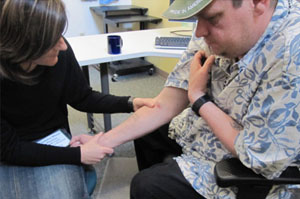
Jeremie Seals with Dr. Christina Milano (Photo by Kristian Foden-Vencil/Oregon Public Broadcasting)
鈥淟ong story short: I鈥檓 terminal,鈥� he says matter-of-factly.
Seals is unwilling to divulge too much about his past. But over the years, he says his health has deteriorated to such a degree, he can no longer hold a job. By 2011, he was sleeping in his car, and that鈥檚 when his medical problems started having a big financial impact.聽
鈥淚 basically lived at the emergency department,鈥� he said. 鈥淓ver since I鈥檇 had a heart attack, anytime my chest hurt, I鈥檇 either call the ambulance or go up to the hospital. and I think it was also out of desperation to just get out of my car and off the street.鈥�
That year, he visited the emergency department at Oregon Health & Science University in Portland 15 times and was admitted to the hospital 11 times.
And that鈥檚 what brought him to the attention of one of Oregon鈥檚 new coordinated care organizations (CCOs). As part of the nation鈥檚 health care overhaul, Oregon has been given permission to conduct聽. One way it鈥檚 trying to reduce Medicaid costs is to encourage people who constantly turn up at the Emergency Department 鈥� so-called 鈥榝requent flyers鈥� like Seals 鈥� to get their health care from regular doctors instead.聽
Lisa Pearlstein of , one of the CCOs, remembers her first meeting with Seals in 2011, when she began to guide him through the medical maze: 鈥淗e鈥檚 sitting in a chair and complaining about his feet being wet. And I said, 鈥榃hy are your feet wet?鈥� And he said, 鈥業 have holes in my shoes.鈥� And I said, 鈥榃ould you like a new pair of shoes?鈥� And so I ended up getting him a new pair of shoes that day. And so we connected over those shoes.鈥澛�
Seals remembers it well: 鈥淣ot only did she get me boots, but she got me a pillow and she got me a really awesome sleeping bag.鈥澛�
2011: 15 ER Visits, 2012: 4
Oregon鈥檚 health care experiment allows Pearlstein to help Seals and other Medicaid patients much like a family member might. She helped him schedule doctor appointments, and went with him to make sure he understood what he had to do. She also helped him get dialysis and take his medications correctly.聽
And importantly, she helped him with more everyday needs.聽
She made sure he had passes for the local community center 鈥� so he could shower. Eventually, she helped him negotiate a spot in adult foster care so he now has a roof over his head.聽
They built a rapport and now he trusts her, Seals says. But it didn鈥檛 come easily. 鈥淚 understood that Lisa was trying to help me. But at the same time I had a real hard time trusting anybody in the medical field.鈥� But, he says, Pearlstein helped him to be more communicative with his doctor and helped him explain his needs calmly and clearly.
His doctor, Christina Milano, says she鈥檚 seen an amazing change: 鈥淲hen he has the resources available to him and when housing had stabilized for him, he is actually wanting to be adherent to the medication.鈥�
With the intervention of Pearlstein and others, Seals鈥� ER visits dropped from 15 in 2011 to 4 in 2012. His hospital stays went from 11 to four in the same time period.聽
And that鈥檚 how the state can improve care and save money.聽
Rebecca Ramsey of , a nonprofit health plan for Medicare and Medicaid patients says 鈥淚t doesn鈥檛 take very many ED visits and it takes less than one hospital admission avoided, to actually more than pay for the time that Lisa spent with Jeremie.鈥�
Oregon has no formal numbers yet, but the federal government the state almost $2 billion and five years to show it can reduce the rate of medical inflation by two percent.
This story is part of a reporting partnership聽that includes聽,听, and Kaiser Health News.聽