

Last May, I wrote that offered tips for caregivers 鈥� without knowing that I would soon become one myself.
A few months later, my dad was rushed to the hospital for emergency surgery. Then came the cancer diagnosis. Now he鈥檚 enduring endless appointments, scans and blood draws, not to mention chemotherapy every two weeks, for three days at a time, administered at home through a portable pump.
Life changed overnight for him, for my mom, who became his full-time caregiver, and for me. I fly to Southern California every two weeks to help.
Armed with my laptop, I can usually work when I am down there. But sometimes I need to take a day 鈥� or just several hours 鈥� off. When I do, I get part of my salary reimbursed through California鈥檚 .
Many of you may not realize that you can take up to six weeks of paid leave in a 12-month period to bond with a new child or care for a sick loved one. Not all of it must be taken at once. You can break it into two or three chunks, or even single days 鈥� or hours 鈥� as I do.
Even many Californians who know about the program do not use it because of the onerous paperwork or the loss of their full salaries, experts say.
鈥淎s much as paid family leave is great, there are still some big lumps in the system for making it easily usable,鈥� says Leah Eskenazi, director of operations for the , a national group based in San Francisco.
Starting this month, the program addresses some of the obstacles: Now you can receive up to 70 percent of your pay, depending on your income, up from 55 percent. And the previously required seven-day waiting period is going away, which means your benefits can kick in on the first day you need them.
California鈥檚 Paid Family Leave program, the first in the country, took effect in 2004. It is funded by employees through payroll deductions 鈥� look for 鈥淐ASDI鈥� on your pay stubs.
You for the program if you work for an employer of any size, in the public or private sector, or even for yourself, so long as you have recently contributed to the program.
Since it began, some 2.65 million Californians have made about 2.8 million paid-leave claims. Nearly 90 percent of the claims were filed by mothers and fathers using the benefit to bond with new biological, adopted or foster children, according to the state鈥檚 Employment Development Department (EDD), which administers the program.
Fewer than one-eighth of the claims have been to care for seriously ill children, parents, parents-in-law, grandparents, grandchildren, spouses or registered domestic partners.
The new rules, which apply to claims effective on or after Jan. 1, increase the wage replacement to about 60 to 70 percent of your income, with low-income employees qualifying for the higher rate. You can plug your salary into the department鈥檚 at edd.ca.gov to see how much you would get.
Benefits max out at $1,216 a week.

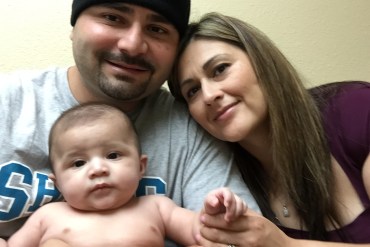
Danny Contreras and his wife, Claudia, wait in a doctor鈥檚 office with their son Danny Jr., who needed some shots. Contreras urges other dads to take paid family leave. 鈥淏e there for your kids. Be there for your wife,鈥� he tells them. (Courtesy of Danny Contreras)
Danny Contreras, 36, first heard about paid family leave when his oldest son, Joseph, affectionately known as 鈥淛ojo,鈥� was born in 2013. Contreras took six weeks, split into two periods, to bond with his new baby.
When his second son, Danny Jr., was born in 2016, he took three weeks.
Contreras thinks many dads don鈥檛 take paid leave because they don鈥檛 know about it, or because pride compels them to keep working.
鈥淚 tell everybody, especially fathers, 鈥楾ake advantage of it. Be there for your kids. Be there for your wife,鈥欌�� the Watsonville resident says. 鈥淭hat鈥檚 sacred time.鈥�
Most paid-leave claims are for bonding with a child because that鈥檚 an event you can typically plan for, says Donna Benton, director of the . Caregiving for an illness, on the other hand, may be less predictable, she says, and it may not be clear how long that role might last.
In 2015, the Family Caregiver Alliance asked 141 people who care for sick relatives about California鈥檚 paid-leave program. Only about 12 percent of those who were eligible used it, Eskenazi says.
Many didn鈥檛 even know the program existed, or that they didn鈥檛 have to take all six weeks off at once, she says.
Those who knew about it reported two major obstacles: insufficient wage replacement and a burdensome application.
鈥淪ome ended up 鈥� not even using paid family leave because it was too confusing,鈥� Eskenazi says.
I can attest that the paperwork is difficult and help hard to get. It is also frustrating to rely on 鈥� and wait for 鈥� doctors who must submit paperwork on your behalf.
The Employment Development Department is working to simplify the online application system, available at , says Loree Levy, a department spokeswoman.
It is also engaged in an outreach campaign to spread the word about the program, not only among employees, but also doctors, foster care agencies and others, she adds.
鈥淲e鈥檙e trying to make sure they have the information they need to help consumers,鈥� Levy says.
Awareness of the program is particularly low among low-income and immigrant families, says Jenya Cassidy, director of the , which advocates for programs that support working families.
If you need help with your application or benefits, you can try the program鈥檚 general phone number (877-238-4373). But I鈥檓 not a fan of the endless, automated phone tree that often leaves you stranded with a recording rather than a real person. You may have more luck with the department鈥檚 online troubleshooting form: .
In addition, , a national organization based in San Francisco, runs a (800-880-8047) that fields about 1,500 calls a year from workers seeking help with Paid Family Leave and other programs.
You can also find an , fact sheets and videos about paid leave at . Click on the 鈥渨orking families鈥� box on the home page to get there.
If you鈥檙e still stuck, try the California Work & Family Coalition at 510-473-2216.
And don鈥檛 forget, your human resources department at work should be a source of information and support, though I know that鈥檚 not the case for everyone.
This story was produced by聽, which publishes聽, an editorially independent service of the聽.