This story聽is part of a reporting partnership that includes聽, 聽 and .
It wasn鈥檛 that long ago that money flowed steadily to entrepreneurs who dreamt up whiz-bang medical devices.
Hospitals souped up their surgical suites with robots or high-tech radiation machines for cancer treatment. Cost wasn鈥檛 an issue: They just got passed along to insurance companies, who passed them on to employers and patients.
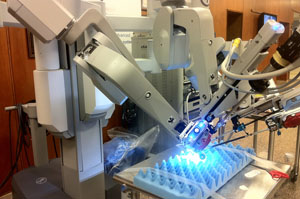
Venture capitalists are spurning high-tech surgical robots like this for more practical health care investments. (Photo by Nick Dawson via Flickr).
But after the Great Recession hit and the 2010 health law passed, the financiers behind the medical arms race started to rethink their investment calculus.
鈥淚f you come in with [a device] that鈥檚 10 percent better and twice as expensive, it鈥檚 hard to get anyone to care,鈥� said聽, a Palo Alto, Calif.-based venture capitalist at Venrock, a Silicon Valley company that invests in firms working on health services, medical devices and drugs.
鈥淭he changes in the health system are rocket fuel for entrepreneurs,鈥� says Roberts鈥� partner聽. He is a former Obama health policy adviser who was hired by Venrock in part to capitalize on the expertise he cultivated working on the law in the White House.
The share of venture dollars flowing to seed and early-stage investments in biotechnology and medical devices has plummeted since 2007, when investors pumped $3.6 billion into 332 deals in which a price was disclosed, according to data聽 by FactSet Research Systems. Overall venture investing declined by nearly one-third as the economic recession set in.
Kocher is eyeing businesses that do things like help hospitals keep patients from returning to the hospital with complications soon after treatment 鈥� a big-ticket cost that the health law will now tie to new penalties. Like other investors, he also anticipates that many people who gain coverage under the law will face high insurance deductibles. So, Venrock and other firms have funded聽, a technology company that helps patients choose the cheapest care.
The opportunities within complex health care ecosystems are in things as mundane as billing. 鈥淭here鈥檚 a half a person per hospital bed on average that sits in the hospital doing coding and collections and trying to get paid,鈥� Kocher says.
Their solution? Drop the manual coding and create 鈥渁 software system that learns as it codes and keeps getting better and better. And all of a sudden you can say to the hospital, Look, we鈥檒l charge you 50 or 70 percent of what you鈥檙e paying now. You guys save 30 percent. But by the way, we can make great margins and make a terrific business because our costs are so much lower, because we鈥檝e actually used technology rather than just people to attack the problem,鈥� Roberts gushes.
On the treatment side, the investors in Silicon Valley understand that hospitals don鈥檛 want space-age solutions for tomorrow as much as they want cheap, pragmatic products that can solve basic problems. When it comes to controlling urinary infections, for instance, the future is indeed in plastics. Plastic catheters.
Vicki Farrar started a company called聽, based in Salt Lake City. She鈥檚 almost evangelical about building a better catheter 鈥� one that kills the microbes that cause infection 鈥� and it鈥檚 not hard to understand why. The infections are totally preventable and Medicare won鈥檛 pay for them.
鈥淚t鈥檚 directly impacting the hospital鈥檚 bottom line, so they don鈥檛 want this out-of-pocket cost. It鈥檚 about $50,000 per infection rate,鈥� she says. Meaning, the hospital loses $50,000 for every catheter-related blood stream infection. The DualCap catheter she sells, which looks like a spark plug and smells of rubbing alcohol, costs less than a dollar.
DualCap investor Anne Degheest figured the catheter was a good business to bet on, because it prevents hospital readmissions. She points to another promising investment: In-room televisions that walk a patient through a doctor鈥檚 orders 鈥� from bed rest to getting prescriptions filled.
鈥淟ike while you鈥檙e in the hospital, they educate you on the TV so that you cannot see your shows until you鈥檝e gone through the education, and they test you,鈥� she says.
It鈥檚 a bit like not getting dessert until you鈥檝e had your vegetables. Maybe this all sounds incredibly simplistic, but venture capitalists say one of the trickiest things about this new world of investing is that their returns, in many cases, hinge on humans changing their behavior. And that鈥檚 a lot harder than building a robot.
鈥揅hristopher Weaver contributed to this report.