LOS ANGELES 鈥� If you were led blindfolded from Los Angeles鈥� grand city hall a few blocks east, you would know when you entered Skid Row.
There is the pungent smell of urine and burning marijuana smoke, and the sound of music and easy laughter. A carnival rising out of misery.
This is the chaos that Chris Mack plunges into on most days. Once homeless himself, Mack is an outreach worker for the , a free clinic that sits at the heart of Skid Row.听
Mack is part of a concerted effort to enroll the nation鈥檚 homeless into Medicaid because, beginning Jan. 1, the federal-state health insurance program opened听to all poor adults, not simply those with disabilities or dependent children.
The outreach is important, homeless experts say. In addition to safe , regular medical care is a critical intervention for getting lost lives back on track.
鈥淎 person who is not feeling very well can鈥檛 behave or perform very well,鈥� Mack explains, 鈥渟o I think health care is primary.鈥�
The Medicaid expansion is a central provision in the Affordable Care Act, the health care law. But after the U.S. Supreme Court made the expansion an option for states, only听 chose to do so. Even without all the states participating, some听 are expected to enroll in Medicaid across the country, and 1.2 million homeless people could be newly eligible for coverage.
Homeless advocates have cheered the expansion: men and women living on the streets and will be able to see a doctor regularly, keep prescriptions filled for asthma, diabetes and schizophrenia, and get referrals to private specialists for lingering ailments.听
鈥楿gly Reality鈥�
Mack鈥檚 journey through Skid Row is an arduous, even perilous undertaking: some 听live on the streets in Los Angeles, and, as elsewhere in the nation, up to 听are mentally ill or addicted to drugs or alcohol which makes enrolling them in a complicated public insurance program all the more difficult.听
鈥淪ometimes on certain streets people are following their habit, smoking or drinking or shooting up,鈥� says Mack. 鈥淭hat鈥檚 part of the ugly reality.鈥�
Mack greets a woman perched on an upside down plastic bucket with a Burberry scarf covering her head. Her eyes are clouded with drink or drugs, and her cheeks are smeared with ash. She tells Chris Mack that her name is Martha Castro, she鈥檚 slept on the streets for four years, and that she has been to the doctor just once for a lung infection.听


Martha Castro declined help to sign up for Medicaid insurance coverage (Photo by Anna Gorman/KHN).
鈥淒o you realize that you can have health insurance?鈥� Mack asks her.听
鈥淣o, I don鈥檛 want to apply for nothing else right now,鈥� Castro replies in a slur of words and confusion.听
She is adamant that, at 64 years old, she鈥檚 healthy enough, and anyway, she says, she doesn鈥檛 have any identification or money. 鈥淪o then how [am I] gonna have insurance for the clinic?鈥澨�
Even when told the insurance鈥擬edicaid鈥攊s free to her, and she doesn鈥檛 need an ID card, Castro, who is high or drunk and perhaps touched by mental illness, shows no interest. 鈥淭hat鈥檚 it,鈥� she says, signaling that the conversation is over.
Mack says he can鈥檛 force anyone, even someone like Castro who he suspects has chronic asthma, to sign up. 鈥淵ou see what I did? I left the door open: 鈥楳artha, if you need help, you can come to us.鈥欌�澨�
Some Saying 鈥榊es, Please鈥� To Insurance听
In a city crowded with chauffeured, black SUVs and upscale hotels, Los Angeles鈥� homeless are a reminder of life鈥檚 cruel turns. For George Farag, an Egyptian immigrant and former security guard, that cruel turn came when he fell asleep one night on the job.听
鈥淚 work in security before. I sleep on the job. [They kicked] me out,鈥� says Farag, standing in the lobby of the John Welsey Community Clinic. As if to prove the veracity of his story, he shows me the emblem embroidered on his shirt: it鈥檚 of his old company鈥檚 logo.听

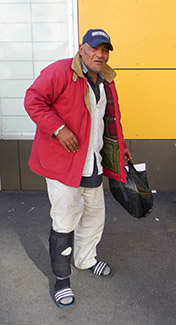
George Farag says his leg was injured in a hit and run when he was sleeping on the street (Photo by Anna Gorman/KHN).
鈥淎fter me lost the job, I lost everything. I sleep on the city two years.鈥澨�
One of those nights sleeping on the streets, George says someone ran over him. A hit and run that crushed his right leg. He鈥檚 come to the JWCH clinic before for the occasional prescription, but on this day, he鈥檚 signing up for Medicaid.听
Through an opening at the glass enrollment window, a clinic worker hands Farag a copy of his new insurance forms, and he stuffs them into a worn-out plastic bag.听
鈥淕od bless you,鈥� Farag says through the window. Once he is enrolled, the clinic will coordinate his medical needs, and perhaps do something about the makeshift brace on his leg.听
Dr. Dennis Bleakley has been treating Skid Row patients at the clinic for more than a decade. He says uninsured homeless adults, like Farag, had little access to specialists. Fractured bones. Bulging hernias. Diseased hearts. All of these things went untended.听
鈥淣ow, at least you have a reasonable length of time and access to specialists,鈥� Bleakley says. 鈥淚t鈥檚 going to open up a whole new world for us.鈥澨�
But even with new services available to them, the homeless will remain some of the toughest, most confounding patients. Disorder and addiction easily sabotage the best-laid efforts, and those who work with the homeless acknowledge few make it out.听
That sober reality doesn鈥檛 stop Chris Mack, the outreach worker, who heads back out on the street to find men and women who might be eligible for Medicaid.听He鈥檚 like a rescue diver plunging into a roiling ocean to bring those who鈥檝e fallen over back to safety, again and again.听