A commission created by Congress to address the country鈥檚 surging need for long-term health care released recommendations Friday but did not reach a consensus on how to pay for these often expensive services.

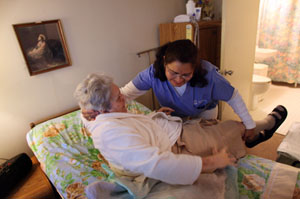
Home health aide Wendy Cerrato helps Olga Socarras get out of her bed in Miami, Fla. (Photo by Joe Raedle/Getty Images)
The proposals were part of a report that received bipartisan support from nine of the 15 commissioners, five Republicans and four Democrats. It also was rejected by a bipartisan minority, five Democrats and a Republican.
The group鈥檚 full report is expected to be released next week.
The three-page聽 tackles a wide-ranging list of concerns but offers few specific remedies. Among its many proposals, the panel calls for supporting criminal background checks for long-term care workers, ensuring that family caregivers are included in care planning, using more technology to share information; revising scope of practice rules to allow nurses and others to provide medical services and improving working conditions and opportunities for direct care workers.
The panel did not agree on a recommendation for a program to help families pay for long-term care services. However, it makes some suggestions for improvements to current options, including allowing disabled workers access to Medicaid, the federal-state health insurance program for low-income families, to pay for services they need in order to keep working. It also recommends eliminating Medicare鈥檚聽requirement that beneficiaries spend three days in the hospital as admitted patients in order to receive nursing home coverage.聽
鈥淚鈥檓 hoping there are members of Congress who will look at this and say this makes sense,鈥� said Grace-Marie Turner, president of the Galen Institute, an Alexandria, Va.,聽think tank, who was appointed to the commission by House Speaker John Boehner (R-Ohio). 鈥淎lmost all of the recommendations have equal support from Democratic and Republican appointees.鈥�
But Judith Feder, a health policy scholar at Georgetown University Public Policy Institute appointed by Senate Majority Leader Harry Reid (D-Nev.), said the commission did not fulfill a key assignment.
She and other four Democratic-appointed members who voted against the recommendations later offered their own plan, including establishing a national social insurance program that would help cover long-term care expenses, setting better pay scales and training for direct care workers and changing the Medicare system to help beneficiaries get more coverage for services and improvements in Medicaid benefits.
鈥淭he fundamental issue in getting people the long-term services and supports they need is an issue of financing,鈥� she said. 鈥淎nd this commission did not address that issue.鈥�
Mark Warshawsky, the commission鈥檚 vice chairman appointed by Senate Minority Leader Mitch McConnell (R-Ky.), disagreed and said that even though the commission couldn鈥檛 come to a consensus, it produced 鈥渕any new ideas for financing long-term care.鈥�
Turner said she argued 鈥渧ociferously鈥� for recommendations to encourage people to buy their long-term-care insurance. If middle class Americans depend on Medicaid for long term care, she said 鈥渢he safety net will be shred.鈥� The six Republicans on the panel late Friday issued a letter to Obama and congressional leaders stressing their belief that new private insurance options for families dealing with long-term care expenses could 鈥渁lleviate pressure鈥� on Medicare and Medicaid. They also emphasized that new programs should not increase state or federal government spending and new taxes should not be considered.
Feder, however, countered that consumers need help with these expenses. 鈥淢edicaid is there for them only after they impoverish themselves,鈥� said Feder. 鈥淲e can do better than that.鈥�
Chris Jacobs, a senior policy analyst at the Heritage Foundation appointed to the commission by Senator McConnell, was the only Republican who voted against the report. He objected to its substance as well as the commission鈥檚 process for adopting it. Despite the hundreds of pages of comments the commission received from national organizations and individuals, he said the public was excluded as the commission considered its final recommendations in a private meeting. The commission 鈥渟pent more than twice as much time in private deliberations than it has in public sessions,鈥� Jacobs said.
The commission only had 100 days, said the panel鈥檚 chairman Bruce Chernof, president of the SCAN Foundation who was appointed by House Minority Leader Nancy Pelosi (D-Calif.). 鈥淚n a very short time frame, the commission did all it could to be transparent while also completing its work and to try to engage the public,鈥� he said.聽
聽faced a daunting challenge: It had meager financing for its operations, few staff members and little time. Congress聽established the panel聽as part of the Jan. 2 fiscal cliff deal, but it took three months for congressional leaders and President Barack Obama to appoint the members. The commission聽held its first meeting June 27聽and was directed to report back by Sept. 12.
One member appointed by Obama was unable to attend meetings after assuming a new job at the White House. The president named a replacement, disability expert Lynnae Ruttledge, on Aug. 30. Her first meeting was the commission鈥檚 last.
The commission had the option to prepare legislation. If they had, it would have been required to be introduced in the U. S. Senate and House of Representatives. 鈥淲e didn鈥檛 have the resources or time to get that done,鈥� Turner said.
The commission was formed after the demise of the voluntary long-term care program created by the federal health law, called the Community Living Assistance Services and Supports Act, or CLASS. The Obama administration cancelled CLASS after determining that it was unfeasible because high premiums would discourage healthy people from joining. If enough people did not voluntarily enroll, the program would not have been self-sustaining. Congress repealed CLASS and replaced it with the commission, which was added to the fiscal cliff compromise law by Sen. Jay Rockefeller (D-W.Va.).
鈥淚mproving our long-term care system will require a multi-faceted approach that takes into account all those who may depend on it, especially the most vulnerable among us,鈥� Rockefeller said Friday. He was disappointed that the commission did not address affordability 鈥渂ecause this system must work for everyone.鈥�
Contact Susan Jaffe at Jaffe.KHN@gmail.com