A lot of the Affordable Care Act聽supporters point to Massachusetts as proof that signing up the uninsured is a big, but doable task. Here, in 2013, that鈥檚 a reasonable conclusion.聽
But back in 2007 and 2008 things were a lot messier, and some advocates for universal coverage were worried.聽
Here鈥檚 why:聽
1) It looked like the state had, by a lot, underestimated the number of people who would be eligible for free and subsidized coverage. (In 2006, the estimate was 140,000. By April 2008, the estimate rose to 225,000, based on early sign-ups. Enrollment plateaued at 177,000 in 2009.

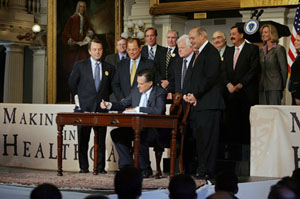
Mass. Gov. Mitt Romney signs the state鈥檚 2006 health care bill into law (Photo by Joe Raedle/Getty Images).
2) A dramatic increase in first enrollment put a strain on doctors and health care services at every level. When the 鈥淐onnector鈥� opened for business in late 2006, people signed up. Within a year there were 367,000 newly insured citizens.
3) Patients, many of whom had not had insurance for years, had a lot of problems they hadn鈥檛 taken care of and were seeking more tests, surgery and other treatment that drove up costs.聽
4) State budget watchers started to panic. The governor鈥檚 office kept going back to the Legislature to ask for more money and a few top lawmakers began to question whether the state could afford to fund the coverage law.聽
5) Employers saw an increase in workers who, to avoid the individual mandate penalty, signed up for their employer鈥檚 coverage, which increased employers鈥� outlays for health insurance.聽
Of course we don鈥檛 know if people who鈥檝e gone without insurance around the country will behave like the newly insured in Massachusetts. There are lots of reasons why Massachusetts residents are different. 聽They see a doctor more often, for example, than do residents of most other states.
Today, despite rising costs, the state鈥檚 effort to cover the uninsured is pretty stable 鈥� 97 percent of the state鈥檚 6.6 million people have it. It鈥檚 the highest coverage rate of anywhere in America.
If there鈥檚 a lesson from Massachusetts as the rest of the country starts enrolling the uninsured, it鈥檚 this: Be prepared for a rush of sick, or at least not completely healthy, people. Healthy folks will sign up later, when the individual mandate kicks in, and hopefully balance out the costs. But any estimates about how many people are eligible and how much care they have been waiting to get may not hold true.
NPR correspondent Dick Knox聽 to this story, which is part of a collaboration that includes NPR, Kaiser Health News and .