Nationally, Republican party leaders say their number one campaign issue for the midterm elections is opposition to Obamacare. But at the same time, a growing number of Republican states are now embracing a major provision of the law 鈥� expanding Medicaid, the government-funded health benefit program for the poor. The Supreme Court made doing that optional for states in 2012 and most Republican-led states said 鈥渘o鈥�. But now, some states like Ohio, Iowa and Michigan are forging compromises with the White House on Medicaid.
To understand why this happened in Michigan, drop in on the cavernous, busy in the heart of Detroit. About patients being treated by the blue-scrubbed swarm of doctors, nurses and techs is uninsured. It鈥檚 a much higher rate than in Michigan or the rest of the country, and that means hospitals like this one had been providing a lot of health care for free.
Henry Ford Hospital CEO Nancy Schlichting says even as in the last decade, the amount of care the institution provides for free increased.
鈥淎bout seven or eight years ago we were at about $100 million a year. We鈥檙e now at $240 million a year in uncompensated care,鈥� she says.

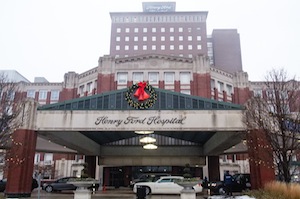
The Henry Ford Hospital in Detroit treats a growing number of uninsured patients (Photo by Eric Whitney).
So when the Affordable Care Act offered Michigan the chance to give Medicaid benefits to , Schlichting lobbied hard for the state to say 鈥測es.鈥�
鈥淲e were very active in advocacy,鈥� she says. 鈥淲e got all of our employees engaged. We had over 5,000 emails that went to state legislators, as they were debating the Medicaid expansion for the state of Michigan. We almost shamed people into it, you know, 鈥楬ow can you turn your back on the people of this state, who have lost jobs?鈥�
A Republican Challenge From A Tea Partier
But Republicans initially saw themselves as turning their backs on Obamacare, not the people of Michigan. State Rep. Al Pscholka was one of them.
Pscholka鈥檚 district, on the southeast shore of Lake Michigan, is a solidly Republican area so Obamacare doesn鈥檛 have a lot of fans there, he says: 鈥淲hen people say Medicaid expansion, I think to a lot of us that meant bigger government, and it meant expanding a program that doesn鈥檛 work very well.鈥�
Pscholka is a Republican party leader in the Michigan House. He was asked to look at ways to reform Medicaid. But then Republican governor, Rick Snyder, of Medicaid expansion last year. Snyder argued that if the state didn鈥檛 expand, the millions of dollars in Affordable Care Act taxes and fees Michigan would be paying would just go to other states, and not come back home in the form of new payments to hospitals and doctors.
Furthermore, Pscholka says when he took a hard look at Medicaid, he didn鈥檛 find the broken, bloated government program he was expecting.
鈥淲hen I understood how it worked, and what we had done in Michigan in the late 鈥�90s, that was actually pretty smart, we鈥檝e privatized a lot of that already, which I think a lot of folks didn鈥檛 understand,鈥� says Pscholka.
Medicaid is a government-funded program, but Michigan long ago started contracting with to administer it. The idea was to use private market incentives to increase efficiency. Pscholka says that makes it easier for conservatives to stomach, and he helped draft legislation to accept federal Medicaid expansion dollars, but with some conditions.
The bill passed by one vote in the state Senate.
鈥淭his is not an easy thing to explain.鈥� Pscholka says. 鈥淚t鈥檚 not an easy thing to get up at a , and look at friends of mine, who鈥檝e been friends of mine for 20 years, who are now shooting darts at me with their eyes, and can鈥檛 believe that I was even involved in this. Not only that I voted for it, but that I was somehow involved in crafting this legislation.鈥�
Pscholka鈥檚 change of heart on Medicaid earned him a primary challenge from Tea Party candidate . But she鈥檚 a longshot to beat him, and those favoring expansion have some strong allies beyond Michigan鈥檚 popular governor. , and the state鈥檚 all rallied behind the idea.
Medicaid Coverage, With A Caveat?
Cynthia Kay, who owns with eight employees in Grand Rapids, hopes putting more people on Medicaid will help keep the price of her company鈥檚 health insurance plan down in the future.
鈥淚f you think about it, we鈥檙e paying for the cost of health care anyway,鈥� Kay says. 鈥淯ncompensated cost of care is driving my premiums up every single year. So, whether I think I鈥檓 paying for it or not, I鈥檓 paying for all the people who are using the emergency room as their primary care physician.鈥�
Advocates for the poor are thrilled so many uninsured Michigan residents will now be able to get Medicaid, but they worry about some significant details that have yet to be finalized.
Among the compromises the White House made to win Republican support in Michigan are requirements for some Medicaid recipients to pay for at least part of their care, according to , a senior policy analyst at the Michigan League for Public Policy, which advocates for low income people. That could include co-pays for physician office visits and procedures.
鈥淐ost sharing is always a concern for low-income people. The research says that that can be a barrier to people receiving the care that they need,鈥� Hudson says.
Still, the White House is in Iowa and Arkansas. Iowa recipients will pay extra if they overuse emergency rooms, and Michigan will charge them more if they don鈥檛 stick with wellness plans designed to keep them healthy.
Groups that favor Medicaid expansion nationwide point to those kinds of requirements as evidence that the White House is willing to compromise, and hope that will entice the to take another look and work out special arrangements of their own.
This story is part of a partnership with and Kaiser Health News with support from the Dennis A. Hunt Fund for Health Journalism, a program of the USC Annenberg School of Journalism鈥檚 .