

Olivia Welter turns 21 on Nov. 9. On her birthday, she will no longer be eligible for the program for disabled children that has kept her healthy. She will lose state funds that cover the expense of nurses like Helen Houchins who prepares liquid food that is sent directly into Welter’s stomach through a feeding tube. (John Poole/NPR)
You’ve probably never seen a person hooked up to so many plastic tubes as Olivia Welter. There’s a ventilator tube that keeps her breathing. There’s a feeding tube that’s also the tube for her dozen or so medicines. There are the tubes to the vibrating vest that loosens the mucus in her lungs. Another tube to help her cough. The tube that her nurse uses a couple times an hour to suction the mucus out of her mouth.
But if you think of being hooked up to machines as something that keeps a dying person alive, that’s not what’s going on here. Olivia Welter is not dying. These tubes and machines keep her healthy.
Olivia Welter is 20 years old and gets all this life-saving medical care through a program provided by Illinois’ Medicaid program. But it’s a program for children. And when Olivia Welter turns 21, at the stroke of midnight on Nov. 9, she is no longer eligible for that care.
“There’s not going to be any magic transformation between Nov. 8 and Nov. 9,” says the young woman’s mother, Tamara Welter. “She will be the same Olivia, with the same challenges and the same care needs.”
Related NPR Content
- NPR Series:
- Interactive Database:
- Timeline:
- Audio:
There are about 600 children with severe disabilities in Illinois who get care through the same in-home program for children, and thousands in other states around the country.
She breathes with the help of the portable ventilator on the back of her wheelchair. She can’t speak; she can’t move. Her eyes are wide open – she can’t even close her eyelids. She has been severely disabled since birth.
John Welter says that when his daughter was a little girl, doctors told him to be ready for her to die.
“We were told very bluntly, and this was very hard to hear, that she would not live past 10 years of age, pure and simple,” John says. “They told us that very directly.”
‘You Do What You Have To Do For Your Child’
So what kept Olivia Welter alive – and healthy – all these years? Better medical technology, for one thing, and the attentive, loving and constant care that she has received at home. That comes from nurses – who work 16 hours a day and are doing some treatment for the girl every several minutes – and from her parents, who take over for the other 8 hours.
“This is intensive care, 24 hours a day,” says Helen Houchins, the day nurse, who sits by Olivia’s side in the family’s living room in a bungalow in Lincoln, Ill.
“You do what you have to do for your child,” says Tamara Welter. She says her daughter’s good health – and good nature – make the family’s sacrifice worthwhile.
“I’ve had doctors, a couple of doctors, who have questioned a decision about doing something for Olivia, kind of on the basis of: Is she worth it? I’ve looked them in the eye and said, ‘Don’t you dare say that to me. Do you have children? What would you do for your child?’ I think society can look at a person like Olivia and say, ‘What can she contribute?’”

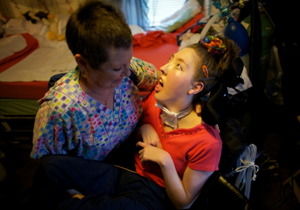
Nurse Helen Houchins moves Welter from her bed to a wheelchair. Welter needs 24-hour care and she breathes with the help of the portable ventilator on the back of her wheelchair. She can’t speak, can’t move and can’t even close her eyelids. (John Poole/NPR)
Tamara Welter blinks back tears and then talks about how her daughter responds when her parents or nurses walk into a room – by glancing at them with her eyes and flailing her arms. She sits with the family – and keeps her eyes toward the TV – as they watch video of her brother starring in community theater productions.
Her father says when no one else is in the house, he and Olivia turn up the country music.
“That’s our guilty pleasure,” he says. “And the more twangy the sound and the sillier the words, the more she loves it. And one day, we were listening to country music and some guy was leaving his girlfriend in his pick-up and I repeated the lyric and said, ‘Kiss my bumper goodbye baby,’ and she just erupted in giggles. And she thought that was the funniest thing.”
Those moments have become fewer in recent years, as Olivia’s seizures get worse.
Still, everyday, her parents tie her hair in one of her many, colorful bows – like the blue and orange one today that matches her clothes. They take her to church and to restaurants. Until last year, her nurses took her to school, although there was no way to tell what she was learning.
Cost Considerations
Olivia Welter is about as disabled as anyone you’ll ever meet. Yet she’s been hospitalized just twice in the last seven years and has had just one bedsore her entire life – and that was a dozen years ago.
Her doctor, Adalberto Torres, director of pediatric critical care at Children’s Hospital of Illinois in Peoria, says that’s the sign of exceptional care.
“They’ve kept her happy and healthy,” Torres says of the Welters. “And one thing you can see with Olivia is when she is sad or happy.”
When Olivia turns 21, the state changes how it measures cost. For an adult, the state says the alternative is no longer a hospital. It’s a less expensive nursing home. The state will pay for the Welters to send her to one, although there are none nearby that would take her.
By keeping her out of the hospital and free of the health care complications common to quadriplegics, they save the state of Illinois from paying high medical bills.
Tamara and John Welter are immensely grateful for what Illinois has done in the past. It’s expensive to care for Olivia at home: nurses cost about $220,000 a year. Still, that’s less than half the cost of what the state counts as the alternative – having her live in a hospital. The Welters figure they’ve saved the state millions of dollars by keeping her at home.
But when she turns 21, the state changes how it measures cost. For an adult, the state says the alternative is no longer a hospital – it’s a less expensive nursing home.
The state will pay for the Welters to send her to one, although there are none nearby that would take her.
And even if they sent her to a distant nursing home, John Welter doubts his daughter would get the close attention she needs to stay alive.
“We cannot bear the thought of having Olivia in a home or a care home,” he says. “Because we would be afraid that in any ten minutes, her life could be put in danger. Or less – in any three minutes. It would be agonizing, day to day to day.”
Families Providing Care ‘Like An Intensive Care Unit’
Torres, Olivia’s doctor, agrees that it is best for Olivia’s health for her to get the care she needs at home.
“These families do this in their home and they provide a level of care that is like an intensive care unit, not just live on a hospital floor, but an intensive care unit.”
So the Welters will say no to the nursing home and will keep Olivia at home. But the state won’t pay more than the cost of that nursing home. And that means the family will get about one half the state funding they rely upon now. They will no longer be able to pay for nurses.
They could hire less expensive personal care aides, instead. But here’s another catch: By Illinois law, aides can’t give Olivia her medicines. They also can’t do the emergency care, like quickly replacing the breathing tube that keeps her alive if it pops out.
“The only way I think I could have an aide,” says Tamara, “is if I am in the house with them, looking over their shoulder, and me doing most of the work.”
And that’s what state officials know that parents like the Welters end up doing – they become full-time caregivers and give that care at no cost to the state.

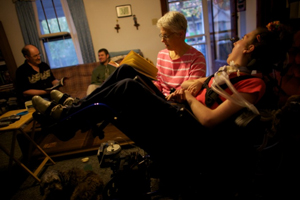
Welter’s mom, Tamara, reads to her in the family’s living room with her father John and brother Brian in Lincoln, Ill. Now, nurses care for Welter 16 hours a day. John and Tamara take over the other eight hours. If they lose the funding for Olivia’s care, the Welters will become her round-the-clock caregivers. (John Poole/NPR)
If the funding disappears, Tamara says she will quit her job as a cashier at the Cracker Barrel that she took to pay for her son’s college. John might need to quit teaching history at the nearby college, but that job gives the family health insurance that pays for other parts of Olivia’s care that the state doesn’t pick up, including a medicine she used a few years ago that cost $7,000 a month.
Suing The State For Coverage
So the Welters are suing the state to continue the care Olivia has received since she was little.
And they have some support from the U.S. Department of Justice.
“Where would you rather live as a 21-year-old?” asks Thomas Perez, the U.S. assistant attorney general for civil rights. “Would you rather stay in the community with your family and your neighbors and all of the benefits of neighborhood and community? Or would you want to go into a nursing home? I’d ask any American: What is that choice?”
Perez has told the state of Illinois that it is in violation of federal law when it cuts off children. This summer, the Department of Justice intervened in a lawsuit filed by another family whose disabled child turned 21 in June. Olivia Welter’s attorney added her to that lawsuit.
The Welters worried that at midnight, as Olivia turned 21, her nurses would be forced to walk out the door. But just over a week ago, the state of Illinois agreed to keep paying for Olivia’s nursing care, at least for a little while longer. It might be a few months – or several months – while the lawsuit makes its way through the courts.
“This is government at its worst,” says Robert Farley, the attorney for the Welters and several other families in Illinois. “Government says, ‘Well, we don’t do anything until the court rules,’ but this stuff is life and death.”
NPR asked to speak to an official from the Illinois Department of Healthcare and Family Services, but the agency declined, saying no one could comment because of the pending lawsuit by the Welters and other families.
States like Illinois are caught between wanting to do more for families and dealing with the reality of rising Medicaid costs.
“By the blessings of the advances of medical technology, we keep people alive who would have died in the past,” says Alan Weil, executive director of the National Academy for State Health Policy, a Washington-based think tank. “That technology is very expensive, and someone has to pay for it. In good times, we are expansive and we put more resources in these programs; when budgets are tighter, there’s concern about how much we’re willing to spend, even for the most needy, the most obviously deserving of assistance.”
State governments are dealing with record budget deficits – Illinois alone is facing a $15 billion shortfall. According to the Center on Budget and Policy Priorities, 46 states faced budget shortfalls this year and total state debt will hit $140 billion in the current fiscal year.
“States are in the worst fiscal situation ever,” says Weil. “Meanwhile, the Medicaid roles have been increasing due to the economic downturn. Medicaid’s a growing share of state budgets.”
Families Fight For Home Care Funding
Every year, about 20 of the 600 children with severe disabilities in Illinois who get in-home care through the program that supports Welter age out. Some go to nursing homes; other families struggle to keep their children at home but often get overwhelmed by the care. Last year, a quadriplegic man in Peoria died at home just a few months after he turned 21 with bedsores so severe that his flesh was open down to his bone.
A few families, like the Welters, get attorneys and sue the state. Sometimes they lose, but lately they’re more likely to win.
David Grooms, of Marseilles, Ill., won, but only after he sued the state when he got cut off when he turned 21 in 2005. His inherited metabolic disorder requires him to use a ventilator 24 hours a day.
His attorney, Karen Ward of Equip for Equality, a disability civil rights legal network, argued that it was medically dangerous to cut back on the level of nursing care that Grooms had relied upon all of his life and to instead use less skilled aides or to send him to a nursing home.
“The state says we do not deny care,” says Ward, “But what they offer is an unsafe level of care.” A court agreed and restored his 16 hours of skilled nursing care.
Grooms now lives in a large room at home with his father, also named David. The father provides care for the other 8 hours a day, but to look after his son, he had to quit work. Now he has no health insurance for himself, and hopes to stay healthy for a few more years until he is eligible for Medicare.
Still, David Grooms, the father, says he’s proud that his son is doing well.
“He’s happy, especially now that he has a girlfriend,” he says. That was an unexpected outcome of the lawsuit – when the son lost his nurses, Jennifer Keith came to work for him as a personal care aide. She lost that job when David got his nurses back, but that allowed the romance to blossom.
They cuddle and Jennifer buries her face in David’s long black hair as the sound of his respirator whooshes softly in the background. They watch TV together in David’s room or send messages on their Facebook pages.
When Chad White-Smith, of Metamora, Ill, turned 21 in February, a court tried to find a compromise. An attorney for the state argued that the program for adults had a cap on how much it would pay, and the state didn’t have unlimited resources to pay for more.
Chad’s doctor, Adalberto Torres, who is also the physician for Olivia Welter, told the court that “it’s just not safe” for White-Smith to rely upon aides instead of nurses. But the judge asked the family to try to find less expensive nurses and aides and see if they could make that work.
Returning from court one day last spring, Carmen Smith, Chad’s mother, was frustrated.
“I understand our economic situation is not very good right now,” she said, “but it’s not acceptable for me to just say I’m willing to risk my son’s life.”
Chad, who has a form of muscular dystrophy and uses a respirator day and night, agrees.
“It’s crazy. I don’t know what they thought would change when I turned 21,” he says. “I’m still the same. I’m not going to get out of this [wheel]chair.”
His family is still fighting for more funding.
Care At Home: A New Civil Right?
The reason families have started to win their cases is a federal law: The Americans with Disabilities Act. In recent years, courts, including the U.S. Supreme Court, have ruled that the ADA gives many people a civil right to get their government-funded long-term care at home.
One result of the law, says Weil, is that even with those budgetary pressures, states still have a legal obligation to provide more home and community-based care.
In 1999, the U.S. Supreme Court ruled, in Olmstead v. L.C., that under the ADA, people with disabilities often have the right to live in the community rather than in institutions. Since then, other federal laws and policies have said that states have an obligation to provide more home-based care. The new health reform law is filled with incentives for the states to spend more.
But federal law is contradictory. An older federal law, the 1965 law that created Medicaid and Medicare, says states have an obligation to provide nursing home care. Home care programs are still optional.
One result is that the number of Americans on waiting lists to get care at home has more than doubled in recent years. Across the country, some 400,000 elderly and young people with disabilities are on waiting lists for home-based care.
On Olivia Welter’s birthday, her family will gather for a quiet celebration. And they will make birthday wishes that a court agrees to tell the state to continue the level of care that has allowed Olivia to live at home and to celebrate birthdays with her family.