Sandra Colbert sits propped up in a hospital bed at Gundersen Lutheran Hospital in La Crosse, Wis., connected by tubes to oxygen and IV fluids. Doctors have told her she didn’t have a heart attack. But it sure felt that way when she collapsed at the gym a few hours earlier. “It felt like my heart exploded,” she says, then adds. “I thought I was going to die.”
She’s not going to die, the doctor reassured her. But now nurses are asking her to think about dying. Or, more specifically, they’ve asked her to fill out a living will.
Related Audio
It might seem almost rude to ask a woman who just a few hours ago had reason to fear she was about to die – but who now knows she’s OK – to think about how she does want to die some day. Yet it’s a routine question in this Midwestern city on the Mississippi River.
The specially trained nurse, in this case a woman named Laura Wiedman, will spend more than an hour with Colbert – and her husband Jim – and help them both think through the treatment they’d want at the end of life.
Respecting Choices
Wiedman takes out a 12-page document and goes through the questions: Who do you want to make health care decisions for you if you can’t make your own? If you reach a point where it is reasonably certain you will not recover your ability to interact meaningfully with friends and family, do you want tube feedings, IV hydration, a respirator, CPR and antibiotics?
These are complicated questions. It’s something that the Colberts – like most adults in this country – have put off. But after Sandra’s scare today, and Jim’s hospitalization with a head injury this summer after he fell off an electric bicycle, it’s something they both know they need to do.
Sandra cries when she writes down that she wants each of her grandkids to speak at her funeral. But there’s more laughter than tears. Sandra says she wants Pink Floyd’s “Put Another Brick in the Wall” and Ricky Martin’s “Livin’ la Vida Loca” played at her funeral. Jim jokes that he’ll write down in his advance directive which of his daughters really was his favorite – a family joke among the girls.
The Colberts complete the directives and the nurse summons witnesses to watch them sign. Then Wiedman enters them in the health system’s computers.
Now, anytime a doctor in this large health system pulls up their records, their wishes for end-of-life care will be prominently displayed.
The result of all this attention is that nearly all adults who die in La Crosse, 96 percent of them, die with a completed advance directive. That’s by far the highest rate in the country.
But it’s expensive to spend time with patients filling out living wills. Medicare doesn’t reimburse for the time the hospital’s nurses, chaplains and social workers do this. Bud Hammes, the medical ethicist who started the program, called Respecting Choices, says it costs the hospital system millions of dollars a year. “We just build it into the overhead of the organization. We believe it’s part of good patient care. We believe that our patients deserve to have an opportunity at least to have these conversations.”
And that’s how La Crosse unexpectedly got in the middle of the national debate over health care and the so-called “death panels.”
A New Standard Of Care
There’s a proposal – it’s in the health bill passed by the House of Representatives – that would pay for the kind of periodic and continued end-of-life discussions with patients that are routine in La Crosse. Gundersen Lutheran is pushing for it.
Hammes says claims that government-run panels would pressure sick people to die are bizarre exaggerations – and that the experience of this Wisconsin city proves it. “These are conversations that we have with our patients. They’re not done in a secret room,” Hammes says. “These are open conversations involving family members, pastors, attorneys. It’s part of our community fabric now, it’s part of how we deliver care.”
One result of the way that care is delivered: At Gundersen Lutheran, less is spent on patients in the last two years of life than any other place in the country.
Choosing In Advance
The Dartmouth Atlas of Health Care documents the vast difference in health care costs from one place in the country to another. At Gundersen Lutheran, the cost of care for someone in the last two years of life is about $18,000. The national average is close to $26,000. At one hospital in New York City, it’s more than $75,000.
“When people see the low cost in La Crosse, there are assumptions about rationing care, about denying care, about limiting – that we limit care for our patients,” says Hammes. But it’s not that dying people in La Crosse are denied care, he says. It’s that they’ve thought out their wishes in advance, so they get exactly the care they want. And often that means avoiding excessive and unwanted care.
When Hammes came to Gundersen Lutheran Health System as a clinical ethicist, he often found himself called in to help families who had suddenly found themselves in the middle of a health crisis. “When I asked these family members, ‘what would your Dad want,’ ‘what would your Mom want,’ ‘what did they say to you previously?’ The response was the same again and again and the response was, ‘If I only knew.’”
Hammes realized the shortcoming of the common practice of handing patients a living will. People didn’t fill them out. They gave up trying to figure out confusing issues like whether to withdraw a feeding tube – and when.
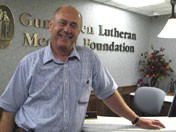

So Gundersen Lutheran started training its staff – as well as ministers, lawyers and others in the community – to help people understand – and make – those choices.
Hammes says the point is to help people make informed choices. Decisions made on the spur of the moment, in crisis, can lead to costly and unwanted care. If a patient’s wishes aren’t clear, the default choice of doctors and family is often to provide high levels of care – even when it’s something unhelpful.
But sometimes, getting a patient to think through choices can mean the patient decides he or she does want the most expensive care.
The Option To Change Your Mind
Joe Hauser, who used to run a TV repair shop, recently found out his kidneys are failing. His doctor told him he’s going to need dialysis, soon.
“I don’t want to go on dialysis,” he says, one recent morning as he takes his medicines with a glass of water at his kitchen table in the nearby town of Onalaska. “I don’t want to be tied to a stupid machine for 15 hours a week. My main thing is I don’t want to be a burden on anybody. I figure I’d love to live to be 150 as long as I can do stuff myself without depending on somebody else to do it for me. But once I get to I can’t do nothing, I’d just as soon croak.”
Joe’s wife, Janice, sits next to him and shakes her head. She wants her husband to go on dialysis.
“Maybe I shouldn’t say that,” says Janice, “but I’m being optimistic about it anyway.”
“See, good old Ma,” says Joe. “She would like to keep me around here as long as possible.”
“Well he’s right,” his wife says with an affectionate laugh. “Who else would put my eye drops in?”
So with some prodding from Janice, Joe recently talked to a nurse at Gundersen Lutheran about what it means to go on dialysis. Joe worried that once he started on dialysis, he wouldn’t be able to stop. That’s not how it works, said co-director Linda Briggs, a nurse in the Respecting Choices program.
Then Briggs invited Joe and Janice to visit the dialysis center and to drop in on a support group meeting, so they can talk to other patients.
Joe hasn’t taken up the nurse on that. He says he still doesn’t want dialysis.
But then there’s a surprise. He extends his left arm across the kitchen table. He wants to show what he calls his “buzzer.” It’s a spot at his wrist where you can feel the vibration from an artery and a vein that a surgeon has joined together.
It turns out that Joe Hauser’s decided to be ready, if he changes his mind. And if he decides he wants dialysis, then the needle of the dialysis machine can slip right in to that spot – the fistula – that the surgeon has prepared at his wrist.
And that gets to the point of why doctors and patients keep talking about end-of-life care in La Crosse: because choices are complicated. Because people’s feelings change about the treatment they want. And the best way to handle that is to know all your options, well in advance of a health care crisis.