

Dr. Yamanda Edwards, the daughter of a truck driver and a stay-at-home mom, grew up just a few miles from Martin Luther King/Drew Medical Center, at the time an iconic yet troubled hospital in South Los Angeles.
As a child in the 1990s, she knew little of its history 鈥� how it rose from the ashes of the Watts riots. And she knew no one in the medical profession.
Still, she wanted to become a doctor. 鈥淚 didn鈥檛 know how I was going to get there, but I wanted to get there,鈥� she said. 鈥淚 was determined.鈥�
Now 32, she is the only psychiatrist at the new , on the grounds of the old county-run King/Drew and steps away from where she attended high school.
In her lifetime, the community where she grew up has changed dramatically. The population is mostly Latino now, no longer predominantly African-American. King/Drew closed in 2007 amid allegations of . The new hospital, a private, nonprofit that opened in 2015, is smaller but vibrant, with brand-new facilities, staff and an outpatient medical clinic. It鈥檚 part of a broader campus that includes outpatient and public health centers run by Los Angeles County.

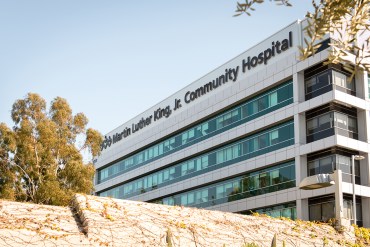
Martin Luther King, Jr. Community Hospital (Heidi de Marco/KHN)
What hasn鈥檛 changed in the area is the need for doctors like Edwards.
Edwards鈥� patients have conditions ranging from anxiety and depression to psychosis. Many have never seen a psychiatrist 鈥� or any mental health professional, for that matter. Yet the pressures in their lives contribute to poor physical and mental health.
鈥淭here are a lot of stressors coming from living in an environment with health care disparities, a lot of access to drugs, poverty, immigration issues,鈥� Edwards said.
The neighborhood surrounding the hospital has higher rates of psychological distress and a greater need for mental health care than the statewide average, according to 2014 data from UCLA. also are more likely to be poor and out of work, though average levels of educational achievement and income have risen somewhat in recent decades.
Edwards teaches her patients about their conditions 鈥� what it means to have clinical depression, how it feels to have a panic attack. Many show appreciation for having someone they can turn to. 鈥淭hey鈥檝e tried to do it on their own, but now it鈥檚 time to see someone,鈥� Edwards said.
Gail Carter, 62, of Compton, Calif., suffers from chronic pain and depression but said she has been sleeping and feeling better since starting sessions with Edwards. 鈥淚 didn鈥檛 know how to figure it out by myself,鈥� she said. 鈥淒r. Edwards helped me. She gets me to think. And she reminds me to breathe.鈥�
Dreaming Of Being A Doctor
Edwards said she feels some nostalgia for her neighborhood, along with sadness. She escaped some of the worst aspects 鈥� violence, drugs and gangs 鈥� protected by her family and its high aspirations for her and her siblings. 鈥淗igher education was just sort of expected of us,鈥� she said. 鈥淚 do believe I was somewhat insulated.鈥�
Her curiosity about medicine started in middle school. She attended the King/Drew Magnet High School of Medicine and Science, which allowed her to shadow doctors at the old King/Drew hospital and help with cancer research. 鈥淚t was almost like we were medical interns, but we were in high school,鈥� she recalled.
Despite the support, she faced setbacks. When she was 15, her father died of colon cancer, four days after he was diagnosed. For some time after that, she didn鈥檛 want to set foot in a hospital. 鈥淚 thought, 鈥楬ow am I going to become a doctor when I hate hospitals?鈥欌��
Then she reflected on how her dad had encouraged her to pursue medicine, knowing it was her dream, and 鈥渢hat motivated me.鈥�
Edwards remembers wondering, when the old King/Drew hospital closed, where patients in the neighborhood would go for care 鈥� and if the high school students would still find hospital internships.


Edwards checks on a new patient, Ernesto Arzate, of Los Angeles. He says he had been binge-drinking when he decided to down a cocktail of medications. As soon as he realized what he had done, he called 911. (Heidi de Marco/KHN)
After graduating from UCLA, Edwards attended medical school at Charles Drew/UCLA 鈥� next to her old high school 鈥� through a program designed for students who wanted to practice in underserved areas. During a student rotation at Kedren Acute Psychiatric Hospital in Los Angeles, Edwards saw bipolar disorder, psychosis and major depression up close, and she was struck by the need for care among minorities, especially African-Americans and Latinos. 鈥淭his is something that doesn鈥檛 really get talked about in either of those communities,鈥� she said.
That propelled her toward a career in psychiatry. She completed her residency in psychiatry at UCLA in June 2017 and started her job at MLK two months later. 鈥淚t just felt right,鈥� she said.
In addition to working at the hospital, Edwards also belongs to a new outpatient medical group the hospital started last year to expand specialty care for its patients. Hospital CEO Elaine Batchlor said Edwards is exactly the kind of doctor they wanted to attract. 鈥淪he understands the people who live in our community,鈥� she said. 鈥淎nd she has a deep commitment to them.鈥�
Separating The Old From The New
Patients come in at all hours of the day and night needing mental health care, said Ameer Moussa, a physician who practices at the hospital. 鈥淎 psychiatrist is something we knew we needed from day one,鈥� he said.
Moussa said Edwards鈥� calm personality and patience enables her to communicate effectively with her patients. 鈥淭rust is a really important thing, and she gains their trust and gains it quickly,鈥� he said.
That helps, especially with patients who recall the difficult history of the old King/Drew, which came to be known in some circles as 鈥淜iller King.鈥�
Edwards鈥� childhood memories of the area help her connect with patients. When they are distressed about their challenges in life, she will often tell them, 鈥淚 understand. I grew up here too.鈥�
Edwards, who now lives in Cypress, Calif., with her husband and 19-month-old son, spends most of her workweek helping to triage mental health patients in the ER and visiting those who are admitted to the hospital.
MLK鈥檚 emergency room has seen twice as many patients as it originally expected when it opened, and many suffer from mental illness.

Edwards checks in with the social worker on duty about possible patients on March 1, 2018. Edwards is the only psychiatrist at Martin Luther King, Jr. Community Hospital, responsible for assessing, stabilizing and treating patients with everything from anxiety to schizophrenia. (Heidi de Marco/KHN)
On a recent afternoon, Edwards saw a woman who was 30 weeks pregnant and threatening to harm herself. Combative and possibly psychotic, she was convinced her baby was an alien. 鈥淟et me go,鈥� she screamed as staffers tried to restrain her. 鈥淕et off of me!鈥�
Edwards ordered medication to help calm her down. She also placed her on a 72-hour psychiatric hold and started searching for an inpatient bed for her.
Edwards knew that wouldn鈥檛 be easy, given the severe psych bed shortage and the woman鈥檚 condition. 鈥淧sychiatric hospitals can sort of pick and choose who they want to take,鈥� Edwards said. 鈥淧regnant patients are a little more risky to take on.鈥�
Edwards spends much of her time at the hospital dashing in and out of patients鈥� rooms, attempting 鈥� often in fleeting conversations 鈥� to assess them and their risk of hurting themselves or others. Many of her patients are homeless, alcoholic or addicted to drugs.
Once a week, Edwards heads to an outpatient clinic run by MLK a few miles away. Some of her patients take a while to warm up to her. She spends a lot of time with them before even raising the idea of medication.
鈥淐oming from a community where there is a lot of stigma about mental health 鈥� the acceptance of medication is another barrier,鈥� she said.
Edwards said she does everything she can to help her patients 鈥� both outside and inside the hospital. But in the end, Martin Luther King, Jr. is an acute care hospital, not a psychiatric one. Edwards isn鈥檛 there round-the-clock, and the hospital can keep certain psychiatric patients for only up to three days. One of the hardest parts of her job, she said, is wondering what will happen to patients when they leave.
鈥淵ou want to know the end result of what happened, if you did the right thing, if they鈥檙e safe.鈥�
黑料吃瓜网 News鈥� coverage in California is supported in part by .