RED LODGE, Mont. 鈥� One of the biggest challenges American hospitals face right now is adopting electronic medical records systems. It鈥檚 costing tens of billions of dollars, eating up tons of staff time and it鈥檚 especially tough for the country鈥檚 2,000 rural and small town hospitals.
Rural hospitals are typically cash strapped, and people with information technology skills can be hard to find outside of big cities.

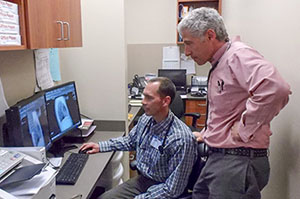
Dr. Billy Oley, left, and Dr. William George review an electronic medical record at the 10-bed hospital in Red Lodge, Montana (Photo by Eric Whitney).
That means a lot of small hospitals are turning to bigger hospitals for help, and giving up some independence in return.聽The hospital in Red Lodge is one of these.聽A historic mining town just outside Yellowstone National Park, Red Lodge is about 60 miles west of Billings.聽On a recent spring day, the only thing slowing cars on Main Street in Red Lodge is a flock of wild turkeys strutting across the pavement.
Just days before, though, this road was covered with two feet of snow. Getting in and out of Red Lodge can be a challenge, as knows. He lives just a few miles from where he works, at the 10-bed hospital here.
鈥淭here was a time that the nurses won鈥檛 let me forget,鈥� he says. 鈥淚 drove my tractor to work one day because I couldn鈥檛 get my truck here. I had to plow with the tractor all the way to the hospital, and I just kept it here.鈥�
On days like that, Oley and his patients are particularly grateful for his hospital鈥檚 electronic medical records. He can share patient records instantly and securely with the big hospital in Billings and get expert advice on an almost daily basis.
鈥淲e see a lot of patients who are able to not have to travel or see specialists, or do different things because we can just take care of it here,鈥� Oley says.
Sharing electronic records sounds simple, but for a lot of little hospitals, doing that, and meeting new federal means coming up with a million dollars or more up front. That鈥檚 tough, when the average rural hospital runs a financial loss of 8 percent a year, says Brock Slabach with the .
So Red Lodge became part of the bigger system, in part to get help with IT. When hospitals align or merge, they give up some, or maybe all, control of their operations 鈥� from which records system they鈥檒l use to which doctors and services are available where.聽But affiliating with a big network often has benefits and can improve the care available in small towns.
Scott Duke with the Billings Clinic system says a lot of small hospitals are weighing tradeoffs like Red Lodge鈥檚 in return for help for EMRs.
鈥淭o almost everyone we talk to, the EMR is right there鈥� as a top concern, Duke says.
But for many rural hospitals it鈥檚 a point of pride, and matter of survival, to stay independent, and make their own decisions about the future.
Four hour鈥檚 drive west from Red Lodge, the little town of Anaconda, Mont., sits in a fold of steep mountains and lush forests. The Community Hospital of Anaconda is a scrappy independent, and a proven survivor. It鈥檚 got 25 beds, and executive Meg Boynton says people in the area rely on it for everything from complex surgeries to more routine care.
鈥淲e average about 36 to 50 births a year,鈥� she says.
This building opened in 1981. The year before, the industry that founded Anaconda, a giant copper smelter, shut down, leaving a lot of empty buildings in town. The economy remains marginal. Steve McNeece, , says it survives because they never get too comfortable.
鈥淧art of our goal and mission is to have a culture that embraces change and challenge,鈥� he says.
McNeece鈥檚 hospital, unlike many in small towns, can find the $1.5 million it needs to finance the digital upgrade.聽He says it鈥檚 an obvious improvement over the old way they used to transfer patient information.
鈥淧ut in a manila folder and put it on the patient鈥檚 abdomen when they鈥檙e in the ambulance going to Saint Pat鈥檚,鈥� he laughs.
Anaconda鈥檚 hospital looks like it鈥檚 going to be able to adopt the latest information technology and stay independent. But their fate is still tied to bigger hospitals in the area. It only makes sense for Anaconda to use the same records system as the places they send most of their referrals.
鈥淭hat was really the main driver in our decision making. From a patient care perspective, this seemed like a safe and wise decision,鈥� says McNeece.
Whether rural hospitals choose to do their digital upgrade independently, or partner with a bigger system, it鈥檚 important they have a digital strategy, says Slabach with the National Rural Health Association.
鈥淲e鈥檙e very concerned about a digital divide that might be created going forward between the urban haves, if you will, and the rural have-nots,鈥� he says.
Slabach worries hundreds of hospitals aren鈥檛 meeting new digital benchmarks as time to take advantage of federal help is running out. Starting this October, hospitals that don鈥檛 meet digital records standards will start seeing , which will make the digital leap even harder going forward.
This story is part of a collaboration between and Kaiser Health News.