Americans have always loved the next big thing: the newest iPhone, the freshest hi-def television, and the latest and greatest ā€¦ medical technology. But that quick embrace of new innovations has come at a cost: Itā€™s driving up the prices hospitals charge insurance companies who in turn raise premiums for the rest of us.
One of the best examples can be found in the operating room at the University of California San FranciscoĀ Mt. Zion Medical Center, which looksĀ like a video arcade plunked down in a NASA Control Center.
Dr. Kirsten Greene, a urologist, shows offĀ a much-loved member of her surgical team, theĀ Da Vinci S-I four arm robot.
The console where the surgeon controls the robot is some 10 feet away from the operating table.Ā ā€œI know this looks like old, 1980s video game console but itā€™s actually fairly high tech,ā€ she says.
During surgery, blackĀ goggles give GreeneĀ a 3-D view inside her patient. She controls the robotā€™s camera and four arms using little joysticks and foot pedals.
Unlike manufacturing plants that often replace humans with robots, in the operating room, robots have become an extra set of hands ā€“ really expensive hands. Surgical robots can cost up to two million dollars plus pricey maintenance fees.

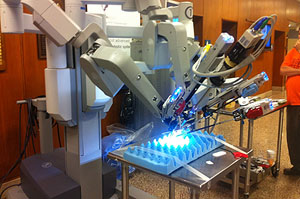
A Da Vinci surgical robot (photo by Nick Dawson via Flickr)
Dr. Greene says the robot is worth it because ā€œitā€™s minimally invasive. Itā€™s less blood loss. Itā€™s faster recovery.ā€
But after researchers studied thousands of robotic surgeries, it turns out that, but for a few exceptions, surgery outcomes arenā€™t any better and patientā€™s recovery time actually arenā€™tĀ any shorter.
Still, that hasnā€™t been enough to stop hospitals from engaging in a really expensive game of keeping up with the Joneses. In the San Francisco Bay Area alone there are at least 20 of these robots. At about $2 million a pop, thatā€™s $40 million.
But insurers typically wonā€™tĀ pay more for a robotic surgery, or for the newest kind of MRI or CAT scan. So instead hospitals recoup their costs by charging insurance companies more for everything. And that contributes to $20 aspirin pills and the worldā€™s highest health insurance costs.
But Greene saysĀ thereā€™s no choice:Ā ā€œI think everyone just assumes you have it, because why wouldnā€™t you? Itā€™s like having blood or beds or light in your OR now. You have to have a robot.ā€