After falling from a ladder and cutting his arm, Ed Knight said, he found himself at Richmond, Virginia's Chippenham Hospital surrounded by nearly a dozen doctors, nurses and technicians — its crack "trauma team" charged with saving the most badly hurt victims of accidents and assaults.
But Knight’s wound, while requiring about 30 stitches, wasn’t life-threatening. Hospital records called it “mild.” The people in white coats quickly scattered, he remembered, and he went home about three hours later.
“Basically, it was just a gash on my arm,” said Knight, 71. “The emergency team that they assembled didn’t really do anything.”
Nevertheless, Chippenham, owned by for-profit chain HCA Healthcare, included a $17,000 trauma team “activation” fee on Knight’s bill, which totaled $52,238 and included three CT scans billed at $14,000. His care should have cost closer to $3,500 total, according to claims consultant WellRithms, which analyzed the charges for KHN.
HCA Healthcare’s activation fees run as high as $50,000 per patient and are sometimes 10 times greater than those at other hospitals, according to publicly posted price lists. Such charges have made trauma centers, once operated mainly by established teaching hospitals, a key part of the company’s growth and profit-generating strategy, corporate officials have said. HCA’s stock has doubled in three years. The biggest U.S. hospital operator along with the Department of Veterans Affairs, HCA has opened trauma centers in more than half its 179 hospitals and in the country.
And it’s not slowing down.
HCA “has basically taken a position that all of their hospitals should be trauma centers,” said Dr. Robert Winchell, describing conversations he had with HCA officials. Winchell is a trauma surgeon and former chairman of the at the American College of Surgeons.
Trauma patients are typically those severely injured in automobile accidents or falls or wounded by knives or guns.
State or local regulators confer the designation “trauma center,” often in concert with standards verified by the American College of Surgeons. The status allows a cascade of lucrative reimbursement, including activation fees billed on top of regular charges for medical care. Trauma centers are mostly exempt from enacted to limit excessive hospital spending and expansion. The bills for all this — reaching into tens of thousands of dollars — go to private insurers, Medicare or Medicaid, or patients themselves.
“Once a hospital has a trauma designation, it can charge thousands of dollars in activation fees for the same care seen in the same emergency room,” said Stacie Sasso, executive director of the Health Services Coalition, made up of unions and employers fighting trauma center expansion by HCA and others in Nevada.
HCA’s expansion into trauma centers alarms health policy analysts who suggest its motive is more about chasing profit than improving patient care. Data collected by the state of Florida, analyzed by KHN, shows that regional trauma cases and expensive trauma bills rise sharply after HCA opens such centers, suggesting that many patients classified as trauma victims would have previously been treated less expensively in a regular emergency room.
Patients admitted to HCA and other for-profit hospitals in Florida with a trauma-team activation were far more likely to be only mildly or moderately injured than those at not-for-profit hospitals, .
HCA is “cherry-picking patients,” said , CEO of the University of Florida Health Shands, which runs a Level I trauma center, the highest designation. “What you find is an elderly person who fell and broke their hip who could be perfectly well treated at their local hospital now becomes a trauma patient.”
HCA’s trauma center expansion makes superior care available to more patients, providing “lifesaving clinical services while treating all critically injured patients,” said company spokesperson Harlow Sumerford.
Richmond’s population “is booming,” said Chippenham spokesperson Jeffrey Caldwell. “This increase in demand requires that the regional health care system keep up.”

Trauma Is Big Business
HCA’s trauma center boom picked up speed in Florida a decade ago and has spread to its hospitals in Virginia, Nevada, Texas and other states. It has sparked fierce fights over who handles highly profitable trauma cases and debates over when rival centers go head-to-head competing for patients.
“There’s no question it’s a money grab” by HCA, said Jimenez, who was part of a largely unsuccessful effort to stop HCA’s trauma center expansion in Florida. “It was clear that their trauma activation fees were five or six times larger than ours.”
In a process shielded from public view in Virginia, Chippenham recently applied for and won the highest trauma center designation, Level I, providing the most sophisticated care — and putting it squarely in competition with nearby VCU Health. VCU has run the region’s only Level I facility for decades. In October, Chippenham announced a contract for its own helicopter ambulance, which gives it another way to increase its trauma business, by flying patients in from miles away. The Virginia Department of Health rejected KHN’s request to review HCA’s Chippenham trauma center application and related documents.
“This is a corporate strategy” by HCA “to grow revenue, maximize reimbursement and meet the interest of stockholders,” said Dr. Arthur Kellermann, CEO of VCU Health, who says his nonprofit, state-run facility is sufficient for the region’s trauma care needs. “Many people in the state should be concerned that the end result will be a dilution of care, higher costs and poorer outcomes.”
Chippenham’s Caldwell said the “redundancy” with VCU “allows the region to be better prepared for mass trauma events.”
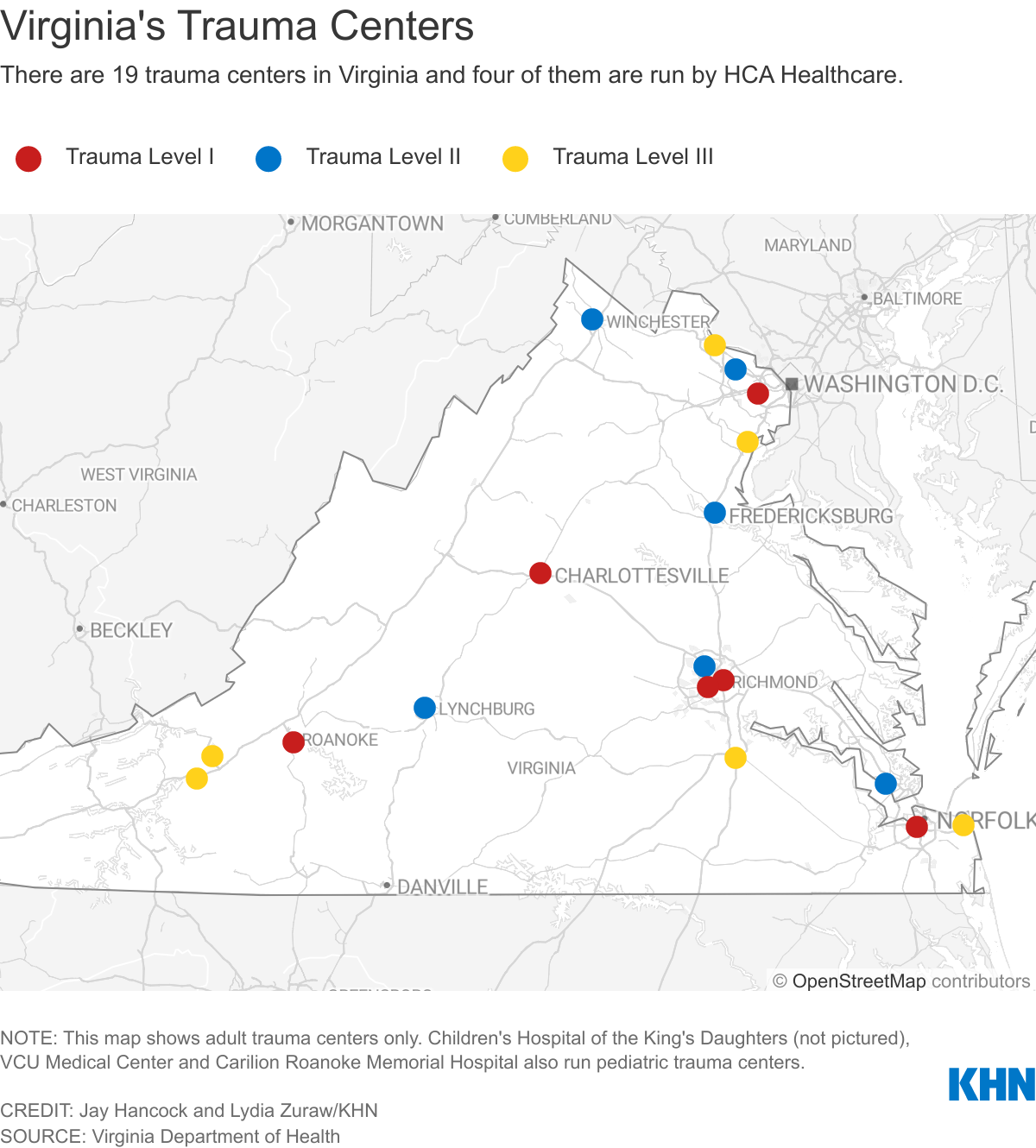
Studies show trauma centers need high volumes of complex cases to stay sharp. Researchers call it the “practice makes perfect” effect. Patients treated for traumatic brain injuries at hospitals seeing fewer than six such cases a year died at substantially higher rates than such patients in more experienced hospitals,
Another study, , showed that a decrease as small as 1% in trauma center volume — because of competition or other reasons — substantially increased the risk that patients would die.
By splitting a limited number of cases, a competing, cross-town trauma center could set the stage for subpar results at both hospitals, goes the argument. The number of VCU’s admitted adult trauma patients decreased from nearly 3,600 in 2014, before Chippenham attained Level II status, to 3,200 in 2019, VCU officials said.
Chippenham was the only Level I center in Virginia that declined to disclose its trauma patient volume to KHN.
“People are trying to push the [trauma center] designation process beyond what may be good for the major hospitals that are already providing trauma care,” said Dr. David Hoyt, executive director of the American College of Surgeons, speaking generally. Local authorities who make those decisions, he said, can be “pressured by a hospital system that has a lot of economic pull in a community.”
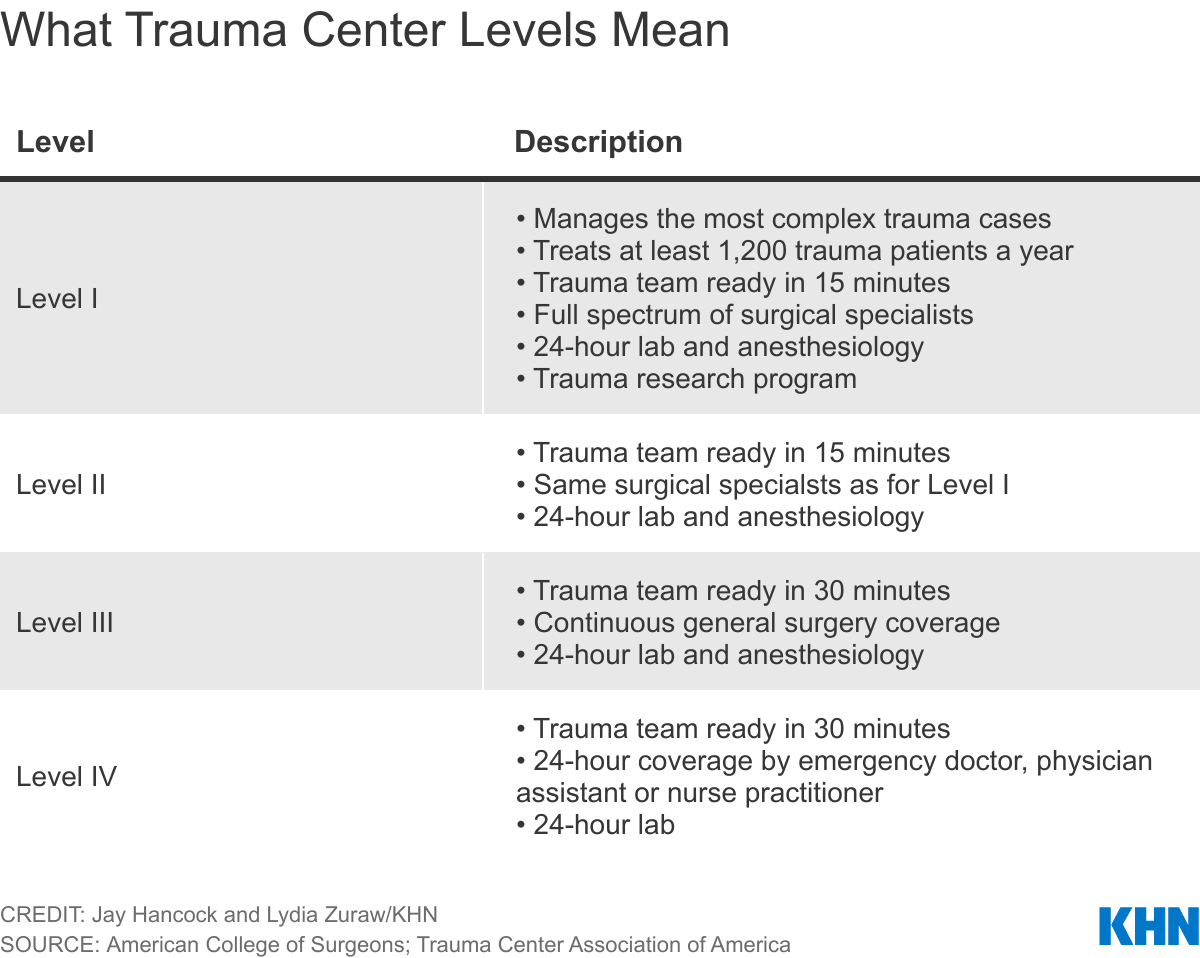
Unlike regular emergency departments, Level I and Level II trauma surgeons, neurosurgeons and special equipment available round-the-clock. Centers with Levels III or IV designations offer fewer services but are still more capable than many emergency rooms, with round-the-clock lab services and extra training, for example.
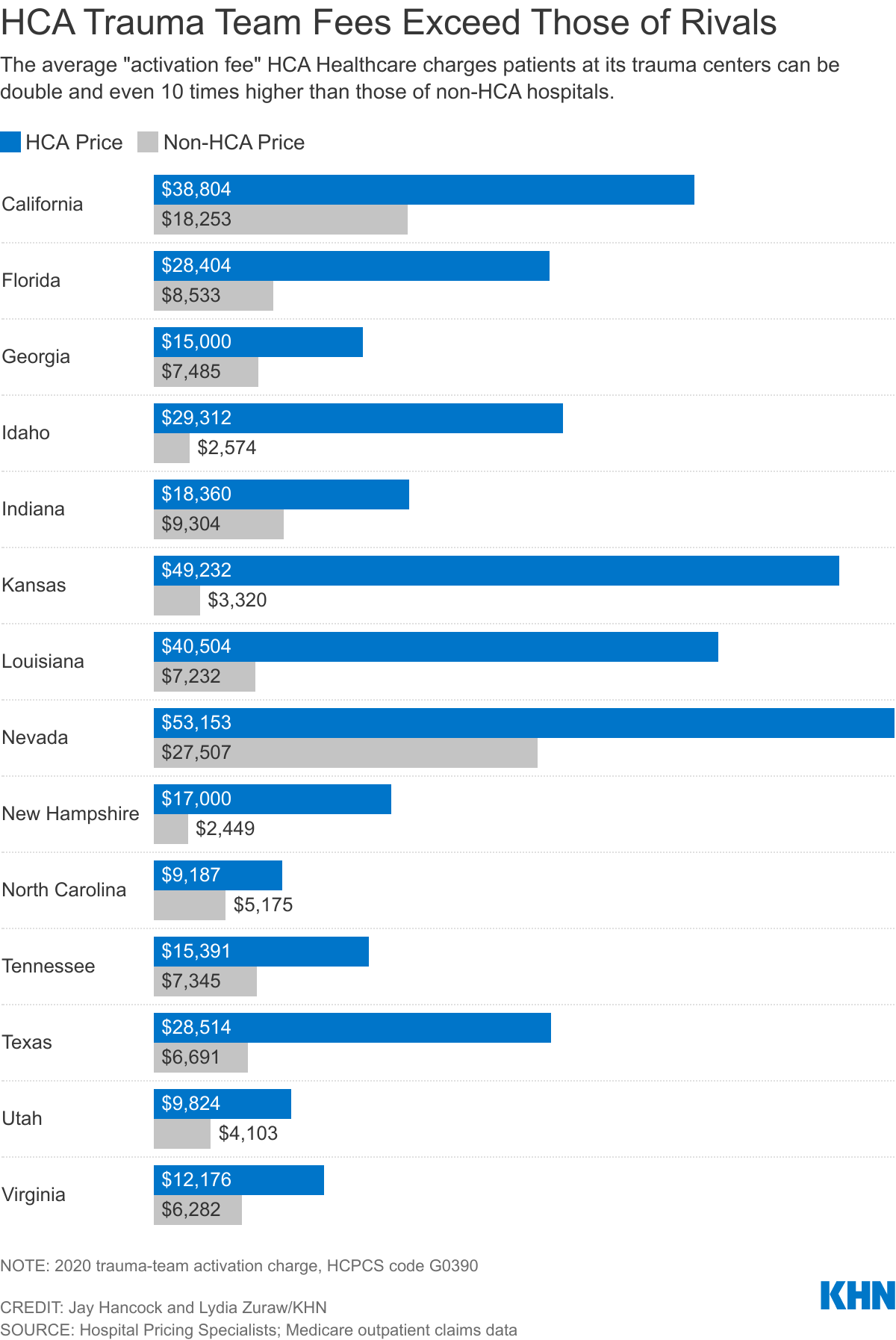
Hospitals defend trauma team activation fees as necessary to cover the overhead of having a team of elite emergency specialists at the ready. At HCA hospitals they can run more than $40,000 per case, according to publicly posted charge lists, although the amount paid by insurers and patients is often less, depending on the coverage.
“Fees associated with trauma activation are based on our costs to immediately deploy lifesaving resources and measures 24/7,” said HCA spokesperson Sumerford, adding that low-income and uninsured patients often pay nothing for trauma care. “What patients actually pay for their hospital care has more to do with their insurance plan” than the total charges, he said.
There is no standard accounting for trauma-related costs incurred by hospitals. One method involves for members of the trauma team by the potential hours worked. Hospitals don’t reveal calculations, but the wide variation in fees suggests they are often set with an eye on revenue rather than true costs, say industry analysts.
Reasonable charges for Knight’s total bill would have been $3,537, not $52,238, according to the analysis by WellRithms, a claims consulting firm that examined his medical records and Chippenham’s costs filed with Medicare. Given his minor injury, the $17,000 trauma activation fee “is not necessary,” said Dr. Ira Weintraub, WellRithms’ chief medical officer.
Often insurers pay substantially less than billed charges, especially Medicare, Knight's insurer. He paid nothing out-of-pocket, and Chippenham collected a total of $1,138 for his care, HCA officials said after this article was initially published. But hospitals can maximize revenue by charging high trauma fees to all insurers, including those required to pay a percentage of charges, say medical billing consultants.
VCU Health charges up to $13,455 for trauma activation, according to its charge list.
Average HCA trauma activation charges are $26,000 in states where the company does business — three times higher than those of non-HCA hospitals, according to data from Hospital Pricing Specialists, a consulting firm that analyzed trauma charges in Medicare claims for KHN.
The findings are similar to those reported , early in HCA’s trauma center expansion. The Times found that Florida HCA trauma centers were charging patients and insurers tens of thousands of dollars more per case than other hospitals.
Treating trauma patients in the ER is only the beginning of the revenue stream. Intensive inpatient treatment and long patient recoveries add to the income.
“We have more Level I, Level II trauma centers today than we have ever had in the company history,” HCA’s then-CEO, Milton Johnson, told stock analysts in 2016. “That strategy in turn feeds surgical growth. That strategy in turn feeds neurosciences growth, it feeds rehab growth.” Trauma centers attract “a certain cadre of high-value patients,” Dr. Jonathan Perlin, HCA’s chief medical officer, told analysts at a 2017 conference.
Patients at HCA’s largely suburban hospitals are more likely than those at an average hospital to carry private insurance, which pays much more than Medicare and Medicaid. the company’s revenue in 2020 came from private insurers, regulatory filings show. Hospitals, in general, collect of their revenue from private insurers, according to the Department of Health and Human Services.
HCA’s trauma cases can fit the same profile. At Chippenham, in south Richmond, trauma cases are “90% blunt trauma,” according to the hospital's online job posting last year for a trauma medical director. Blunt-trauma patients are generally victims of car accidents and falls and tend to have good insurance, analysts say.
VCU and other urban hospitals, on the other hand, treat a higher share of patients with gun and knife injuries — penetrating trauma — who are more often uninsured or covered by Medicaid. About 75% of VCU’s trauma cases are classified as blunt trauma, hospital officials said.
The 90% figure is “not accurate today,” Caldwell said. “Chippenham’s current mix of trauma type is aligned with that of other trauma centers in the region, and we treat traumas ranging from motor vehicle accidents to gunshots, stabbings and other critical injuries regularly.”
‘Trauma Drama’ in Florida and Beyond
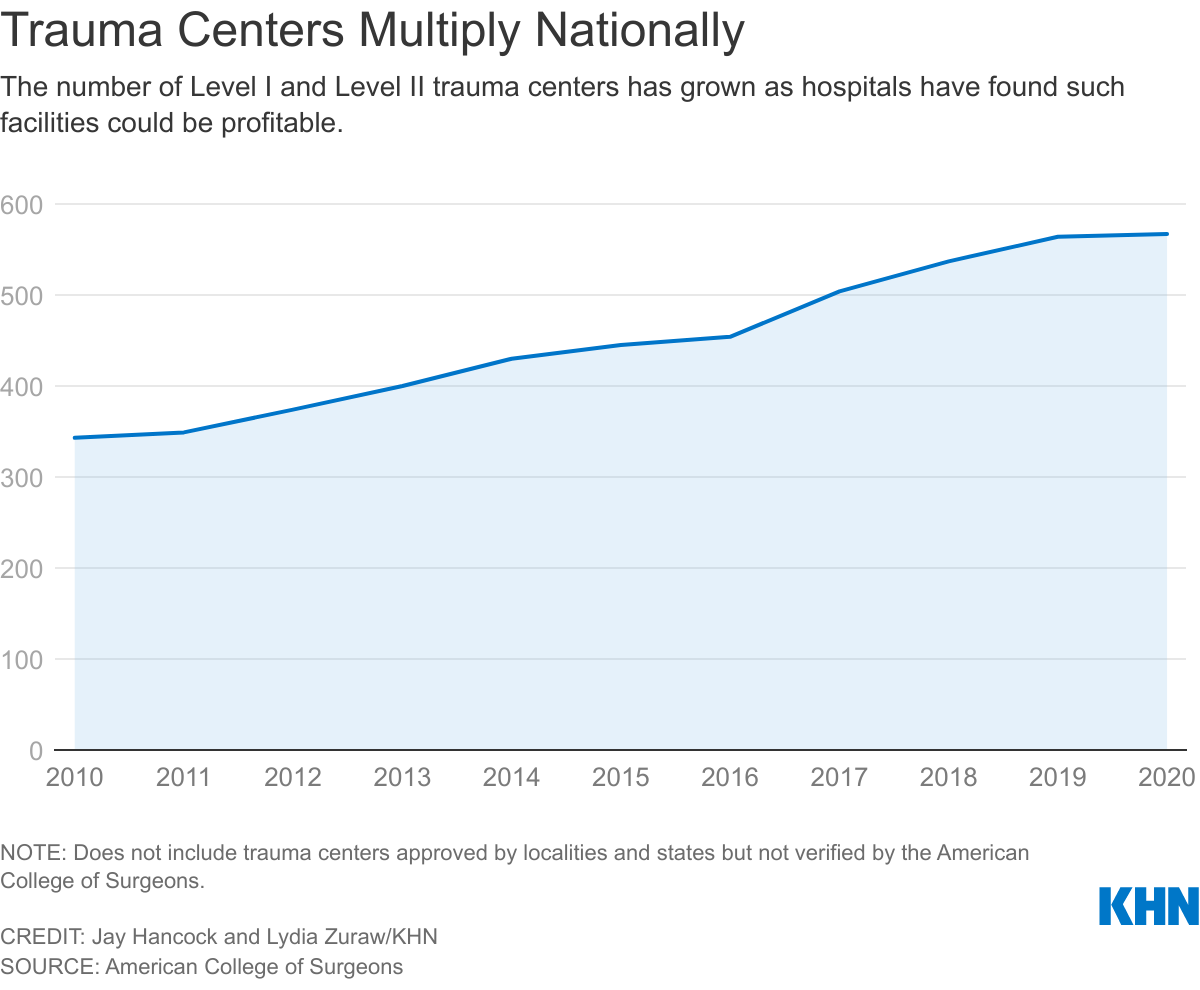
HCA’s growth strategy is part of a wider trend. From 2010 to 2020 the number of Level I and Level II trauma centers verified by the American College of Surgeons nationwide increased from 343 to 567.
Nowhere has HCA added trauma centers more aggressively or the fight over trauma center growth been more acrimonious than in Florida. The state’s experience over the past decade may offer a preview of what’s to come in Virginia and elsewhere.
In the thick of the controversy, — but only after the number of HCA trauma centers in the state had grown from one to 11 over more than a decade and helped spark an explosion in trauma cases, according to Florida Department of Health data.
News headlines called it “trauma drama.” Hospitals with existing centers repeatedly filed legal challenges to stop the expansion, with little effect. Florida’s governor at the time was Rick Scott, former chief executive of Columbia/HCA, a predecessor company to HCA.
After launching Level II centers across the state, HCA officials not to adopt recommending severely injured patients be treated at the highest level of trauma care in a region — Level I, if available.
HCA “kept on working, working, working, working for 10 years” to gain trauma center approvals over objections, said Mark Delegal, who helped broker the legislative settlement as a lobbyist for large safety-net hospitals. “Once they had what they wanted, they were happy to lock the door behind them.”
HCA hospitals “serve the health care needs of their communities and adjust or expand services as those needs evolve,” said Sumerford.
As HCA added trauma centers, trauma-activation billings and the number of trauma cases spiked, according to Florida Department of Health data analyzed by KHN. Statewide, inpatient trauma cases doubled to 35,102 in the decade leading up to 2020, even though the population rose by only 15%. HCA’s share of statewide trauma cases jumped from 4% to 24%, the data shows.
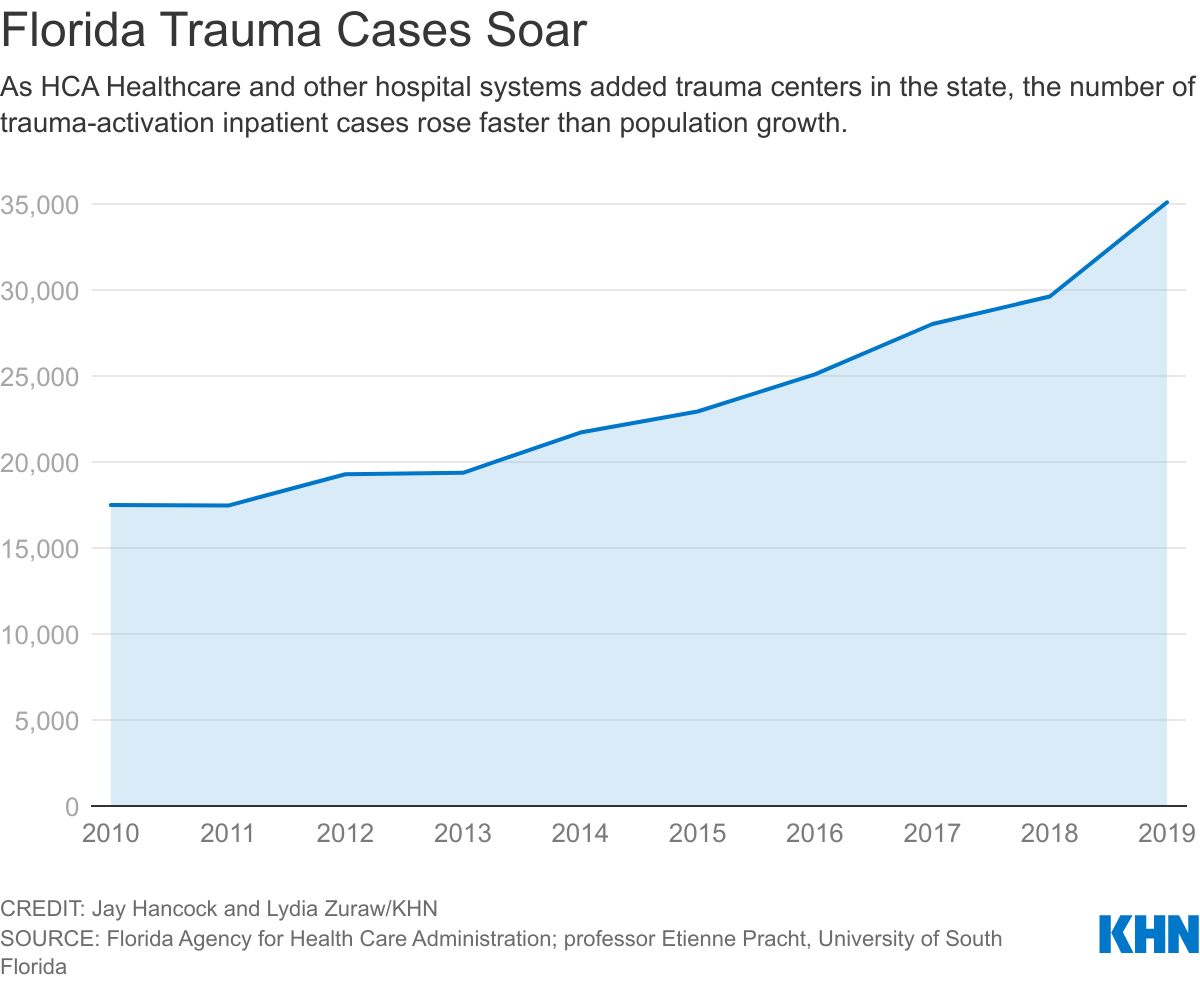
Charges for trauma activations, also known as trauma alerts, for HCA’s Florida hospitals averaged $26,890 for inpatients in 2019 while the same fees averaged $9,916 for non-HCA Florida hospitals, the data shows. Total average charges, including medical care, were $282,600 per case in 2019 for inpatient trauma cases at HCA hospitals, but $139,000 for non-HCA hospitals.
HCA's substantially higher charges didn't necessarily result from patients with especially severe injuries, public university research found.
Over three years ending in 2014, Florida patients with sprains, mild cuts and other non-life-threatening injuries were “significantly more likely” to be admitted under trauma alerts at HCA hospitals and other for-profit hospitals than at nonprofit hospitals, by University of South Florida economist Etienne Pracht and colleagues. HCA hospitals have admitted emergency department Medicare patients at substantially higher-than-average rates since 2011, suggesting that at other hospitals many would have been sent home, new by the Service Employees International Union found.
“What’s going on with HCA is the Wall Street model they’re following,” said Pracht, who provided KHN with additional Florida Department of Health data showing soaring trauma cases. “And Wall Street’s not happy unless you’re expanding. They’re driven by the motive to keep the stock price high.”
Lobbying and Campaign Dollars
In Virginia, health care organizations need to go through process to add something as basic as a $1 million MRI imaging machine.
But to open or upgrade a trauma center, all that’s needed is the approval of the health commissioner after a confidential qualification procedure. Chippenham did not seek or obtain Level I verification from the American College of Surgeons before getting Level I approval from the state. It is ACS-verified as a Level II center and, Caldwell said, is seeking Level I status with ACS.
Virginia requires an “extensive application” and “in-depth” site reviews by experts before a hospital gains status as a trauma center, Dr. M. Norman Oliver, the commissioner, said in an email. “Chippenham Hospital met the requirements” to become a Level I center, he said.

Nearly 80% of HCA’s Level I and Level II trauma centers have been verified by the American College of Surgeons “and the others currently are pursuing this verification,” said HCA spokesperson Sumerford.
As in other states, HCA invests heavily in Virginia in political influence. are registered with the state to advocate on HCA’s behalf. One lobbyist from December 2019 through February 2020 treating public officials to reception spreads and meals at posh Richmond restaurants such as L'Opossum and Morton’s the Steakhouse, lobbying records submitted to Virginia’s Conflict of Interest and Ethics Advisory Council show. HCA’s political action committee to state candidates last year, according to the records.
Like other hospital systems, HCA hires former paramedics for “EMS relations” or “EMS outreach” jobs. HCA’s EMS liaisons are expected to develop a “business plan, driving service line growth,” according to its employment ads.
Chippenham’s decision to start a helicopter ambulance operation last year to compete with others in transporting trauma patients surprised some public officials. HCA and its contractor had for the operation to be reimbursed by insurers when Richmond City Council members learned about it. Members “were not up to speed on this matter,” council member Kristen Larson told a May 2020 meeting of the Richmond Ambulance Authority, .
Chippenham’s air ambulance partner, private equity-owned Med-Trans, has been the subject of media reports of patients with in out-of-network bills. It’s not unusual for air ambulances to charge $30,000 or more for transporting a patient from a highway accident or just across town, according to news reports.
Last year, 85% of Med-Trans flights for Virginia patients with health insurance were in-network, said a company spokesperson. But Med-Trans is out of network for Virginia members of Aetna and UnitedHealthcare, two of the state’s biggest carriers, said spokespeople for those companies. Med-Trans is part of Anthem Blue Cross Blue Shield’s network, an Anthem spokesperson said.
HCA runs trauma centers “really well,” said Winchell, who runs the Level I trauma center at NewYork-Presbyterian Weill Cornell Medical Center.
But “there are clearly areas of oversupply” for trauma centers generally, he said.
Instead of letting a drive for profits dictate trauma center expansion, health authorities need “objective and transparent metrics” to guide the designation of trauma centers, Winchell in the Journal of the American College of Surgeons.
Free-market advocate “Adam Smith might have been a good economist,” he wrote, “but he would have been a very poor designer of trauma systems.”
KHN data editor Elizabeth Lucas contributed to this report.
ºÚÁϳԹÏÍø News is a national newsroom that produces in-depth journalism about health issues and is one of the core operating programs at KFF—an independent source of health policy research, polling, and journalism. Learn more about .