DARLINGTON, S.C. ��� Just off the deserted town square, with its many boarded-up businesses, people lined up at the walk-up pharmacy window at Genesis Health Care, a federally funded clinic.
Drug sales provide the bulk of the revenue for Genesis, a nonprofit community health center treating about 11,000 mostly low-income patients in seven clinics across South Carolina.
Those sales helped Genesis record a $19 million surplus on $52 million in revenue ��� a margin of 37% ��� in 2021, according to its audited financial statement. It was the fourth consecutive year the center���s surpluses had topped 35%, the records showed. The industry average is 5%, according to a federally funded report on health centers��� financial performance.
Genesis attributes its large margins to excellent management and says it needs the money to expand and modernize services while being less reliant on government funding. The center benefits financially from the use of a government drug discount program.
Still, Genesis��� hefty surplus stands out among nonprofit federally qualified health centers, a linchpin in the nation���s safety net for treating the poor.
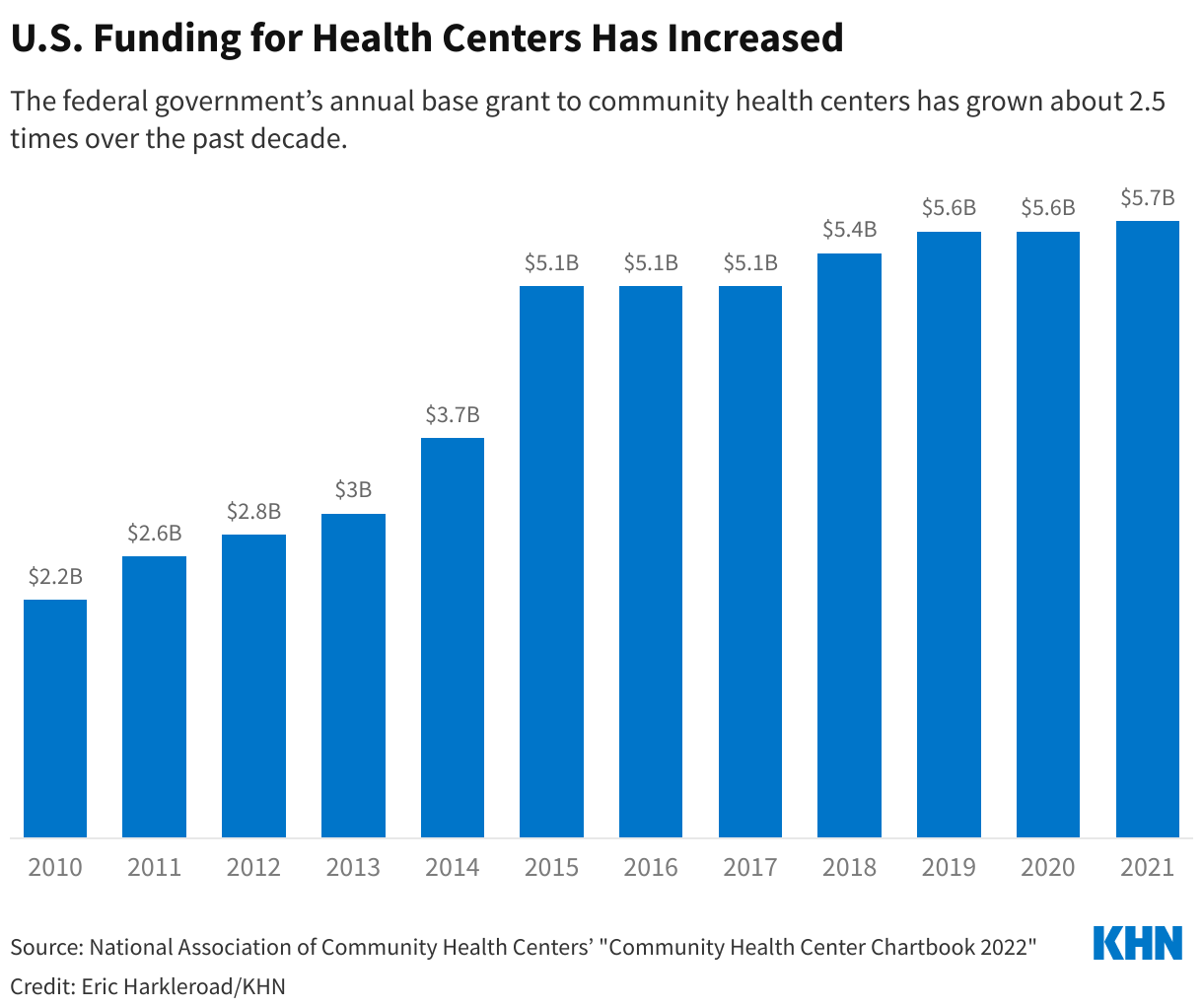
The federal government pumped more than $6 billion in basic funding grants last year into around the country, which provide primary care for mostly low-income people. In 2021, the American Rescue Plan Act provided an additional $6 billion over two years for covid-19 care.
These community health centers must take all patients regardless of their ability to pay, and, in return, they receive annual government grants and higher reimbursement rates from Medicaid and Medicare than private physicians.
Yet a KHN analysis found that a handful of the centers recorded profit margins of 20% or more in at least three of the past four years. Health policy experts said the surpluses alone should not raise concerns if the health centers are planning to use the money for patients.
But they added that the high margins suggest a need for greater federal scrutiny of the industry and whether its money is being spent fast enough.
���No one is tracking where all their money is going,��� said , an assistant professor at the University of Oklahoma who has studied health center finances.
The federal Health Resources and Services Administration, which regulates the centers, has limited authority under federal law over how much the centers spend on services and how they use their surpluses, said , an associate administrator.
���The expectation is they will take any profit and plow it back into the operations of the center,��� Macrae said. ���It���s definitely something we will look at and what they are doing with those resources,��� he added about KHN���s findings.
, an accounting and health professor at Johns Hopkins University, questioned why some centers should be making profit margins of 20% or more over consecutive years.
A center with a high margin ���raises questions about where did the surplus go��� and its tax-exempt status, Bai said. ���The centers have to provide enough benefit to deserve their public tax exemption, and what we are seeing here is a huge amount of profits,��� she said.
Bai said centers must be able to answer questions about ���why aren���t they doing more to help the local community by expanding their scope of service.���
Officials at the health centers defended their strong surpluses, saying the money allows them to expand services without being dependent on federal funds and helps them save for big projects, such as constructing new buildings. They pointed out that their operations are overseen by boards of directors, at least 51% of whom must be patients, ostensibly so operations meet the community���s needs.
���Health centers are expected to have operating reserves to be financially sustainable,��� said Ben Money, a senior vice president at the National Association of Community Health Centers. Surpluses are necessary ���as long as health centers have plans to spend the money to help patients,��� he said.
Some center officials noted bottom-line profit margins can be skewed by large contributions earmarked for building projects. Grants and donations appear as revenue in the year they were given, but a project���s costs are allocated on financial statements over a longer period, often decades.
���We Don���t Take Unnecessary Risks���
The annual federal base grant for centers makes up about 20% of their funding on average, according to HRSA. The grants have more than doubled over the past decade. These federal grants to the centers are provided on a competitive basis each year based on a complex formula that takes into account an area���s need for services and whether clinics provide care to specific populations, such as people who are homeless, agricultural workers, or residents of public housing.
The centers also receive Medicare and Medicaid reimbursements that can be as much as twice what the federal programs pay private doctors, said Jeffrey Allen, a partner with the consulting firm Forvis.
In addition, some health centers like Genesis also benefit from the 340B federal drug discount program, which allows them to buy medicines from manufacturers at deeply discounted rates. The patients��� insurers typically pay the centers a higher rate, and the clinics keep the difference. Clinics can reduce the out-of-pocket costs for patients but are not required to.
For its analysis, KHN started with research by Davlyatov that used centers��� tax filings to the IRS to identify the two dozen centers with the highest profit margins in 2019. KHN calculated bottom-line profit margin for each of the past four years (2018 through 2021) by subtracting total expenses from total revenue, which yields that year���s surplus, and then dividing that by total revenue. Money given by donors for restricted uses was excluded from revenue. After examining the centers��� finances, KHN found nine that had margins of 20% or more for at least three years.
North Mississippi Primary Health Care was one of them.
���We don���t take unnecessary risks with corporate assets,��� said Christina Nunnally, chief quality officer at the center. In 2021, the center had nearly $9 million in surpluses on $36 million in revenue. More than $25 million of that revenue came from the sale of drugs.
Nunnally said the center is building a financial cushion in case the 340B program ends. Drugmakers have been seeking changes to the program.
The center recently opened a school-based health program, a dental clinic, and clinics in neighboring counties.
���There may come a day when this type of margin is not feasible anymore,��� she said. If the center hits hard times, it would not want to ���have to start cutting programs and people.���
In Montana, Sapphire Community Health in Hamilton, which accumulated nearly $3 million in surpluses from 2018 through 2020 and had a profit margin of more than 24% in each of those years, wants to move out of its rented quarters to a building that will cost at least $6 million to construct. ���A new facility will enable us to provide services that we cannot provide due to lack of space, such as imaging, obstetrics, and dental services,��� CEO Janet Woodburn said.
Outside Los Angeles, Friends of Family Health Center CEO said his high margins are the result of good management and California���s broad Medicaid coverage for low-income residents.
The center ��� whose profit margins topped 25% from 2018 to 2020 ��� opened a $1.9 million facility in Ontario last year and purchased the building that houses its main clinic, in La Habra, for $12.3 million, with plans to expand it, he said.
Bahremand added that the center also keeps administrative costs down by focusing on having more providers in relatively fewer locations.
���You shouldn���t be asking: ���Why are we making so much money?��� You should be asking: ���How come other clinics are not making so much money?������ Bahremand said.
Concern About Paying the Bills
In South Carolina, Genesis began as an independent clinic and was sometimes barely able to make payroll, said Tony Megna, Genesis��� CEO and general counsel. Converting to a federally qualified health center about a decade ago brought federal funding and a more solid footing. It recorded more than $65 million in surpluses from 2018 to 2021.
���Our attitude toward money is different than most because it���s so ingrained in us to be concerned about whether we are going to pay our bills,��� said Katie Noyes, chief special projects officer.
The center is spending $50 million to renovate and expand its aging facilities, Megna said. In Darlington, a new $20 million building that will more than double the facility���s space is scheduled to open in 2023. And its strong bottom line helps the center pay all its workers at least $15.45 an hour, more than twice the minimum wage in the state, Megna said. Darlington County���s annual median household income is a bit over $37,000.
Megna was paid nearly $877,000 in salary and bonuses in 2021, according to Genesis��� latest IRS tax filing, an amount nearly four times the industry average.
David Corry, chairman-elect of the Genesis board of directors, said in a memo to KHN that part of that compensation made up for several years when Megna was inadvertently underpaid. ���We determined early on that providing Mr. Megna an ���average��� compensation like those of other FQHCs CEOs was not what we wanted. Mr. Megna���s extensive legal experience and education as well as his institutional and regulatory knowledge set him apart from others.���
Megna said his base salary is $503,000.
Genesis officials said the financial security afforded by the center���s surpluses has allowed them to provide extra patient services, including foot care for people with diabetes. In 2020, Genesis used $2 million to create an independent foundation to help families with food and utility bills, among other needs.
Most of Genesis��� revenue comes from the 340B program, according to its audited financial statements. Many prescriptions filled at the clinic pharmacy are for expensive specialty drugs, which treat rare or complex conditions such as cancer. Getting accredited to dispense specialty drugs was expensive, Corry said, but ���paid off because it gives our patients access to extremely high-priced, and often lifesaving prescription drugs that would not otherwise be available to many of them.���
Megna, 67, a former bankruptcy lawyer, said it���s vital to keep the center financially secure to stay open for patients.
���We are very careful in how we spend our money,��� Megna said.
窪蹋勛圖厙 News is a national newsroom that produces in-depth journalism about health issues and is one of the core operating programs at KFF���an independent source of health policy research, polling, and journalism. Learn more about .