As more than $50 billion makes its way to state and local governments to compensate for the opioid epidemic, people with high hopes for the money are already fighting over a little-known bureaucratic arm of the process: state councils that wield immense power over how the cash is spent.
In 15 states, these councils have the ultimate say on the money, which comes from companies that made, distributed, or sold opioid painkillers, including Purdue Pharma, Johnson & Johnson, and Walmart. In 24 other states, plus Washington, D.C., the councils establish budget priorities and make recommendations. Those will affect whether opioid settlement funds go, for example, to improve addiction treatment programs and recovery houses or for more narcotics detectives and prisons.
窪蹋勛圖厙 News, along with Johns Hopkins University and Shatterproof, a national nonprofit focused on the addiction crisis, gathered and analyzed data on council members in all states to create the first database of its kind.
The data shows that councils are as unique as states are from one another. They vary in size, power, and the amount of funds they oversee. Members run the gamut from doctors, researchers, and county health directors to law enforcement officers, town managers, and business owners, as well as people in recovery and parents who���ve lost children to addiction.
���The overdose crisis is incredibly complex, and it demands more than just money,��� said , a policy associate with the nonprofit Community Education Group, which is across Appalachia. ���We also need the right people in charge of that money.���
That���s the $50 billion question: Are the right people steering the decisions? Already, criticism of the councils has been rife, with stakeholders pointing out shortcomings, from overrepresentation to underrepresentation and many issues in between. For example:
- Council membership doesn���t always align with the states��� hardest-hit populations ��� by race or geography.
- Heavy presence of specific professional groups ��� treatment providers, health care executives, or law enforcement officials, for example ��� might mean money gets directed to those particular interests at the expense of others.
- Few seats are reserved for people who���ve dealt with a substance use disorder themselves or supported a family member with one.
Admittedly, no one can design a perfect council. There���s no agreement on what that would even look like. But when a pile of money this big is at stake, everyone wants in on the action.
More than $3 billion of opioid settlement funds has already landed in government coffers, with installments to come through 2038. The money is meant as restitution for the hundreds of thousands of Americans from drug overdoses in recent decades.
But what restitution looks like depends on whom you ask. People running syringe service programs might suggest spending money immediately on the overdose reversal medication naloxone, while hospital officials might advocate for longer-term investments to increase staffing and treatment beds.
���People naturally want money to go toward their own field or interest,��� said , vice president of state policy at Shatterproof.
And that can trigger hand-wringing.
In many parts of the country, for instance, people who support syringe service programs or similar interventions worry that councils with high numbers of police officers and sheriffs will instead direct large portions of the money to buy squad cars and bulletproof vests. And vice versa.
In most states, though, law enforcement and criminal justice officials make up fewer than one-fifth of council members. In Alaska and Pennsylvania, for instance, they���re not represented at all.
Outliers exist, of course. Tennessee���s 15-member council has two sheriffs, one current and one former district attorney general, a criminal court judge, and a special agent from the state Bureau of Investigation. But like many other councils, it hasn���t awarded funds to specific groups yet, so it���s too soon to tell how the council makeup will influence those decisions.
Pendergrass and Johns Hopkins researcher , who together compiled the list of council members, say criticism of councils drawing too heavily from one field, geographic area, or race is not just a matter of political correctness, but of practicality.
���Having diverse representation in the room is going to make sure there is a balance on how the funds are spent,��� Pendergrass said.
To this end, Courtney Gary-Allen, organizing director for the , and her colleagues chose early on to ensure their state���s 15-member council included people who support what���s known as harm reduction, a politically controversial strategy that aims to minimize the risks of using drugs. Ultimately, this push led to the appointment of six candidates, including Gary-Allen, to the panel. Most have personal experience with addiction.
���I feel very strongly that if these six folks weren���t on the council, harm reduction wouldn���t get a single dollar,��� she said.
Others are starting to focus on potential lost opportunities.
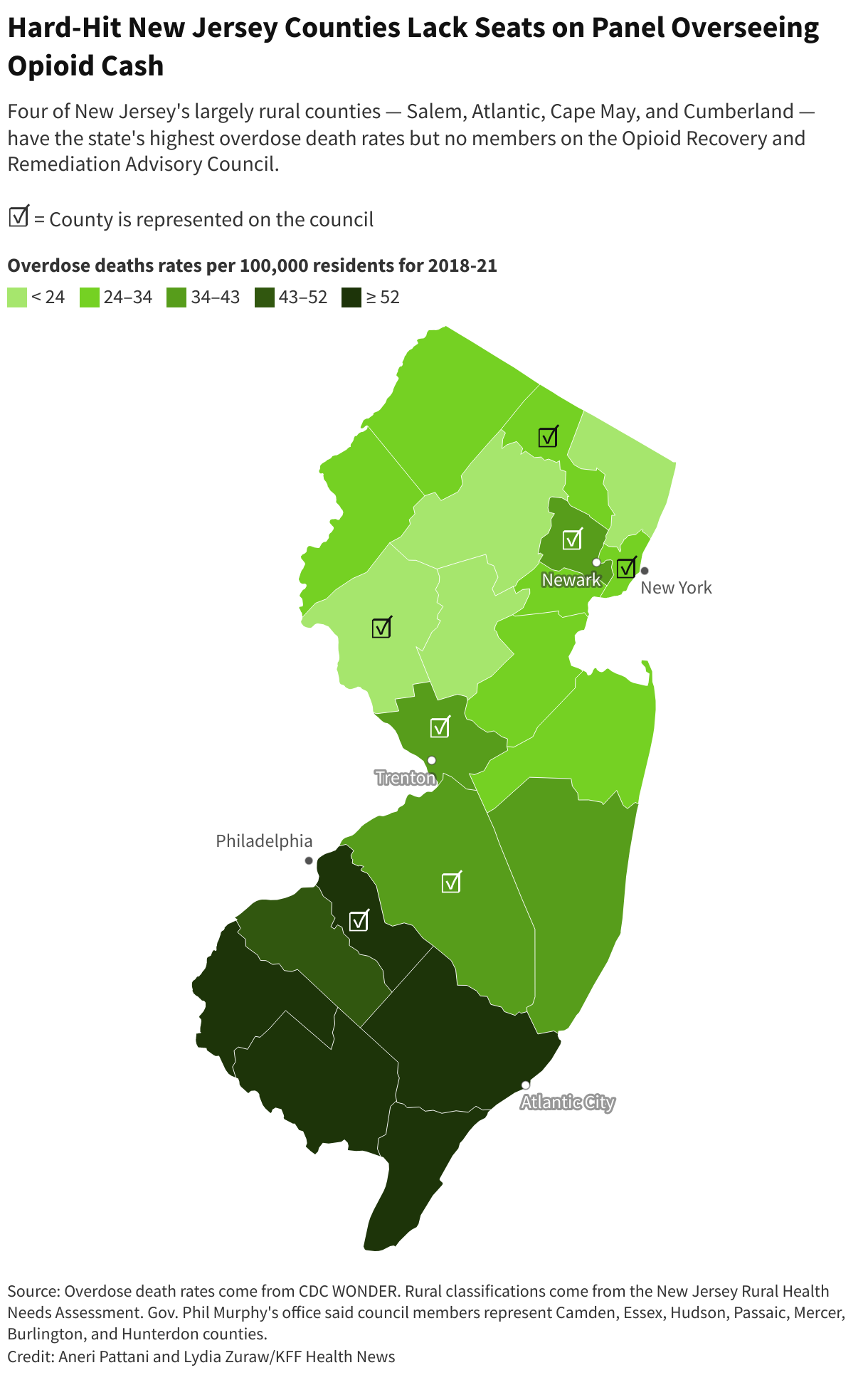
In New Jersey, , who is in recovery from substance use disorder, has noticed that most members of her state���s council represent urban enclaves near New York City and Philadelphia. She worries they���ll direct money to their home bases and exclude rural counties, which have the highest rates of overdose deaths and unique barriers to recovery, such as a lack of doctors to treat addiction and transportation to faraway clinics.
Natalie Hamilton, a spokesperson for New Jersey Gov. Phil Murphy, a Democrat who , said the council represents ���a wide geographic region,��� including seven of the state���s 21 counties.
But only two of those represented ��� Burlington and Hunterdon counties ��� are considered rural by the state���s Office of Rural Health . The state���s hardest-hit rural counties lack a seat at the table.
Now that most of the council seats nationwide are filled, worries about racial equity are growing.
Louisiana, where nearly a third of the population is Black, has no Black council members. In Ohio, where Black residents are at the highest rates, only one of the 29 council members is Black.
���There���s this perception that this money is not for people who look like me,��� said , who is chief operating officer of Faces & Voices of Recovery and is Black. His group organizes people in recovery to advocate on addiction issues.
Research shows Black Americans have the overdose death rates and face the most .
In several states, residents have lamented the lack of council members with firsthand knowledge of addiction, who can direct settlement dollars based on personal experiences with the treatment and criminal justice systems. Instead, councils are saturated with treatment providers and health care organizations.
And this, too, raises eyebrows.
���Service providers are going to have a monetary interest,��� said , who leads policy advocacy at the New York-based Legal Action Center. Although most are good people running good treatment programs, they have an inherent conflict with the goal of making people well and stable, she said.
���That is work to put treatment programs out of business,��� Gardner said. ���We must never forget the business model. It was there for HIV, it was there for covid, and it���s there for the overdose epidemic.���
Councils in South Carolina and New York have already seen some controversy in this vein ��� when organizations associated with members or funding. It���s not a particularly surprising occurrence, since the members are chosen for their prominent work in the field.
Both states��� councils have robust conflict-of-interest policies, requiring members to disclose professional and financial connections. New York also has a law precluding council members from using their position for financial gain, and South Carolina to objectively score applications.
That these situations cause alarm regardless shows how much hope and desperation is tied up in this money ��� and the decisions over who controls it.
���This is the biggest infusion of funding into the addiction treatment field in at least 50 years,��� said Gardner. ���It���s money coming into a starved system.���
Database Methodology
The list of council members��� names used to build the database was compiled by Johns Hopkins University���s Sara Whaley and Henry Larweh and Shatterproof���s Kristen Pendergrass and Eesha Kulkarni. All council members, even those without voting power, were listed.
Although many states have councils to address the opioid crisis generally, the database focused specifically on councils overseeing the opioid settlement funds. A council���s scope of power was classified as ���decision-making��� if it directly controls allocations. ���Advisory��� means the council provides recommendations to another body, which makes final funding decisions.
The data is current as of June 9, 2023.
窪蹋勛圖厙 News��� Aneri Pattani, Colleen DeGuzman, and Megan Kalata analyzed the data to determine which categories council members represent, based on the following rules:
��� Each council member can be counted in only one category. There is no duplication.
��� People should be given the most descriptive categorization possible. For example, attorneys general are ���elected officials,��� but it is more specific to say they are ���law enforcement and criminal justice��� officials.
��� A ���government representative��� is typically a government employee who is not elected and does not fit into any other descriptive category ��� for example, a non-elected county manager.
��� People who provide direct services to patients or clients, such as physicians, nurses, therapists, and social workers, are classified as ���medical and social service providers.��� People with more administrative roles are typically classified as ���public��� or ���private health and human services,��� based on their organization���s public or private affiliation.
��� ���Lived or shared experience��� refers to someone who has personally experienced a substance use disorder, has a family member with one, or has lost a loved one to the disease. Because people���s addiction experiences are not always public, only individuals explicitly appointed because of their firsthand connection or to fill a seat reserved for someone with that experience were categorized as such.
窪蹋勛圖厙 News��� Colleen DeGuzman and Megan Kalata contributed to this report.
窪蹋勛圖厙 News is a national newsroom that produces in-depth journalism about health issues and is one of the core operating programs at KFF���an independent source of health policy research, polling, and journalism. Learn more about .