


For three exhausting years, Lauren Lockwood tried to get her son Rex to sleep through the night. As an infant, he couldn���t sleep without a blanket over his carrier to drown out the world around him. At age 2, it sometimes took hours for him ��� and her ��� to fall asleep, only for him to be jolted awake from night terrors that left him shrieking in panic.
Over the years, Lockwood, a nurse midwife who runs a group for new moms from her home in Oakland, California, experimented with a gamut of approaches to bedtime. When Rex was a baby, she let him ���cry it out��� so he could learn to put himself back to sleep. As he got older, she would lie beside him for hours each night. Finally, she hired a sleep consultant who created yet another plan that didn���t solve the problem. By the time Rex was 3, Lockwood, with another baby on the way, was worn out and desperate.
Then she read about melatonin, a hormone released by the human pineal gland that helps regulate the sleep cycle. Melatonin is sold as a dietary supplement at pharmacies across the U.S. and marketed for kids in the form of chewable tablets, flavored liquids, and gummies. ���I thought maybe he just needed a reset,��� said Lockwood.
From the very first night, said Lockwood, ���it was like a whole different kid.��� She gave him a melatonin tablet and read him a story, and he fell asleep almost immediately. ���Our plan was to use melatonin for two weeks and stop.���
Six years later, he still takes it every night.
Throughout history, parents have searched for the secret to a smoother bedtime: sleeping together, sleeping apart, the war of wills, offering stuffies and pacifiers and warm milk, even spending $1,600 on a ���smart��� bassinet that responds to a baby���s cries with white noise and motion.
In recent years, melatonin supplements have become an increasingly common child sleep aid that in the U.S. requires no prescription and is only lightly regulated by the FDA.
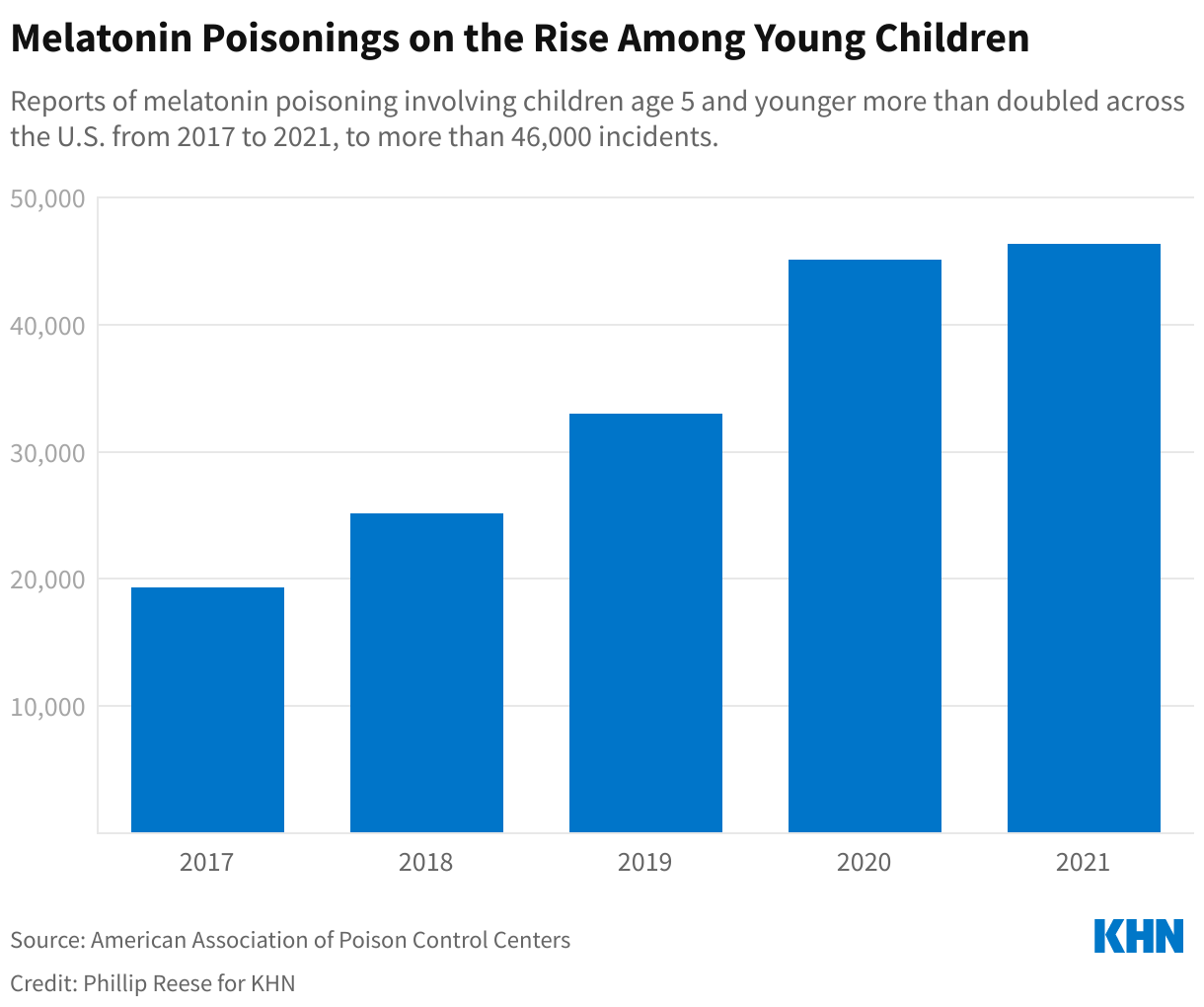
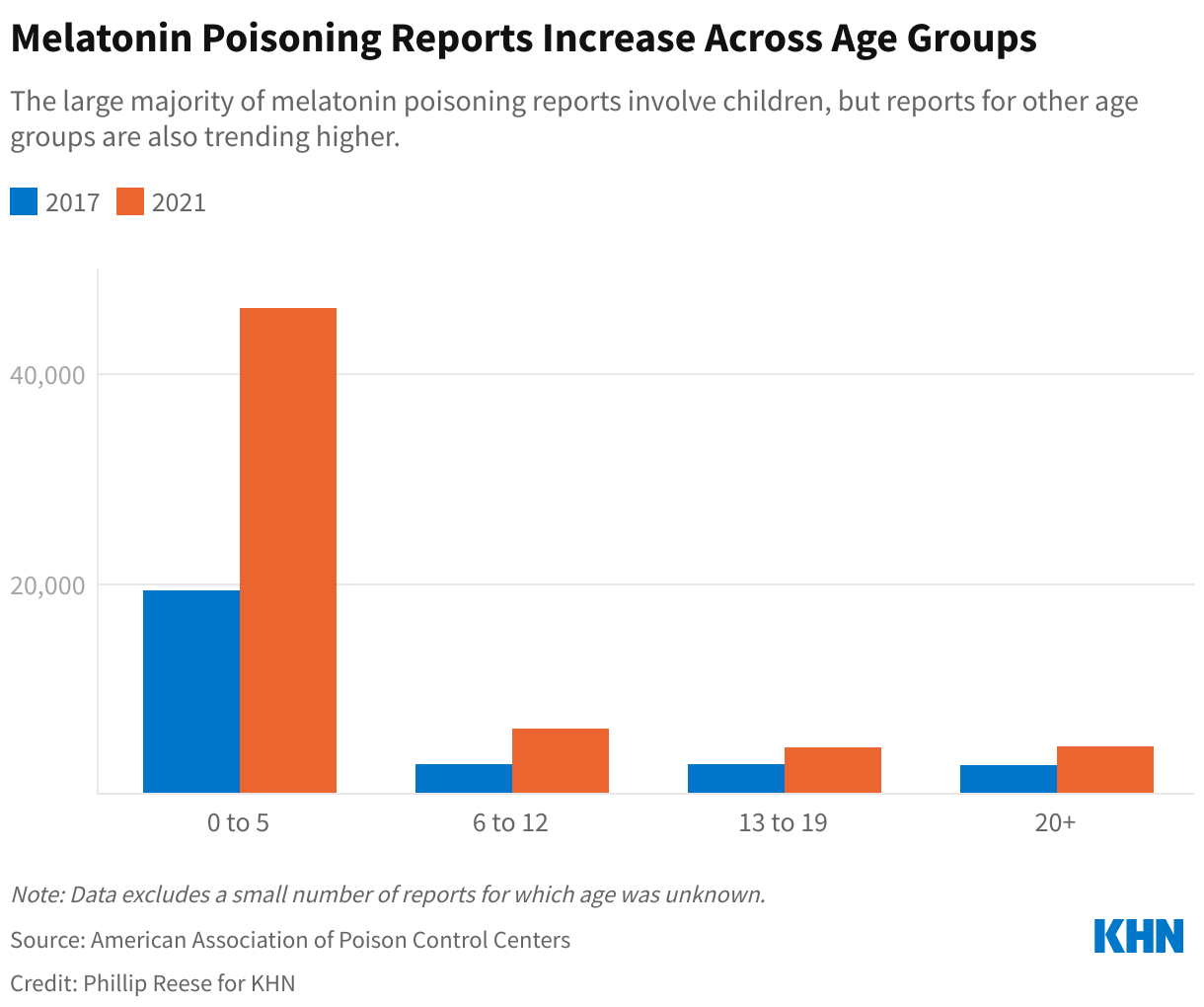
In 2021, Americans spent $1.09 billion overall on melatonin supplements, a nearly 150% increase over 2018 sales, according to data provided by NielsenIQ. Meanwhile, the number of reports of melatonin poisoning involving young children ��� meaning they ingested excessive dosages ��� more than doubled from 2017 through 2021, according to the American Association of Poison Control Centers. There were about 46,300 melatonin poisoning reports involving children age 5 and under in 2021, up from nearly 19,400 in 2017. Potential symptoms of an overdose include headaches, dizziness, and irritability. Only a handful of the reported incidents led to major medical issues.
���It speaks to the ubiquitousness of melatonin. It���s trickled down to younger and younger children,��� said Dr. Judith Owens, co-director of the sleep center at Boston Children���s Hospital and a professor of neurology at Harvard Medical School. ���What I find particularly alarming is that pediatricians are recommending this as a quick fix. It gives parents and then older kids the message that if you can���t sleep, you need to take a pill.���
The American Academy of Sleep Medicine the use of melatonin for chronic insomnia in both adults and children and will soon release a health advisory stating that melatonin should not be used in children without a physician���s supervision, said Dr. Muhammad Adeel Rishi, co-chair of the group���s public safety committee and a sleep specialist at Indiana University.
���More often than not insomnia in children is a behavioral problem, and it���s related to their bedtime routine, access to electronics at bedtime, and other activities they engage with other than sleeping,��� said Rishi. ���Often you can treat it without medication, with behavioral interventions.���
Rishi attributes the recent increase in children���s use of melatonin in part to marketing efforts by supplement manufacturers, including products like gummies targeted specifically to children. But he also believes the pandemic has spawned a ���growing epidemic of insomnia.���
���We���ve been going through a very stressful time as a society. It���s available over the counter, so there���s easy access. Parents are often taking it themselves. And it���s supposedly safe,��� said Rishi. ���It���s kind of a perfect storm.���
For all the concern expressed about melatonin, it also has staunch defenders among sleep specialists and pediatricians, creating a confusing mixed message for parents seeking a fix for their sleep-deprived households.
Dr. Rafael Pelayo, a professor in the division of sleep medicine at Stanford Medicine, said he considers melatonin a useful tool for treating sleep disorders in children. ���It���s simply telling the brain that night is approaching,��� he said. ���I think the real problem isn���t that it���s being overused. It���s how prevalent sleep problems are for kids.���
���A small improvement in the child���s sleep,��� he added, ���can have a dramatic impact on the family.���
Pelayo said he sometimes recommends melatonin for children while the family also implements behavioral changes to address an underlying issue. Many kids manage without it after they learn the skill of sleeping on their own, he said, but some do end up taking it long term. He said it works best for children who have trouble falling asleep, rather than those who wake frequently through the night.
Melatonin is a heated topic of conversation in Facebook groups like , of which Jill Kunishima is a member. Kunishima first tried melatonin for her son at the suggestion of their pediatrician. He had been a good sleeper until he went to preschool at age 3. The school���s late naptime disrupted his schedule, and he was staying up until nearly 10 p.m.
���The next day he was a mess. We���d go into his room in the morning, and he was all crotchety,��� said Kunishima, who lives in Oakland.
The pediatrician recommended a 1-milligram melatonin tablet for a week or two, and her son���s bedtime went back to 8:30 p.m. ���It got his body to calm down,��� she said. ���It was just what he needed.��� But when she tried to wean him, she said, the problem started again.
When Kunishima went in for her son���s next medical visit, the pediatrician said not to worry. ������If that���s the thing that���s going to keep your life just a little bit sane during this moment, just go ahead,������ she recalled the doctor telling her. ���But now he���s 6, in first grade, and he���s still using it.���
Studies suggest that melatonin appears to be safe for short-term use in children, but there is little information on the long-term effects, . Because melatonin is a hormone, some experts worry its use could delay puberty, though the evidence is scarce. Other possible side effects include drowsiness, bed-wetting, and agitation.
Because melatonin is treated as a supplement in the U.S. ��� as opposed to a drug ��� the quality and dosage levels can vary widely. that tested 31 melatonin supplements found the actual melatonin levels ranged from less than a fifth to nearly five times the dosage listed on their labels. One in 4 of the products tested also contained serotonin, a hormone that can have serious side effects even at low doses.
Owens said she worries about the teenagers and young adults who have been on melatonin for a decade or more, the effects of which are still unknown. ���Whenever you recommend or prescribe a sleep medication, you have to have an exit strategy. What is your benchmark for saying we���re going to stop this medication now?��� she said. ���I have patients who ask for their sleep pill every night, and that sends chills up my spine.���
She also worries that the American Academy of Pediatrics has not released official guidelines on the use of melatonin in children, given pediatricians frequently recommend melatonin as a sleep aid and in ever-younger patients ��� sometimes starting at 6 months old.
Lockwood said her now-9-year-old son still takes about a quarter of a milligram of melatonin every night before bed. It���s such a small dose that she wonders if perhaps he might be experiencing a placebo effect, but efforts to wean him revive his insomnia.
At Lockwood���s new moms group in Oakland, sleep is often the main topic of conversation. ���It���s just this thing that consumes us as parents,��� she said. ���For me, it was that no one was helping me and no one had the answer.���
���Sometimes I wonder if he���s going to have to keep doing this for his whole life,��� she added. ���But I don���t beat myself up anymore. It works, and he���s happy.���
Phillip Reese, an assistant professor of journalism at California State University-Sacramento, contributed to this article.


