


EAST ST. LOUIS, Ill. 鈥� The parking lot was dark when Marie Franklin and her husband, Sam, last stopped at a corner store near their home. The couple didn鈥檛 want much from the market that night. But they still strategized before Sam, 49, went inside.
鈥淢y husband wouldn鈥檛 let me go in,鈥� Marie Franklin, 57, recalled. 鈥淎bout four or five guys were hanging around the door.鈥�
For her, the scene felt all too familiar in a city where it鈥檚 getting harder to find a safe place to buy milk. In some neighborhoods across the country, such corner stores often stock more alcohol than food 鈥� and poor-quality groceries at that 鈥� amid a minefield of violence just outside their doors. Yet especially for many of the country鈥檚 poorest residents, the shops are among the few options for buying groceries using the federal Supplemental Nutrition Assistance Program food benefit.
Nationwide, according to the U.S. Department of Agriculture鈥檚 Food and Nutrition Service, convenience stores make up about 45% of all , the modern name for food stamps.
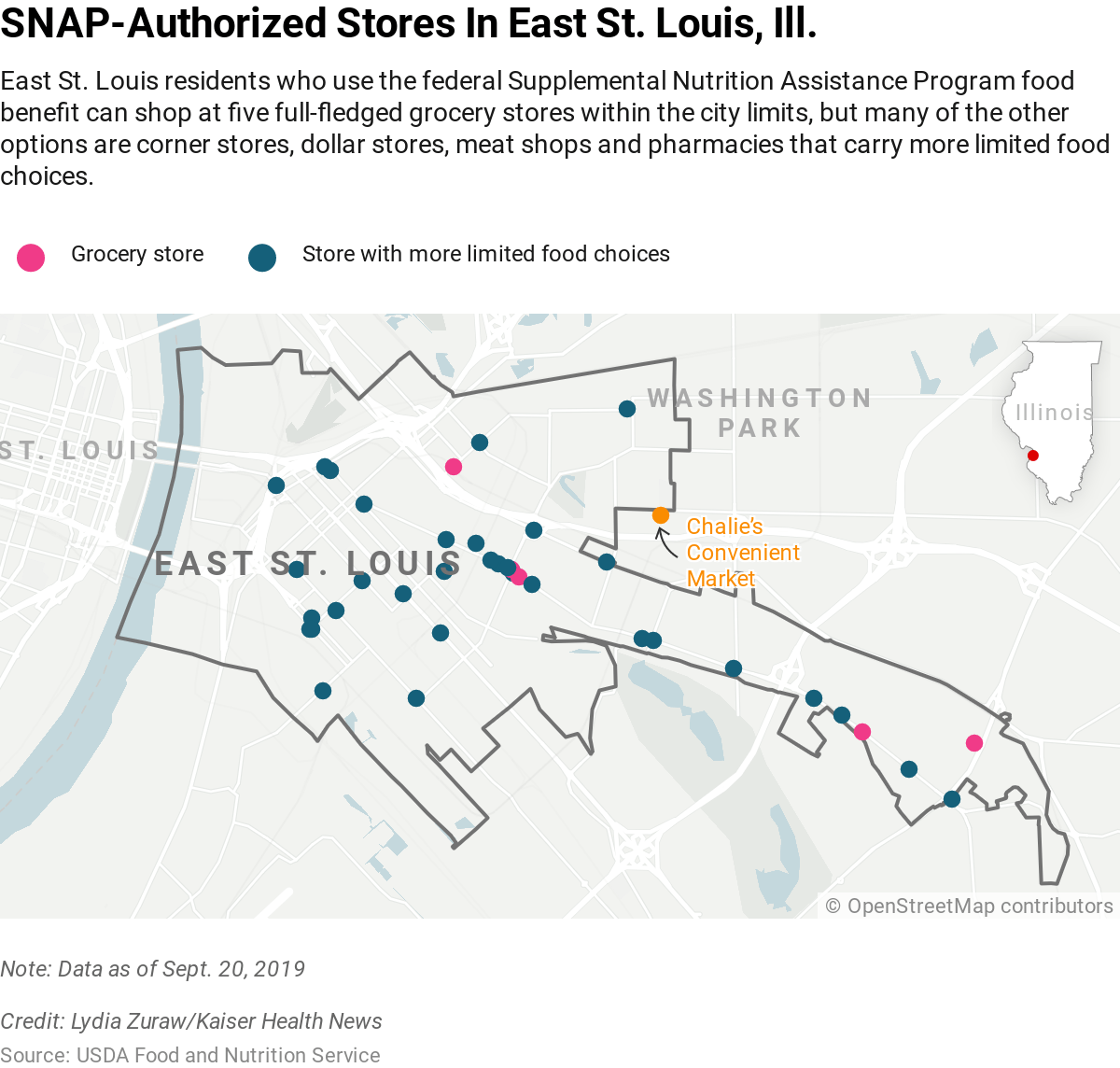
This city of fewer than 27,000 people, just across the Mississippi River from downtown St. Louis, has about three dozen authorized SNAP shops, mostly corner stores, within 89 blocks. But fewer and fewer residents see the shops as a safe place to buy food.
Drug dealers allegedly working in cahoots with corner store owners have become East St. Louis鈥� worst-kept secret, while the smell of stale food greets SNAP shoppers at some front doors. It鈥檚 so bad that, in some neighborhoods, residents avoid the corner stores at all costs.
鈥淪o much goes on in these corner stores now, you just have to be careful,鈥� said Nona Owens, 68. 鈥淵ou never know when somebody else has made somebody mad. 鈥� And they want to come and shoot.鈥�
To be sure, not all SNAP-authorized stores nationwide face this problem, and not everyone in East St. Louis uses SNAP benefits. But many residents of this and other low-income communities of southern Illinois are fed up with the violence around their neighborhood stores, even as officials in Washington turn a blind eye to the storefront gunbattles.
Instead, the program keeps getting caught in politics. While the Obama administration modestly upped the range of items authorized SNAP retailers were required to stock as an effort to help end what are known as food deserts, the Trump administration wants to weaken those requirements so canned spray cheese, pimiento-stuffed olives, maraschino cherries and beef jerky can count as staple foods. Trump administration officials have also proposed budget cuts for the program that could lead to more than .
Amid the federal whipsawing over SNAP, local residents are taking care of the problems themselves, trying to clean up the corner stores in their neighborhoods so they have safe and healthy options.
Those residents and local food access advocates regard a new trespassing law passed in East St. Louis as a start. They also are taking notes from activists who pushed for stricter corner and liquor store rules in Baltimore, Philadelphia and Omaha, Neb.
Those communities attempted to solve their corner store problems by first addressing the number of alcohol outlets in residential areas. Studies show that alcohol plays a role in 40% of violent crimes.
In the nearby village of Washington Park, Shantez Rias and his business partners are trying to revive the SNAP-authorized store they took over earlier this year. They don鈥檛 sell alcohol at Chalie鈥檚 Convenient Market. But they still do business behind seemingly bulletproof windows in the small market known among neighbors as the 鈥淥range Store.鈥�


These corner store owners 鈥� Rias, Rocky Miller and Martin Cooper Jr., themselves former corner boys 鈥� know the violence is not an easy problem to solve. They set up shop with a clear understanding of how quickly a fight can escalate when outsiders cross 鈥渆nemy lines.鈥�
鈥淚 don鈥檛 care what store you鈥檙e at,鈥� Miller said after residents complained about crime at local corner stores. 鈥淭hat鈥檚 one thing we can鈥檛 prevent.鈥�
Two teenage boys were before the trio took ownership. A few weeks earlier, nearly 18 shots were fired outside the store, .
And the so-called bulletproof windows the owners stand behind? They have bullet holes in them. Customers use one of the holes to slide in change under a handwritten sign, 鈥淭ip the Cook.鈥�
A Hidden Stream Of Income
East St. Louis residents Lakeesha Thomas, 42, and her niece, Jordan Thomas, 22, were shopping in one of those convenience stores around 8 p.m. on a recent September night when shots were fired outside.
鈥淚 actually wanted to crawl in a cooler,鈥� Lakeesha Thomas said. 鈥淓ven the guys who worked in the store took cover because the building was getting hit with bullets.鈥�
The sound of gunfire that night came as no surprise to Jordan Thomas, a SNAP recipient with an infant son. She has grown accustomed to it and the unwelcoming men who stand outside corner stores where she still regularly shops.

At Chalie鈥檚 Convenient Market, the windows between the store owners and customers have bullet holes in them. Customers use one of the holes to slide in change under a handwritten sign, 鈥淭ip the Cook.鈥�(Michael B. Thomas for KHN)

A customer pays for merchandise through a partition.(Michael B. Thomas for KHN)

Rias stands beneath a surveillance camera display at Chalie鈥檚 Convenient Market. He and his partners are trying to revive the store after taking it over this year, but they say the surrounding violence is not an easy problem to solve.(Michael B. Thomas for KHN)
Such young men who huddle outside corner stores in East St. Louis were identified as a problem long before the city passed an ordinance in June that could potentially end the drug trade happening in plain sight.
鈥淭hese people are out here selling drugs in front of the place,鈥� said Ontourio Eiland, the city鈥檚 assistant police chief. 鈥淎nd that鈥檚 why the citizens are scared sometimes to get their milk, eggs and their cereal for their kids.鈥�
Just about everyone in this city has heard whispers about the hidden stream of income some corner store owners have allegedly received from drug dealers.
鈥淚f they gave the owner protection or money or something, he, kind of, turned his head to it,鈥� Police Chief Kendall Perry told Kaiser Health News.
Rias, who said he has been both a drug dealer outside a store and now a store owner, defended other local corner store owners, explaining that most 鈥渄on鈥檛 mess with drugs.鈥�
鈥淭hat鈥檚 not how they move,鈥� Rias said. 鈥淭his is their hustle, these little stores.鈥�

Miller, Rias and Martin Cooper Jr. took over ownership of Chalie鈥檚 earlier this year.(Michael B. Thomas for KHN)
And the mayor, Robert Eastern III, is bewildered by the men standing outside corner stores and contributing to the city鈥檚 food and crime problem.
鈥淏usiness owners may be intimidated or they condone it, I don鈥檛 know,鈥� Eastern said. 鈥淲e鈥檙e going to figure out a way to get our corners back. And make East St. Louis safe.鈥�
The loitering prompted Perry to back the new criminal trespassing ordinance this year. A previously approved anti-loitering rule wasn鈥檛 effective, Eiland said.
Yet few residents know about the rule change. And, even with it in place, an up-and-coming rapper was outside an East St. Louis gas station and convenience mart in September.
In some other parts of the country, the . As of June 4, liquor stores in residential areas of Baltimore were ordered to , leaving them to find other products to sell instead or shut down.
In 2017, on corner store establishments known there as 鈥渟top-and-gos.鈥�
And in 2012, city officials in Omaha, Neb., passed what鈥檚 known as a 鈥済ood neighbor ordinance,鈥� which allows the city to pull the occupancy permits of liquor establishments.
East St. Louis food access advocates now want elected officials to put a cap on the number of liquor licenses issued. They also want code enforcement officials to speak up when corner store owners break the rules.

Rias, who says he has been both a drug dealer outside a store and now a store owner, defended other local corner store owners, explaining that most 鈥渄on鈥檛 mess with drugs.鈥�(Michael B. Thomas for KHN)

The Orange Store owners hope to obtain a liquor license, but, for now, the store doesn't sell alcohol. (Michael B. Thomas for KHN)
Calling For Help
It鈥檚 not just the shootings and crime in front of corner stores that residents of low-income neighborhoods are complaining about.
Documents obtained by KHN through a public records request show that, in 2018, the East Side Public Health District that covers East St. Louis and several neighboring communities received more than a dozen complaints about poorly maintained corner stores and spoiled food in the markets.
鈥淪ome of these stores, they鈥檝e got buckets in the middle of the floor catching water, then you get your meat order standing next to it,鈥� Lakeesha Thomas said. 鈥淚t鈥檚 disgusting.鈥�
Local health department officials can give troubled markets what鈥檚 known as a risk control plan, according to the documents, which requires health inspectors to visit stores more frequently.
But the stores licensed to offer SNAP food benefits rarely face much federal oversight outside of fraud investigations. The USDA Food and Nutrition Service occasionally checks the food inside, not the crime outside.
Officials from SNAP, the largest nutrition assistance program administered by the USDA, may visit stores for the reauthorization that occurs every five years. The Government Accountability Office noted in a 2018 report that FNS officials annually for reauthorization but 鈥渟aid they did not follow through with those plans.鈥�
Contractors working for FNS conduct occasional spot inspections. According to the USDA, they note when food is out of date and assess inventory that does not appear to be moving.

Richard Watson cleans a store mat inside Chalie鈥檚 Convenient Market.(Michael B. Thomas for KHN)
鈥淲hile FNS does not have direct oversight over food quality and safety, the agency recognizes shoppers鈥� concerns over the quality and safety of food at SNAP retailers,鈥� according to a USDA statement provided by agency spokesman Tony Craddock Jr. 鈥淪NAP-authorized retailers are expected to follow all state and local laws, including health requirements.鈥�
But Myla Oliver-Blandford, assistant administrator of Environmental Health Programs at East Side Health District, said her department doesn鈥檛 receive reports about the stores from FNS and doesn鈥檛 share her department鈥檚 local findings with federal officials.
Neither agency addresses the violence that springs up at the stores. Minimal communication among government agencies, little oversight of corner stores and limited policing leave residents feeling as if they are fending for themselves.
Corner stores residents of one southern Illinois neighborhood said they avoided because of safety concerns, according to a 2018 federally funded Community-Based Crime Reduction survey.
Searching For A Solution
North 20th Street in East St. Louis 鈥� a thoroughfare marked by a worn 鈥淲elcome to Healthy Street鈥� sign 鈥� has become a safe zone for food access advocates who gather every other month to discuss wellness programs, safety and the condition of corner stores in the area.
Most corner stores on their list are less than a half-mile away from public housing, churches and schools. The nearest full-fledged grocery stores are about 3 miles from most of the neighborhoods in East St. Louis, making them difficult to access for those without cars.
鈥淲e really want those corner stores to become responsible,鈥� Greg Witherspoon, a community leader, told city councilors a few months ago. 鈥淲e believe that those corner stores can help to serve fresh fruit and fresh vegetables.鈥�

鈥淚t鈥檚 our time to get our own neighborhood back,鈥� Rias says. 鈥淚t鈥檚 simple: Help each other.鈥�(Michael B. Thomas for KHN)

Rias, Miller and Cooper cleaned up Chalie's by replacing liquor bottles with baby bottles, rice, cereal, meat, cheese and other grocery items. (Michael B. Thomas for KHN)

鈥淐rimes don't make money,鈥� Miller says. (Michael B. Thomas for KHN)
But these days, Amy Funk, a SNAP educator and community organizer, spends less time talking about carrots and apples and more time talking about crime and the density of liquor establishments in the community.
She has spent countless hours poring over heat maps of the region that show high volumes of crime in front of corner stores around East St Louis.
鈥淚 started off trying to put broccoli in corner stores,鈥� Funk said. 鈥淣ow I鈥檓 in this world.鈥�
Today Rias, one of the Orange Store owners, wants to give his neighbors a better place to shop. While he and his partners hope to obtain an alcohol license eventually, they cleaned up their market by replacing liquor bottles with baby bottles, rice, cereal, meat, cheese and other grocery items.
鈥淚t鈥檚 our time to get our own neighborhood back,鈥� Rias said. 鈥淲e spend enough money around here. If we all come together, we can do it. It鈥檚 simple: Help each other.鈥�


