


HOUSTON — At any one time, an estimated 2.9 million children have a parent who has, or has had, cancer.
Dozens of studies show that many of these children experience worry and stress, but that good communication can ease their fears and isolation, even up to the point of a parent���s death. Still, figuring out ��� and when ��� is not an easy decision, and many parents who have cancer get little to no advice from their doctors about how to handle it.
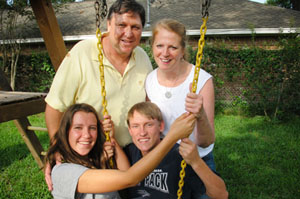
The Goodman family has dealt with mom Julie���s cancer diagnosis since 2009. Clockwise from top left are John, Julie, Jack and Lena (Photo by Carrie Feibel/KUHF).
Two hospitals in Houston are tackling the issue with support groups for parents and children. The and work with to offer emotional and practical support for families dealing with the disease.
Martha Aschenbrenner, a hospice counselor at MD Anderson, says that a very natural response to a cancer diagnosis is to try to protect children by hiding the facts or keeping them vague. But she what���s happening in age-appropriate ways. Whether Mom or Dad is going to die is usually one of the first things a pre-teen will ask, she says.
���The wrong way to answer the question is ���No, no, I���m not going to die.��� Because you can���t promise that,��� Aschenbrenner says. ���A better way that also invites more conversation is: ���That is not my plan. And I���m going to a hospital where they���re going to give me very strong medicine, and I hope and my plan is I���m going to get better. And I���m going to tell you what happens, so you don���t have to worry that I���m keeping secrets from you. I���m going to keep you informed.������
The Susan J. Komen Houston Affiliate funds a support group at LBJ, which is part of the publicly-funded , with a two-year grant of $237,500. That means women with breast cancer and their children can benefit from the six weeks of group sessions free of charge. The grant even covers parking charges for participants.
During a recent meeting of the group called Tender Drops of Love, Lindsey Leal, a child-life specialist at LBJ Hospital, explains to kids that parents with cancer sometimes feel sad, but it���s not the kids��� job to cheer them up.
�����The thing is sometimes [your parents are] going to feel bad about themselves, and they���re going to feel sad and they���re going to feel angry. And sometimes you���re going to feel sad and you���re going to feel angry. And, is that okay?��� Leal asks the group of kids aged six to 12. One boy answers, ���No, that���s not helping.���
But Leal counters:�� ���It is okay. No, it���s not healthy to punch a wall. It���s not healthy to act on your anger. It is healthy to talk about your anger.���
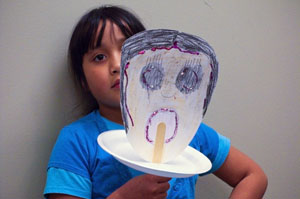
Laura Molina, 9, shows the mask she created expressing the feeling of “sadness.” Molina’s mother is being treated for inflammatory breast cancer at the Lyndon B. Johnson public hospital in Houston, Texas (Photo by Carrie Feibel/KUHF).
As cancer progresses or retreats, parents need to keep the discussion going, therapists say.
Julie Goodman was diagnosed with colorectal cancer in 2009 at the age of 43. Her daughter Lena was in fourth grade and son Jack was in seventh. After the colorectal cancer spread to her lungs, she had more surgeries and chemo.
But now she���s had six months of clean scans.
���And whenever I come home from that, we just go ���Yay, mom had clean scans!��� And they���re like ���Yay, OK, what���s for dinner?��� You know, moving on,��� Goodman says. ���They may be desensitized a little bit to it now. Mom goes to the doctor, mom comes home, she���s fine.���
Goodman says she still struggles with how much to tell her kids. On the one hand, she wants her children to remember she���s not out of danger, not yet.
But she also loves the fact that they���re not worried anymore, that they don���t think about it every day. Instead, they have what every parent wants: that the everyday concerns be what���s for dinner, and walking the dogs, and homework, and time for bed.
This story is part of a collaboration that includes , and Kaiser Health News.


